CBA Hypomonitor: The cooling of the mortgage market continued in August, with rates at 5%
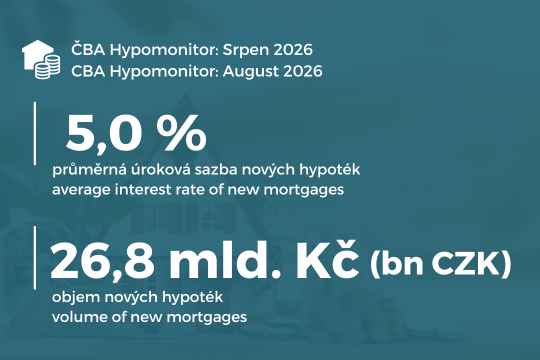
Prague, September 16, 2026 – In August 2026, banks and building societies issued 26.8 billion CZK in new mortgages (excluding refinancing). Compared to July, activity continued to decline by 13% in terms of volume. This decline cannot be attributed to seasonality, as was the case in July. We are likely observing a delayed correction following the effect of pre-stockpiling mortgages ahead of stricter regulations on investment mortgages and a rise in market interest rates. Since the beginning of the year, the total volume has reached 273 billion crowns, which is 68 billion more than a year ago. The average interest rate on new mortgages rose further to 5% from 4.9% in July, returning to the average rate seen in 2024. Meanwhile, the spread relative to the relevant, still-rising market rates remained below 0.6 percentage points in August and thus remains significantly below the long-term average of 1 percentage point. This information is derived from data provided by the Czech Banking Association’s (CBA) Hypomonitor, which compiles data from all domestic banks and building societies offering mortgage loans.
The weaker August figures, more so than in June and July, reflected the fading of the previous pre-stockpiling effect. Some clients had arranged mortgages earlier in an effort to avoid the impact of higher market rates as well as the CNB’s April tightening of rules for so-called investment mortgages. The lower share of these loans likely also contributed to a decline in the average amount of new mortgages, which remained below 4.6 million CZK in August. As a result, the average monthly payment on a new mortgage remained below 26,000 CZK despite higher interest rates. The impact of higher rates is also more evident in refinanced mortgages, where rates remain below those of new loans, though the difference is smaller than in May and June.
August’s mortgage figures suggest a cooling of the mortgage market, as both the number and volume of new mortgages have declined not only from their spring highs but also below the levels seen in the second half of last year. The mortgage figures should support the central bank’s wait-and-see approach, even as it adjusts its macroprudential policy for mortgages on November 26. More on this in the CBA Monitor.
Table 1: Summary of Mortgage Volume and Average Interest Rates for August 2026

Source: CBA Hypomonitor. Note: Seasonally unadjusted data
Jaromír Šindel, Chief Economist of the Czech Banking Association:“The August mortgage figures reinforced four key trends from July. Both the number and volume of new mortgages cooled off compared to the strong second half of last year. The growth in actual mortgage rates remains gradual compared to market rates. Rates on refinanced mortgages are no longer trending downward as they did in May and June. The likely lower share of investment mortgages contributed to keeping the average amount of new mortgages lower.”

Note: The outlook through the end of the year is indicative—it is based on the current trend, not on a model prediction. For the remainder of the year, it assumes a 7% adjustment in the number of mortgages relative to the pace recorded in the second half of 2025. See Chart 7 for an illustration.

Mortgage activity slowed further toward the end of the summer, but both volumes and numbers remain close to the strong levels seen in the second half of last year
Overall, banks and building societies reported new unconsolidated business in August in the form of new and refinanced mortgages totaling CZK 34.5 billion. This is nearly 15% less than a month ago. Year-over-year, the figure rose by 4%, a significantly slower pace than the average 52% increase seen over the previous seven months, as the mortgage market strengthened significantly in the second half of last year. The total volume of mortgages so far this year has reached CZK 369 billion, representing a 44% increase compared to January through August of the previous year.
In August, new mortgage loans (excluding refinancing) totaled CZK 26.8 billion. Compared to July, new mortgage activity thus declined by approximately 13%in volume. However, volumes typically increase by 1% in August. Unsurprisingly, after seasonal adjustment, August saw an 11% decline in the volume of new mortgages to CZK 26.7 billion compared to July’s CZK 30.1 billion (the average for the previous three months was CZK 31.6 billion). In contrast to July, the volume of new mortgages granted in August was approximately 9% lower than in the second half of last year. On a year-over-year basis, the growth in the volume of mortgages granted in August remained at approximately a 3% increase.
Michal Neubauer, mortgage specialist at UniCredit Bank:“The approximately 13% decline in mortgage activity in August compared to July is not surprising given the rise in interest rates. However, the volume of newly issued mortgages remains at a solid level. Higher rates are already beginning to influence the decisions of some households considering financing a home. The key to the market’s future development will be whether the rise in rates stops and whether the pace of real estate price growth does not outpace the growth in household incomes.”
The number of new mortgages in August fell by 13.1% month-over-month to 5,825, which is 4% less than a year ago. We estimate that, after seasonal adjustment, the number stands at around 5,911 (similar to June 2025), approximately 13% below the average (6,789) for the previous three months. Since the beginning of the year, the number of new mortgages has reached 58,100 (+17% year-over-year). The growth rate of new mortgages over the past three months—that is, from June through August—suggests that the total number this year will reach around 82,000. That would be about 9% more than last year, but below the average of around 92,000 from 2016 to 2018 and still well below the 114,000 recorded in 2021.
Chart No. 2: Newly Granted Mortgages Excluding Refinancing
August brought another correction to selected metrics of new mortgage lending activity …

Source: Czech Banking Association, CNB, CZSO, Flat Zone.
Chart 3: Average Mortgage Amount by Purpose
… thanks in part to the average mortgage amount remaining below spring levels.

Source: CNB, CBA Hypomonitor
The volume of refinanced and increased loans (either internally or from another institution) fell to 7.7 billion CZK in August. This is 9% more than the average of 7.1 billion refinanced last year (in July, it was 36% more) and 96% above the 3.9 billion refinanced in 2024. The share of refinanced loans in the total volume of mortgages granted then fell to 22.3% (over 25% in June). However, it remains above last year’s average of 21% and above the 17% share from 2022–2023, though it is below the nearly 29% share from 2020–2021, when households refinanced at a rate of 2.14%.
In August 2026, households refinanced at an interest rate of 4.97%, which is nearly half a percentage point higher than a year ago. Higher refinancing volumes reflect the convergence of expiring longer-term fixed-rate periods from the low-interest-rate era and shorter-term fixed-rate periods from the recent period of higher interest rates. For more on the growing wave of mortgage refinancing, see the CBA Focus: The wave of mortgage refinancing is gaining momentum, but the interest rate shock is subsiding. Higher inflation remains a risk.
Petr Gapko, Chief Economist at MONETA Money Bank:“Mortgage activity slowed in August, which can be attributed primarily to higher interest rates, which are approaching the five percent mark. Even so, in some cases it is still possible to secure a mortgage at an interest rate lower than 5 percent, but with the outlook for rates on the rise, this is unlikely to last until the end of the year.”
The average mortgage rate rose further to 5% as steadily rising market interest rates are gradually being reflected in mortgage rates
The average interest rate on new mortgages rose further in August to 5% from 4.9% in July. The August rate is thus half a percentage point higher than the 4.52% rate a year ago, which increases the illustrative average monthly payment on a new mortgage by 1,200 CZK, or approximately 1.2% of the applicant’s net income. By comparison, the average mortgage rate in 2025 reached 4.58% and is approaching the average rate of 5.07% from 2024.
At 5%, the August mortgage interest rate remained approximately 0.6 percentage points above average market interest rate swap rates. This is still just under half a percentage point below the long-term average since 2014, which stands at 1.04 percentage points. Between March and May, this spread relative to market rates even reached 0.37 percentage points. In our study , we highlighted structural factors—primarily the strength of demand in a competitive market—that influence the pass-through of market rates to mortgage rates. However, a new survey suggests that in the third quarter, there may be a lack of momentum to keep mortgage rates significantly below market swap rates. For more details, see here: Mortgage standards have tightened, but strong demand was not the only factor dampening the impact on lending conditions.
Czech longer-term market interest rates,[1]which have a key influence on mortgage rates—where three-year fixed-rate terms predominate—remained on an upward trend in August and the first half of September, primarily due to the deteriorating situation in the oil market, but also supported by domestic factors. Czech five-year interest rate swaps rose by 0.15 percentage points in August from 4.35% in July to 4.5% and, in the first half of September, continued to rise above 4.7% due to the worsening situation in the oil market, remaining above June’s 4.26%. Over the past twelve months, Czech five-year swaps have fluctuated between monthly averages of 3.6% (in February 2026) and 4.5% in August. Compared with the average level of five-year swaps in 2025, August rates were 0.85 percentage points higher. In the case of U.S. five-year interest rate swaps, rates rose to 4.37% in August (and to 4.6% in the first half of September) from 4.3% in July and were 0.51 percentage points above their average for 2025. Euro-denominated five-year swaps rose to 3.07% in August (and to over 3.3% in the first half of September) from 2.96% in July, and were 0.73 percentage points above their average level of 2.34% last year. The spread between Czech and euro five-year IRS interest rates has hovered around 1.4 basis points over the past month and a half, similar to the previous five months, but above the 1.16 percentage points seen at the start of the year and the 1.3 percentage points recorded last year.
Domestic factors influencing the development of interest rate swaps included persistently elevated core inflation and proposals for a more accommodative fiscal policy, while revisions to wage growth tempered that growth, even though wage growth remains fundamentally inflationary. This mix, combined with further increases in oil prices, is raising market expectations regarding a future increase in the CNB’s interest rate following its rise to 3.75% in June. For more on these factors, see the analyses in CBA Monitor: The CNB is waiting for a new impetus and is counting on less inflationary economic growth, Four Stories from the June Data: Energy, Exports, Wages, and Housing Starts.
[1]These are primarily long-term interest rate swaps (IRS), which reflect the cost of capital over longer maturities—in recent years, around 3 to 5 years— but the entire 2- to 10-year curve remains relevant, even though 10-year maturities are less relevant due to higher central bank rates compared to the previous decade, as well as due to the costs associated with early mortgage prepayment.
Chart 4: Average Mortgage Interest Rate – New Loans
Mortgage rates in August continued to respond to the previous sharp rise in market rates

Source: CNB, CBA Hypomonitor
Chart 5: Renewed U.S. attacks on Iran are keeping market swap rates higher
… which in September gained further upward momentum toward levels seen in the second half of 2023

Source: Macrobond (September 14, 2026), CBA
The average monthly new mortgage payment remained below 26,000 CZK, and the median payment below 21,000 …
The combination of higher interest rates and a higher average mortgage amount in August 2026 increased the average monthly payment on a newly issued mortgage by 3,200 Kč compared to the average values for 2025. Table 2 illustrates scenarios for the development of monthly payments for various mortgage terms. It shows that an increase in mortgage rates of more than 0.4 percentage points from their average level of 4.58% in 2025 would increase the monthly payment on an average mortgage with a typical term of approximately 26.9 years by just under 1,100 CZK to roughly 25, 900 CZK. This corresponds to approximately 1.1% of the applicant’s net income compared to last year’s average payment.
At the same time, the current average mortgage amount was 9% higher than the 2025 average, which in itself increases the monthly payment by 2,200 Kč. This is a comparison with a payment calculated based on last year’s average mortgage amount, but at the current interest rate. The monthly payment on a one-million-koruna mortgage with a 30-year term is currently around 5,400 CZK.
Compared to the average mortgage rate of 2.33% for new mortgages in 2021, the current refinancing rate of 4.97%—when the loan term is shortened—increases the monthly payment on an average mortgage by nearly 3,300 CZK. This corresponds to approximately 6.4% of the current gross average wage. However, that wage has risen by 32% compared to the end of 2021. We discussed the implications and circumstances in Fokus CBA: The wave of mortgage rate resets is gaining momentum, but the interest rate shock is subsiding. Higher inflation remains a risk.
Table 2: Illustration of Monthly Payments for an Average and Median Mortgage Based on Loan Term and Interest Rate

Source: CBA (the table with values is available in an XLS file attached to this report). Note: The colored column corresponds to the interest rate from the latest CBA Hypomonitor report in combination with the typical repayment term; other rates are for illustrative purposes only. The colored row corresponds to the average and median terms of new mortgages according to CNB data; amounts are rounded to the nearest ten crowns. The median monthly payment is based on the median mortgage amount. This is calculated based on the ratio of the average to the median amount of new mortgage loans over the last three quarters, according to CNB statistics (118.7%). The calculation also assumes an average maturity of 30 years (corresponding to the median) and an average interest rate, since the difference between the average and median rates has been negligible over the long term (approximately 0.045 percentage points). Unlike the mean, the median represents a “typical” value—half of the loans are lower and half are higher—and is not influenced by extreme values.
… thanks to the fact that the average size of new mortgages remained below 4.6 million CZK in August
However, the average size was still 8% higher than a year ago. The higher average mortgage amount at the beginning of this year—which reached 4.85 million CZK from March through May—likely reflected the lingering effect of pre-stockpiling for so-called investment mortgages. For these, the CNB has tightened the requirements—specifically, the LTV to 70% and the DTI to seven times annual income. Based on CNB data from the Financial Stability Report, we estimate that the average amount of an investment mortgage— i.e., mortgages for additional owner-occupied housing or rental properties, was approximately 29% higher last year and in the first quarter of this year than for owner-occupied mortgages and other truly new mortgages.
The average mortgage amount is also closely linked to trends in real estate prices. These , too, in the first quarter, their growth only slowed slightly to 10% year-over-year. Apartment prices in the second quarter saw a slowdown in the growth of asking prices to 1.4% quarter-over-quarter from 2.7% in the first quarter, falling below their long-term average increase of 1.8%. However, the growth in actual sale prices remained at 2.5% quarter-over-quarter, signaling a possible future slowdown to 10% year-over-year from 12.3% in the second quarter. According to data from Flat Zone, the transaction price of apartments sold in the second quarter to nearly 100,000 crowns per square meter, exceeding 165,000 in Prague. This is 8.3% and 9.7% higher, respectively, than a year ago (see charts on CBA Monitor). However, a more significant slowdown in price growth will continue to be hindered by a combination of constraints on the supply side and a stronger build-up of mortgage inventory, as well as the continued solid growth in real household wages (4.3% year-over-year in Q2 2026; see chart here).
Chart 6: Illustrative comparison of monthly payments for the current average newly issued mortgage with those from a year ago, based on the interest rate, mortgage amount, and mortgage term in years
In a year-over-year comparison, the rise in mortgage rates led to an increase in the average monthly payment of 1,000 CZK, while the rise in the average mortgage amount caused an increase of 1,750 CZK. However, the average mortgage amount has been declining over the past two months, which has offset the impact of the higher interest rate.

Source: CBA. Note: Amounts are rounded to the nearest ten crowns.
Statistical Appendix
Chart 7: Seasonality of New Mortgage Loans

Note: These are truly new mortgages (i.e., excluding refinancing and loan increases). The underlying data are available in an XLS file attached to the CBA Hypomonitor website. The outlook through the end of the year (fcst) is a snapshot—it is based on the current trend, not on a model prediction. However, for the remainder of the year, it assumes a 7% adjustment in the number of mortgages compared to H2-2025.
Chart 8: Breakdown of New Mortgage Loans by Purpose

Source: CBA Hypomonitor
Note: The latest figure represents the average for the past 12 months. The interpretation of the “other” segment may be skewed by the inclusion of so-called “mortgages without real estate” arranged without a specific purpose. For more details, see the methodological note below.
In 2025, the mortgage market saw strong growth in volume—up 41%—and an increase of nearly a quarter in the number of loans
Throughout 2025, banks and building societies provided new mortgage loans totaling 321 billion CZK. That is 93 billion CZK more than the 228 billion CZK issued in 2024. This year-over-year jump represents a 41% increase. In addition, mortgages totaling 85 billion CZK were refinanced, bringing the total mortgage market to 406 billion CZK in 2025, up from 275 billion in 2024. If we adjust the volumes for the rise in apartment prices of around 15–16% (according to various statistics), the volume of new mortgages increased by slightly less in real terms. This also corresponds to a more moderate increase in the number of new mortgages in 2025—by just under a quarter to more than 76,110—and a nearly 15% increase in the average amount of new mortgages granted to CZK 4.21 million.
New mortgages in 2025 were financed at an average interest rate of 4.58%, which was half a percentage point lower than in 2024, while the spread relative to the market swap yield curve reached just under one percentage point, slightly below the long-term average. The average monthly mortgage payment in 2025 reached just under 22,800 CZK, which is 8.6% more than in 2024, and likely slightly exceeded last year’s increase of more than 7% the average nominal wage. The average year-over-year increase in the monthly mortgage payment of approximately 1,800 korunas in 2025 primarily reflected a higher average mortgage amount, with an increase in the payment of nearly 2,900 korunas, while the lower mortgage interest rate reduced the average monthly payment by more than 1,200 CZK.
Chart 1: Annual Volume, Number, and Average Amount of Mortgages Granted from 2020 to 2025

Source: CBA Hypomonitor
The Czech Banking Association Publishes Aggregate Statistics for the Entire Banking Market
The Czech Banking Association, in cooperation with its member banks, publishes new aggregate statistics on the housing market. These primarily include the volumes and numbers of newly issued and refinanced mortgages, as well as the corresponding interest rates. The CBA publishes these statistics in aggregated form for the entire banking sector on a regular basis, typically around the middle of each month. All domestic banks and building societies providing mortgages in the Czech Republic participate in the survey. The data is available starting in January 2020 in the attached file at www.cbaonline.cz, where the relevant statistics can also be found separately for banks and building societies. The figures listed above represent the sector as a whole and can also be viewed in a simple graphical format on the website cbamonitor.cz.
CBA Hypomonitor Methodology
The CBA Hypomonitor categorizes mortgage loans provided by banks and building societies to households into several categories to distinguish new loans from refinanced loans or internal rate resets. New loans are then reported in categories based on the purpose of the loan:
1. New Loans
These are loans whose full amount enters the economy for the first time. Loan consolidation or refinancing does not fall into this category. They are divided into three categories:
· Purchase of real estate
· Real estate construction —including real estate renovation
· Other new agreements —only new loans that are in no way related to the purchase or construction of real estate (which does not apply in the case of so-called “mortgages without real estate” arranged without a specific purpose), i.e., for example, so-called “American mortgages,” settlement of joint marital property, reimbursement of the purchase price, settlement of an inheritance share, settlement of a cooperative share, etc.
2. Refinanced Loans from Another Financial Institution
These are loans created by refinancing one or more loans from a financial institution other than the reporting one. Regardless of the amount refinanced and regardless of the amount of any increase, the total amount of the newly created loan is reported in this category.
3. Increased or Internally Refinanced Loans
These are loans that were already part of the reporting entity’s portfolio in the previous reporting period and for which one of the following changes occurred during the reporting period:
· an increase in the agreed-upon amount
· changes occurred such that the original loan was refinanced or converted into a new loan within the reporting entity. This constitutes a truly new contract, not, for example, merely a new arrangement as part of the refixing of an existing contract. Therefore, the volume of such loans in the CBA statistics is lower than that of “other new arrangements” in the Czech National Bank’s statistics.
Data for the CBA Hypomonitor are provided by the following banks and building societies: Air Bank, Česká spořitelna, ČSOB, ČSOB Stavební spořitelna, Fio banka, ČSOB Hypoteční banka, Komerční banka, mBank, Modrá pyramida, MONETA Bank, Oberbank, Partners Banka, Raiffeisen stavební spořitelna, Raiffeisenbank, Stavební spořitelna České spořitelny, and UniCredit Bank.