Focus: A More Cautious View of the Improvement in National Income, While the FDI Story Enters a New Phase
This shift is driven by a combination of primarily these three factors: the life cycle of foreign investment in the form of reinvested earnings, a more moderate outflow of dividends, and the role of superdividend statistics, as well as higher income from Czech investments abroad, including the CNB’s foreign exchange reserves.
1) The Life Cycle of Foreign Investment and Its Impact on Reinvested Earnings
One of these factors is the trend in reinvested earnings of foreign owners of Czech companies. Under the national accounts methodology, these earnings are included in the income of foreign owners, even though they do not represent an actual cash flow abroad—the generated profit remains within the company and increases its equity.
Data from the Czech Statistical Office (CZSO) suggest that, in the past, reinvested earnings reduced the Czech national income relative to GDP more than they do today. However, this trend is not necessarily unequivocally positive. It may be related to the natural life cycle of foreign investments, but it may also reflect a reduced willingness on the part of investors to further expand production capacity or upgrade the technology used in their operations in the Czech Republic.
Moreover, data from the Czech National Bank (CNB) offer a somewhat different perspective. They do not show a decline in reinvested profits by foreign investors in the Czech Republic—in 2025, these reached 2.8% of GDP. However, their impact on national income is partially offset by the growing reinvestment activity of Czech investors abroad, amounting to 1.3% of GDP. In other words, the volume of profits generated by Czech owners in foreign economies is also growing.
2) A More Moderate Outflow of Dividends
A more moderate negative dividend balance also contributes to the smaller negative gap between national income and GDP. Among other factors, the normalization of profitability following the COVID-19 and energy price shocks of 2022–2023 plays a role here.
According to data from the CNB, the outflow of dividends moderated to 4.4% of GDP in 2025 from an average of 4.7% in the years 2021–2025, 5.2% in 2006–2015, and 5.6% in 2011–2020. Although data from the Czech Statistical Office (CZSO) paint a more favorable picture in terms of a milder outflow of dividends, this may be distorted by differences in how so-called “superdividends” are accounted for; these are not included in dividend figures and also reduce reinvested earnings because they decrease a company’s equity. That is why it is advisable to take CNB data into account.
However, the debate about dividend outflows from Czechia cannot be separated from the country’s strong export performance and trade surplus, to which foreign investment has made a significant contribution – both directly through export-oriented production and indirectly through technology transfer, know-how and other spillover effects, which played an important role in boosting productivity and modernising the Czech economy, particularly during the transformation period around the turn of the millennium. At the same time, the role of Czech capital abroad is gradually increasing, including dividend inflows into Czechia, thereby reducing the net outflow of dividends from the Czech economy (see the quartet of charts below).
3) Higher income from Czech investments abroad, including the CNB’s foreign exchange reserves
The third factor is stronger investment activity by Czech entities abroad. According to CNB data, dividend income from foreign direct investment nearly doubled in 2025 to 0.7% of GDP, compared with 0.3% during the 2006–2015 period.
Higher returns on the CNB’s foreign exchange reserves also contribute to this trend. Inflows from portfolio investment earnings, including returns on foreign exchange reserves, reached 0.7% of GDP, compared with 0.4% in the 2006–2015 period.
So how has national income changed over time?
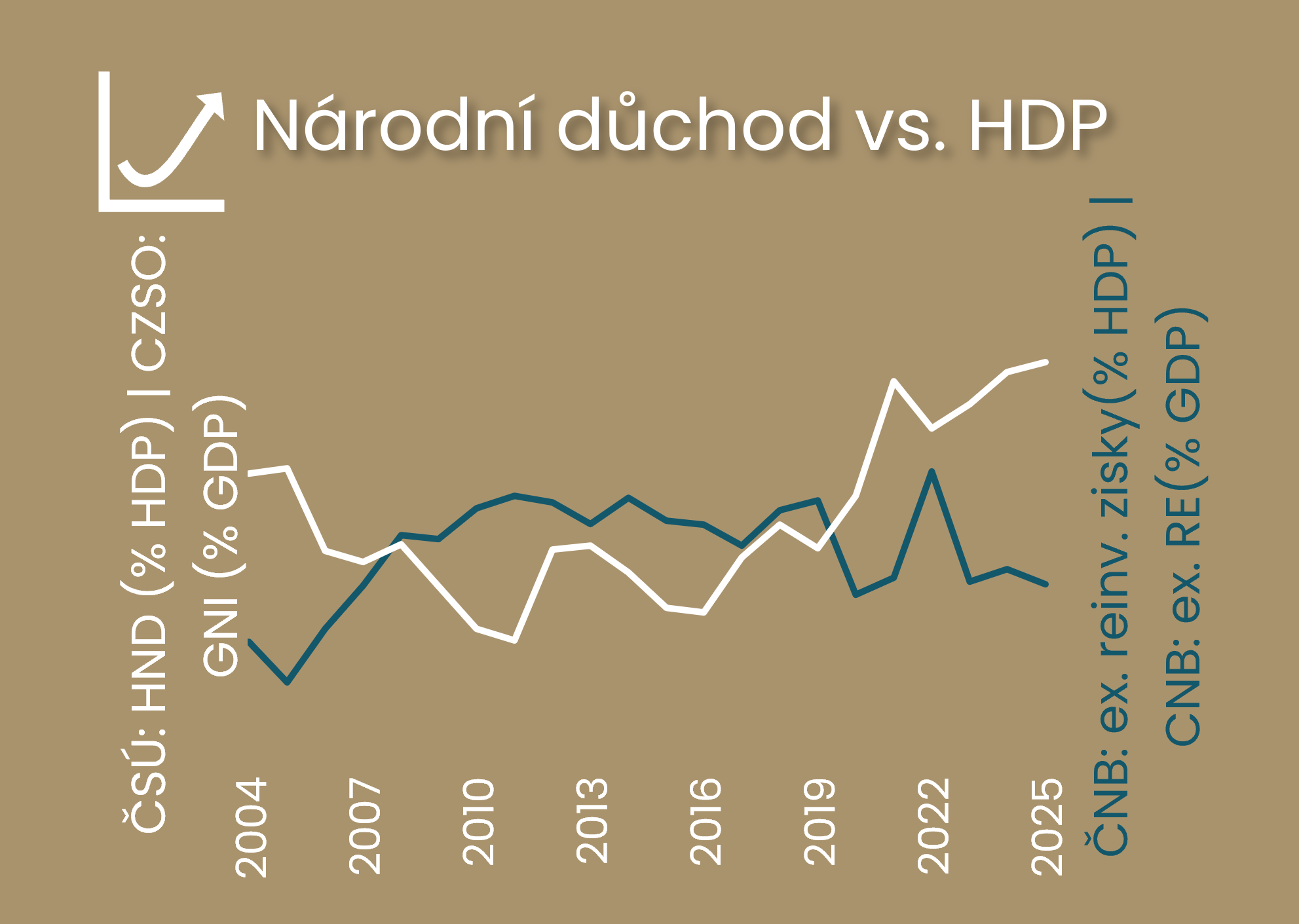
According to data from the Czech Statistical Office (CZSO), gross national income in 2025 was roughly 2.6% lower than GDP, whereas in 2006–2015 the difference was nearly 7% of GDP. The negative gap thus narrowed by 4.2 percentage points.
If, for analytical purposes, we exclude the reinvested profits of foreign owners of Czech companies, then in 2025 national income was 2.1% lower than GDP, whereas between 2006 and 2015 it was approximately 4.6% lower. The improvement in the gap thus amounts to roughly 2.5 percentage points instead of 4.2 points.
This, too, is a positive development, albeit less pronounced than the basic comparison suggests.
Data from the Czech National Bank’s balance of payments paint an even more subdued picture. These figures show national income in 2025 still roughly 4.6% below the level of GDP. Compared to the 2006–2015 average, the gap has thus narrowed by less than one percentage point.
If we exclude reinvested profits here as well, the CNB’s data for 2025 show a national income gap relative to GDP of 3.1%. It is therefore approximately one percentage point larger than according to CZSO data, but at the same time about one percentage point smaller than in the 2006–2015 period.
In recent years, gross national income has shown a smaller gap relative to GDP ...

... although a lot depends on how you look at national income, or rather, what data you use

Why Are Reinvested Earnings Important
Reinvested earnings influence the interpretation of national income in two ways—methodologically and through the life cycle of foreign investment.
a) Methodological Role
When using the difference between gross national income and GDP as one measure of the domestic economy’s performance, it is important to distinguish between income attributable to foreign owners and actual cash flows abroad.
Reinvested earnings are not paid out at that particular moment. They remain within the firm, increase its equity, and can support further investment or the financing of its operations. This does not mean that, from the perspective of national income, they do not accrue to the foreign owner, but their economic interpretation differs from that of dividends that are actually paid out.
The significance of this mechanism is evident, for example, in the banking sector. Here, retained earnings strengthen banks’ capital and thus their ability to support lending activity. From this perspective, when assessing the difference between GDP and national income, it is advisable to examine not only the amount of foreign income itself but also its structure.
Any subsequent dividend payments then represent a different phase in the distribution of the generated profits. When interpreting time series, it is therefore important to apply the methodology of individual statistical indicators consistently and not to treat reinvested profits and subsequent dividend payments as two independent economic costs of the same investment.
b) The Role of the Investment Life Cycle
The second aspect relates to the natural life cycle of a foreign investment. In the early years, a larger portion of the generated profit is often reinvested in expanding production capacity, modernization, or upgrading technology.
In a later phase, a larger portion of profits may be distributed as dividends, and the share of reinvestment may decline. The trend in reinvested profits therefore depends not only on the immediate profitability of firms but also on their investment opportunities and the willingness of owners to further expand their business in the Czech Republic.
A decline in reinvested profits alone cannot, therefore, be automatically interpreted as an improvement in the Czech economy’s position. Similarly, however, without further information, it cannot be claimed that this is a sign of waning confidence among foreign investors.
Overall, therefore, the Czech national income relative to GDP has shown an improvement in recent years, though the extent of this improvement is less clear-cut than a basic look at the aggregate data would suggest. Depending on the methodology and data source used, the improvement compared with the 2006–2015 period amounts to approximately 1 to 2.5 percentage points. A more accurate picture is thus provided only by breaking down the individual components of foreign income and comparing multiple statistical perspectives.
Dividend outflows from Czechia have slowed, while reinvested earnings remain high

Reinvested earnings are rising; 2026 was affected by a significant share issuance of defense industry abroad.

Czech capital is increasingly flowing abroad, but Czechia remains a net recipient of capital. Dividend inflows still amount to only around 15% of dividend outflows.
Dividend outflows cannot be viewed separately from the contribution of FDI, which, particularly around the turn of the millennium, significantly supported productivity, modernisation, competitiveness and the export performance of the Czech economy.

A breakdown of the key factors behind the improved ratio of national income to GDP ...

... although it is necessary to take into account the differences in methodology between the statistical office and the central bank
