Two bank stress tests, one conclusion: the resilience of Czech banks
Difference No. 1: Different selection of banks. Different selection of banks. The macro stress test published in the Financial Stability Report (FSR) assesses the resilience of the banking system based on a sample of 21 banks, but the CNB’s models do not take into account the specific business models of individual banks. On the other hand, the supervisory stress test focuses more on the individual banks on which it is conducted, and the results are also used to assess the P2G capital requirement, which is applied only rarely in the Czech Republic (in 2026, the SREP lists one bank with a 1% requirement relative to RWA). It covers 13 institutions representing approximately 92% of the sector’s assets, is based on the methodology of the European Banking Authority (EBA), and utilizes the individual banks’ internal models.
Difference No. 2: Different economic downturns. Both stress tests assume a more severe recession in the adverse scenario. The macro-stress test in the ZFS projects an average annual decline in GDP of 3.7% year-over-year during 2026–2028, while the supervisory stress test projects a decline of 3.1%. This may not seem like a significant difference, but the ZFS does not anticipate an economic recovery, and the economy’s level at the end of 2028 is nearly 14% lower than at the end of 2025. The supervisory stress test assumes a recovery in 2028 that will mitigate the decline relative to the end of 2025 to −8.7%. Both stress tests assume an economic level nearly 9% higher in the baseline scenario. Both project an increase in unemployment from 3% to 11%.
Difference No. 3: Expanding vs. static balance sheet. Expanding vs. static balance sheet. The ZFS’s regular stress test anticipates continued growth in the volume of loans. Specifically, in the baseline scenario, corporate loans are projected to grow by more than 5% and household loans by more than 9%. The adverse scenario assumes “positive” stagnation in corporate loans and more moderate growth in household loans of approximately 5%. This leads to a 17% increase in banks’ balance sheets over three years in the baseline scenario and a 6% increase in the adverse scenario. In contrast, the supervisory stress test assumes a static balance sheet—that is, an unchanged total volume of loans as well as government bonds.
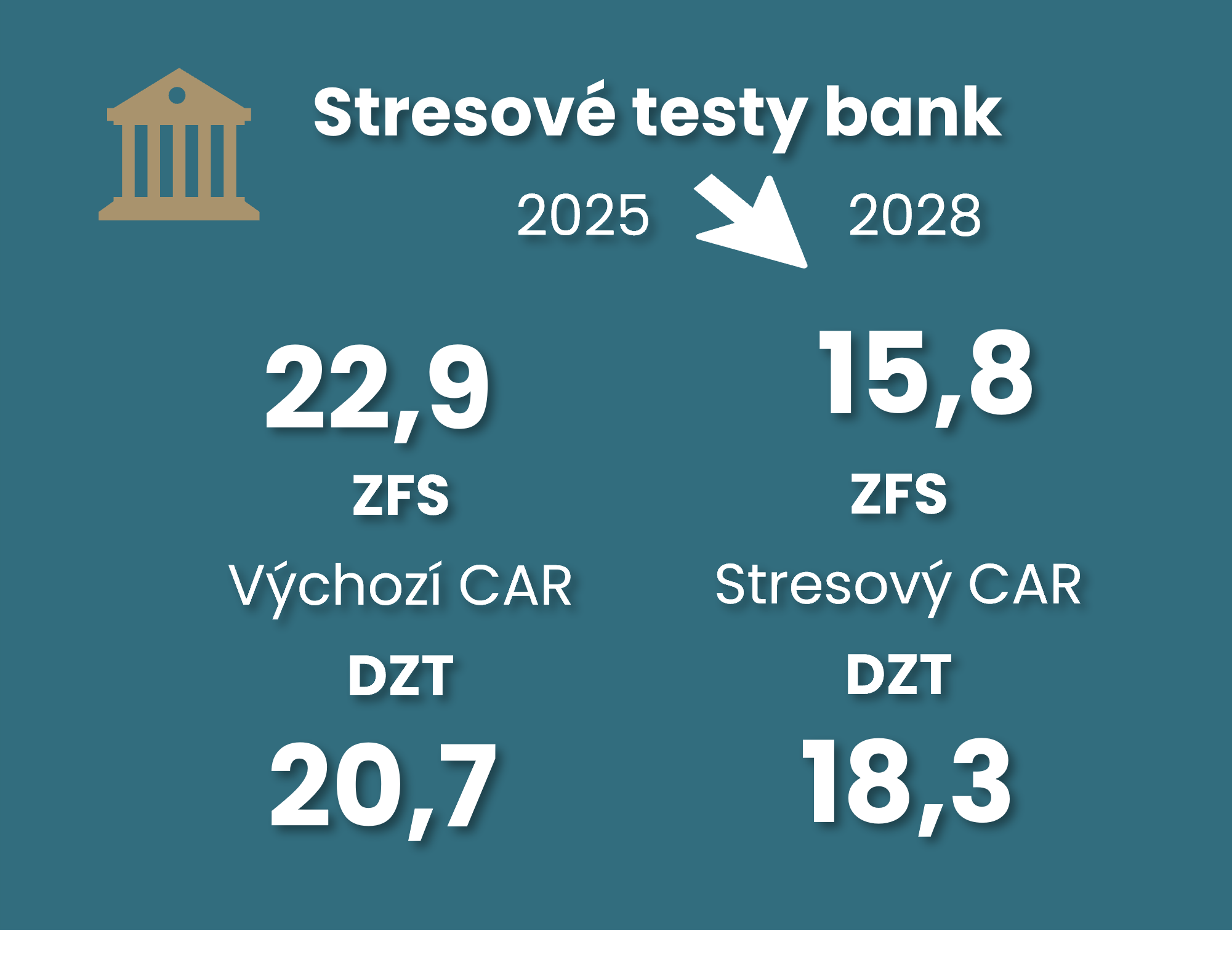
This means that risk-weighted assets (which constitute the denominator of the capital ratio) increase in the supervisory stress test “solely” due to higher risk weights. The capital ratio therefore declines by only 2.3 percentage points in the negative stress scenario of the supervisory stress test, from 20.7% to 18.4%, whereas in the ZFS stress test, it falls by 7.1 percentage points, from 22.9% to 15.8%. The CNB notes that the isolated increase in exposures contributed to a 1.3 percentage point decline in capital adequacy.
Difference No. 4: Different impact of the recession on credit losses. However, both models assume different credit losses, and we must take into account the differing nature of the recession in the scenario. The nature of the calculation, the different sample of banks, and the impact of the static balance sheet in the supervisory test also play a role.
In an adverse stress test under the ZFS framework, credit losses would exceed 290 billion crowns and reduce capital adequacy by 8.2 basis points. However, in the supervisory stress test, they would reduce capital adequacy by 5.3 basis points due to their increase to 180 billion. Or, to 200 billion crowns, if we simplistically take into account the different levels of risk-weighted assets in both scenarios.
Although the results of these stress tests cannot be compared mechanically, the overall conclusion is the same. Not even a severe economic downturn, a rise in unemployment from 3% to 11%, and the associated deterioration in credit quality would threaten the stability of the Czech banking sector. Banks would use a portion of their capital reserves—57% of which consist of retained earnings—exactly for the purpose for which they were created. And as a whole, they would remain sufficiently capitalized. However, it is also important to note that in the ZFS stress test, the adverse scenario would lead to the use of macroprudential buffers (CCyB, SyRB, and CCoB) in the case of roughly half of the 21 stressed banks (excluding NRB and ČEB) and branches headquartered outside the EU.
Summary of the stress tests in the Financial Stability Report ...

... and from the supervisory stress test of the banking sector ...

... whose previous baseline scenario projections are coming true

Actual Trends in Capital Adequacy

Profitability trends in both surveys and scenarios ...

... and the magnitude of credit losses in stress tests
