The CNB keeps rates at 3.75%. Core inflation and energy prices leave the door open for a rate hike in November
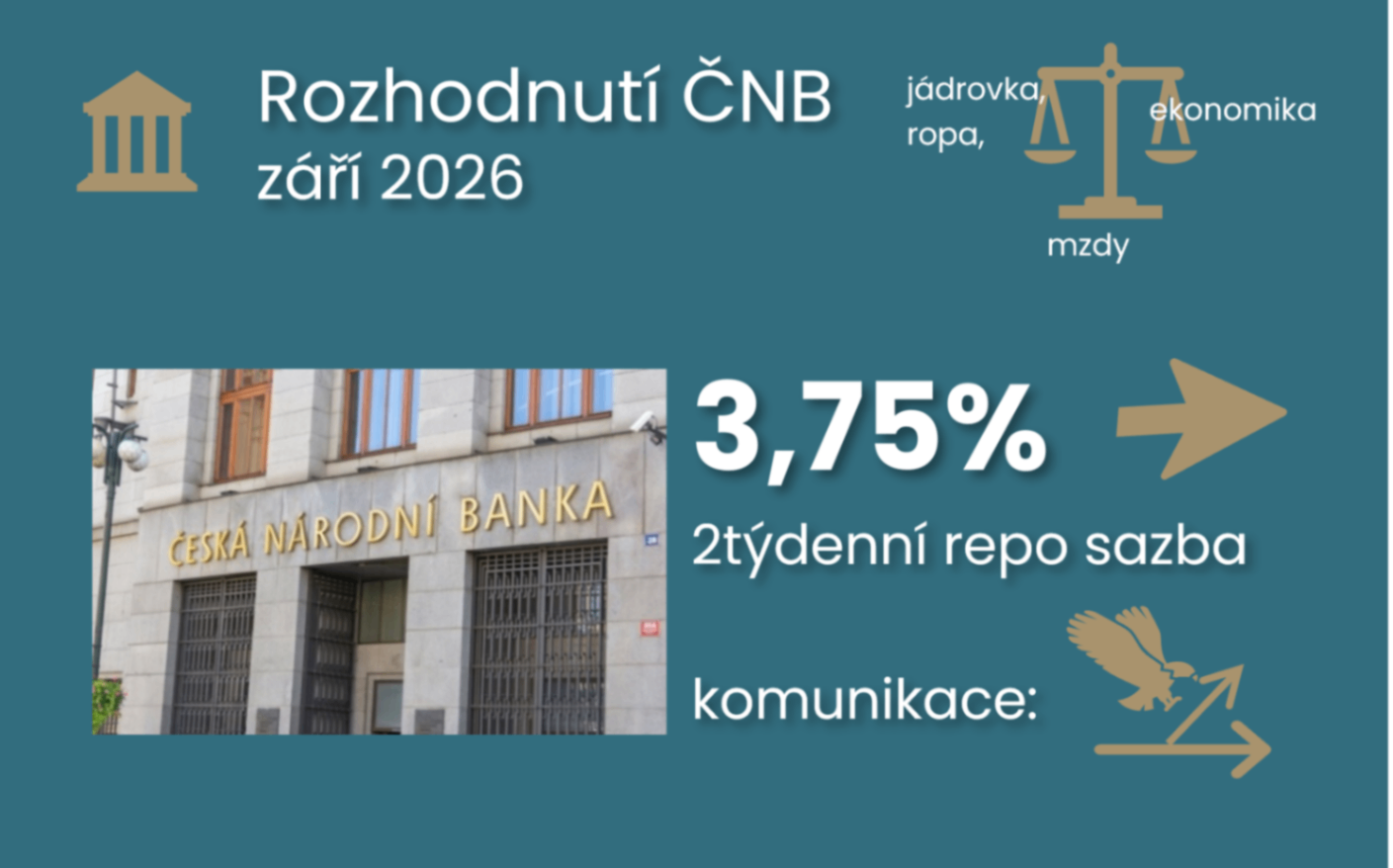
The CNB Bank Board unanimously left its interest rates unchanged, with the two-week interest rate at 3.75%. This contrasts with the September rate hikes by the ECB (deposit rate up 25 basis points to 2.5%) and the U.S. Federal Reserve (up 25 basis points to 3.75–4%). The CNB’s two-week repo rate has remained unchanged since the June increase of 25 basis points from 3.5%, a level at which it had been since May 2025 following the conclusion of the phase of interest rate cuts from 7% that began in December 2023. The Bank Board expects a temporary increase in consumer price inflation at the turn of the year (starting in November, there will be base effects from lower food prices at the end of 2025, and in January, a half-percent base effect due to the January transfer of POZE funds to the state budget).
Core inflation (CPI excluding food, alcohol, tobacco, fuel, energy, and regulated prices) remains the focal point of the Bank Board’s decision-making. Governor Michl mentioned core inflation—at 3% year-over-year—on several occasions, whether in connection with rising oil prices or in response to a question about the monetary policy of foreign banks. Wage growth, a tight labor market, real estate prices, and economic demand thus remain in the CNB’s crosshairs. Wage growth was correctly described as strong, despite the revision (see discussion here: Slower wage growth nevertheless maintained strong momentum in the second quarter).
The governor emphasized the role of the money supply created through credit creation as one of the key factors influencing inflation. He explicitly mentioned the proposal for a larger fiscal deficit as an inflationary risk (I note here that, from the perspective of new money creation, this could be mitigated by bond issuance to households, as well as by the government’s efforts to bring additional entities under the Ministry of Finance’s state treasury). By the November meeting, the CNB will also have data on September lending activity at its disposal. For now, we saw a 13% cooling of the mortgage market in August, which cannot be attributed to seasonality (see the tightening of financial conditions at the longer end of the yield curve and see the CBA Hypomonitor here : The mortgage slowdown continued in August, with the rate at 5%).
Higher energy commodity prices represent a new inflationary risk for the CNB. Whether this risk materializes—that is, whether higher fuel and energy prices spill over into the rest of consumer inflation—will depend on demand pressures and wage negotiations. For further discussion, see the set of six charts below.
How long can the CNB ignore the impact of the U.S. and euro yield curves on Czech rates? TheCzech yield curve is, without a doubt, strongly influenced by these curves. But the strength of this influence depends on domestic inflationary conditions. In other words, I am convinced that if Czech core inflation were to rise around 2% over the long term—or, more precisely, remain below that level—if we were to see a smaller gap between wage growth and productivity, and if fiscal deficits (after excluding effective defense spending) were to decline, then the reaction of Czech longer-term market interest rates to U.S. or eurozone rates would be weaker. The CNB’s ability to disregard foreign interest rates will therefore depend on how Czech core inflation responds to the tightening of monetary (CNB rates and the exchange rate) and financial (IRS rates and government bonds) conditions to date. It will also depend on any future tightening, should the CNB raise its two-week interest rate to 4%.
If not, then the narrowing of the short-term interest rate differential will likely push the koruna lower— probablyto a more moderateextent, thanks to foreign trade surpluses, though still weaker than before. A stronger reaction would occur in the event of a rise in the risk premium, which would likely happen if there were a significantly sharper increase in energy commodity prices, pushing the trade balance into a deficit (see Charts 7–8 here regarding the deficit: Industry started the third quarter on a weak note, though not across the board. Infrastructure supported the resilience of the construction sector).
The CNB Bank Board unanimously left its interest rates unchanged, this time at odds with the ECB and US Fed

Core inflation remains the focal point of the Monetary Policy Board’s decision-making

Oil prices have once again become one of the main inflationary risks, but 12-month futures remain close to the forecast

Prices are rising, including gas prices, though not as in 2022

Global food prices are also tending to shift the trend in Czech food prices, although local producer prices remain low for now

Industrial producer prices remain a risk to inflation. The strength of the koruna will therefore be important

September producer prices for services continue to signal sustained, stronger growth

Prices of construction materials rose more slowly in September (following the spring energy shock, which could, however, recur as gas prices rise), but construction activity continued to grow at its usual pace and continues to signal strong growth in imputed rent within consumer inflation

Long-term U.S. and euro-area interest rates are increasing as markets anticipate higher central bank policy rates ...

... and they are having a strong impact on Czech rates as well. This is because they reflect a shared risk—higher commodity prices—but also because the Czech economy continues to be driven by an inflationary narrative.

The interest rate differential relative to foreign markets affects the CZK exchange rate ...

... and is one of the model's key variables.
