Net interest income

1.56 % of assets
Current value
2.08 % of GDP
Current value

Comment by the Czech Bar Association

The net interest margin of the banking sector’s assets reached 1.57% in 2025, which represents a lower net interest margin than in the previous year (1.62%). In the most recent available quarter, the first quarter of 2026, the annualized year-to-date yield of 1.56%, which was below the long-term average of 1.95% since 2008 and below the average yield of 1.75% from the pre-COVID five-year period of 2015–2019.
The banking sector’s net interest income as a percentage of Czech nominal GDP fell to 2.06% of GDP in 2025 from 2.1% recorded in the previous year. In the most recent available first quarter, the ratio of the banking sector’s net interest income reached 2.08% of GDP, falling below the 2.4% long-term average since 2008 and below the average 2.3% ratio of net interest income to GDP during the pre-COVID five-year period.

Net interest income

(%)

CBA Monitor
You can hide a data set by clicking on the data set name in the chart legend.

Source of primary data

CNB ARAD

Category

Banking Sector

Data Frequency

quarterly

Note

Net interest income as a percentage of GDP refers to quarterly figures relative to seasonally adjusted quarterly nominal GDP.
The data also include figures for banks and branches of foreign banks providing services in the Czech Republic, as well as figures for branches of banks operating abroad.
For download:

Comments

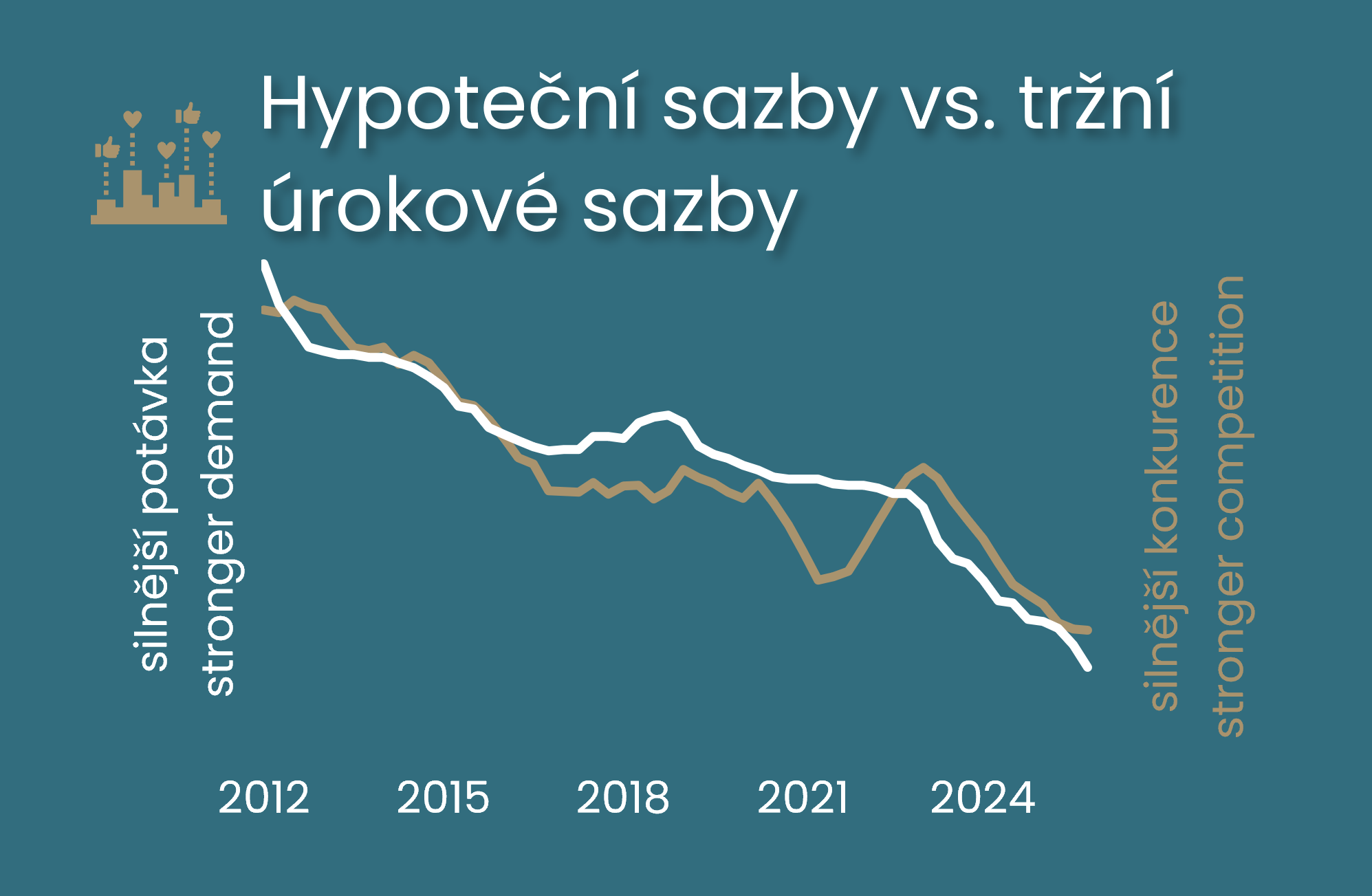
Market forces in mortgage rates: the rise in market interest rates has only partially been reflected in mortgage rates. Strong competition in the market is helping.

Comment by Jaromír Šindel, Chief Economist of the CBA: Mortgage rates are significantly determined by the movement of market interest rates. However, structural factors in the banking market are also important. The CNB's investigation of credit conditions in our analysis helps to explain what factors influence the difference between mortgage and market interest rates deviating from its normal level. The CBA analysis shows that a combination of stronger demand and competition among banks plays a key role. It is the latter that can lead to more favourable rates for clients without undermining market stability. The difference between mortgage rates and market rates that we have been monitoring is therefore mainly dampened by stronger demand, but in an environment of growing competition, which is key. Banks' profitability also plays a role, acting as a corrective mechanism to maintain competitive interest rate spreads but also market stability.