CNB tightens banks' capital buffer. Responds to faster credit growth and new risks, including fiscal
The countercyclical capital buffer should rise to 1.5% from July 2027, which will increase banks' total capital requirements to around 17% next year, in response to continued growth in lending to households and firms and lower perceived risks in the banking sector. Again, we are also seeing stronger wage growth outpacing productivity. In the case of rising investment credit, however, this is a dilemma for macroprudential policy. In addition to the financial cycle, the results of stress tests, including concerns about the interconnectedness of the banking and government sectors, are likely to have factored into the decision. It leaves mortgage rules unchanged.
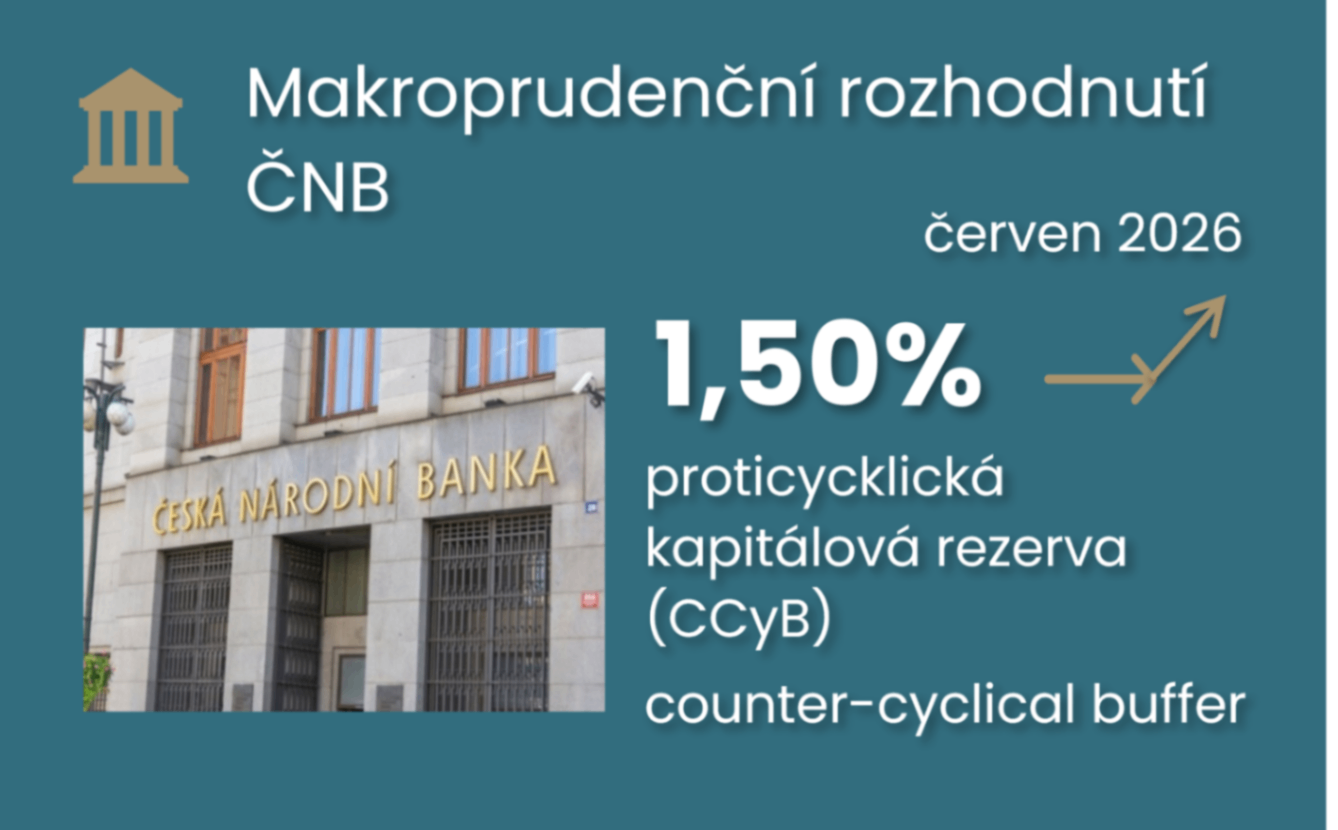
The article was updated after the CNB published its more detailed decision on 5 June.
The increase in the countercyclical capital buffer should not come as a major surprise, as its increase had been announced with increasing likelihood as early as March and to a lesser extent at the previous financial stability meeting last year.
Broad-based credit growth outpacing nominal economic growth. Although driven by housing credit, consumer and corporate credit is also rising. And that includes investment, as the CNB noted. But here we run into a classic macroprudential policy dilemma. Since it is clear that, on the one hand, investment loans are needed to increase the economy's potential (or maintain it) or to reduce structural problems, to which the CNB's other capital buffer associated with systemic risks responds.
In numbers. The CNB estimates that potential losses stemming from cyclical developments have risen to roughly CZK 56bn, equivalent to about 0.65% of GDP. This compares with an average of 0.52% of GDP over the previous four quarters. According to the CNB, this would correspond to a CCyB rate of 1.78%. At the end of last year, banks maintained a countercyclical capital buffer of just under CZK 39bn, equal to around 5.3% of total capital of CZK 733bn. A 20% increase in the CCyB would therefore lift the buffer to CZK 47bn in absolute terms, although further balance-sheet expansion means the amount is likely to be higher. If RWAs rise by 7.5% over the next 18 months, the buffer could amount to CZK 50bn by the middle of next year, CZK 13bn above the level seen at the end of last year.
What is the impact on the banking sector? For the banking sector as a whole, and not necessarily for each individual bank, the required additional capital is below the CET1 capital surplus of nearly CZK 300bn reported at the end of last year, consisting of retained earnings from previous periods. See charts 3 and 4.
The CNB argues for decreasing risk weights and lower loan loss provisioning ratios, also due to the low share of problem assets. Since the lower risk level is also part of the stronger profitability of the banking sector, the CNB has probably decided to lock in some of the bank profits in the form of a higher CCyB. Its higher level will be supported by a higher estimate of expected losses, as the CBN expects the 12-month default rate in the corporate sector to rise, probably due to the aforementioned higher debt ratio and a decline in profits in the economy due to higher wage growth. This reflects lower productivity growth. Clearly, this issue has wider implications for economic policy. Unfortunately, however, it is more in the area of regulatory and stabilisation policy, but not so much in structural economic policy.
In addition to the higher phase of the financial cycle, I think the harsher stress test in the Financial Stability Report and the change in fiscal policy and its impact on the financial sector have contributed to this view. First things first.
(1) The adverse economic scenario (with about a 15% decline in economic output over three years) sends the banking sector into an across-the-board loss in one year, whereas previous scenarios did not foresee an across-the-board loss. However, we will not have the details of the scenario until 22 June.
- Bank capital adequacy would fall below 16% from 23% at the start of the test
- Half of the sector would use the entire CCyB, part of the SyRB and some banks would break other non-releasable capital buffers
3. Growing dynamics in investment funds (but government retail bonds are likely to fit here). The CNB has done sensitivity scenarios of a shift of deposits from banks to investment funds (but government retail bonds also fit here, although the CNB has not mentioned them). This shift (quantification of which is likely to be in the Financial Stability Report) would reduce banks' interest profits and hence capital adequacy by 0.2 pp.
Although the CNB has left the systemic risk buffer (SyRB) unchanged at 0.5%, the CNB warns that it is prepared to increase it in the event of an escalation of geopolitical risks. The issue of the sectoral systemic buffer was not mentioned in the discussion, given the buoyant mortgage market, as it was earlier (we will see more in the minutes of the 22 June meeting). In the sensitivity scenario, the CNB assumes that a further shock to energy prices would reduce the capital ratio by 0.2 pp.
In contrast, the CNB is prepared to dissolve both buffers if risks materialize into bank credit losses.
The CBN also provided its view on the mortgage market and does not expect a blanket reintroduction of DTI and DSTI requirements. For now, it is waiting because of the obscuring effect of data frontloading on so-called investment mortgages. However, it does not believe that current developments should lead to a blanket reintroduction of DTI and DSTI requirements. One argument is that the aforementioned frontloading is driven by mortgages to wealthier households, whereas the current LTV requirements for non-investment mortgages are only exceeded in 1.5% of cases (vs. the 5% exemption). The CNB assumes that 6% house price growth would be more neutral for the real estate market . Thus, for mortgage loans, the CNB has left the measure unchanged, i.e. 70% LTV and 7x DTI for so-called investment mortgages, 80 and 90% LTV for conventional mortgages with the across-the-board DSTI and DTI requirements turned off.
We will analyse the decision further after the release of further information from the CNB, on 22 June when the full Financial Stability Report is released.
Previous discussions on financial stability have suggested an increased risk of increasing the countercyclical buffer to 1.5% ...

... which, all other reserves being equal, would raise the total capital requirement to 17% from July 2027
The countercyclical capital buffer is presented in the chart together with the other components of the CBR, i.e. the remainder of the combined capital buffer requirement.
Macroprudential buffers within the capital requirements framework are covered by banks’ retained earnings.
Lending activity has picked up in recent quarters. Even in the case of non-financial corporations.

A 15% fall in the economy in the CNB stress test, which would lead to a fall in capital adequacy relative to the baseline scenario with more than 23% compliance ...


Source: CNB
... due to increased credit losses and risk weighting of banks' assets

Source: CNB
The loan loss provisioning ratio has been declining, also due to the falling share of non-performing loans. However, the CNB estimates a rise in the 12-month default rate in the corporate sector

Source: CNB
The CNB mentioned the higher profitability of the Czech banking sector, also by looking at ROA internationally, which is partly true in comparison with euro area countries, ...

... but not in a regional perspective

The profitability of Czech banks relative to the performance of the economy is not stunning in international comparison ...
... which is also the case for banks' net interest income.