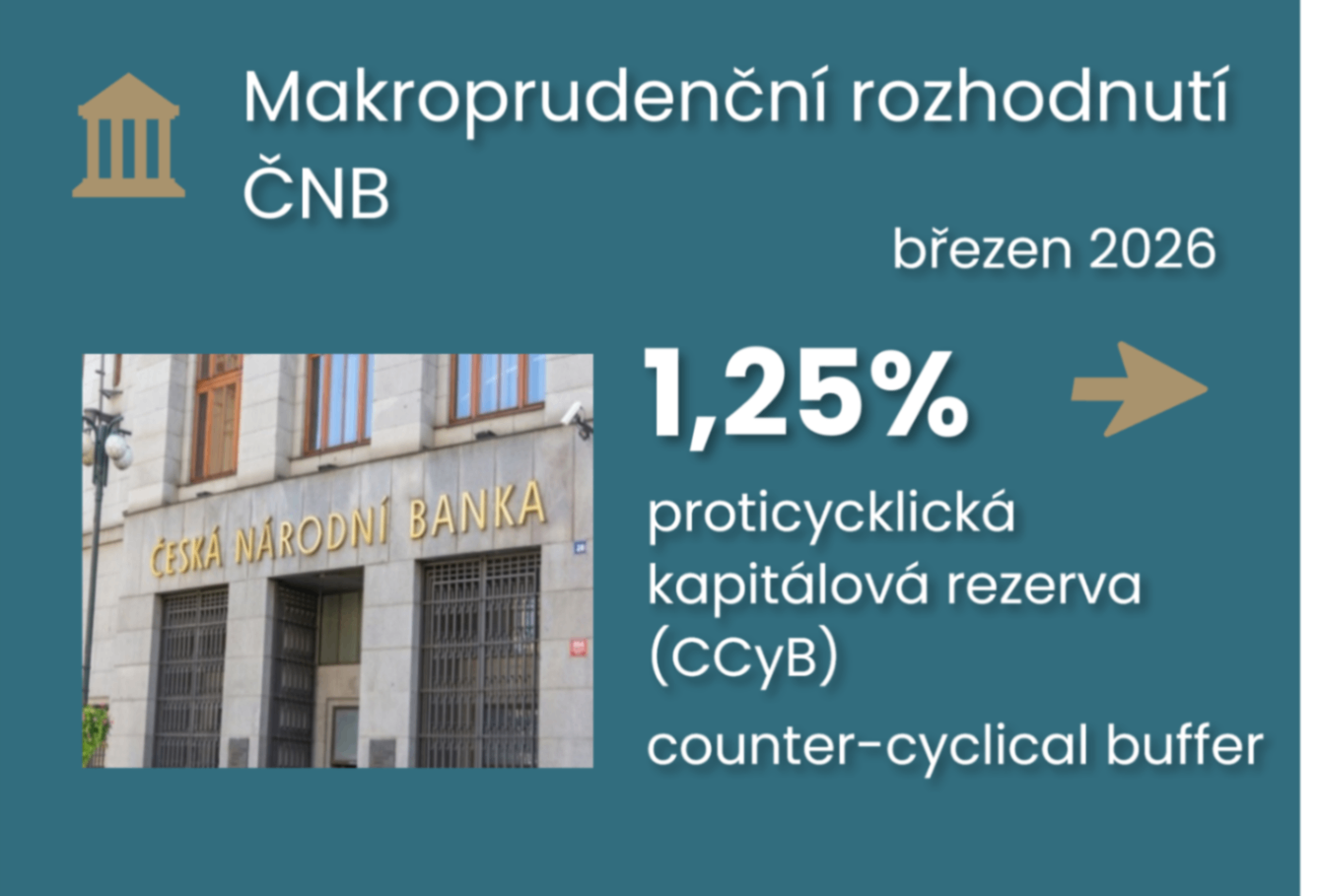
Loans are mainly driven by mortgages, which is why the CNB left the countercyclical reserve at 1.25%, but with the risk of an increase
The current growth in credit activity is mainly driven by mortgage lending, on which the countercyclical buffer has a more limited impact. Although there was also a recovery in lending activity to non-financial corporations last year, these are still rather early signs of recovery and the economy needs stronger investment activity outside construction. These reasons are probably behind the central bank's decision to leave the countercyclical buffer in banks' capital unchanged at 1.25%, but with the caveat of a growing likelihood of a future increase.
The article was updated on 6 March to reflect the new estimate by the Czech National Bank regarding the level of potential cyclical losses and the required increase due to the deterioration in risk weights.
The countercyclical capital buffer (CCyB) at 1.25% thus remains unchanged from June 2024, when it was reduced from 1.75%. Its highest level in the previous cycle was 2.5% from March 2022 to June 2023. According to the central bank , sufficient coverage of estimated losses and relatively low sectoral indebtedness are behind the decision to keep its level. In its previous decision in November, the CNB perceived a risk of an increase in the CCyB if the Czech financial cycle does not stabilise. At the same time, in November the Czech National Bank (CNB) estimated the required level of the countercyclical capital buffer to cover potential losses from future developments or a deterioration in risk weights at around CZK 45 billion (0.5% of GDP), which it considered consistent with a CCyB rate of 1.45%. The CNB has now revised this estimate to CZK 46.8 billion (0.55% of GDP), corresponding to a CCyB rate of 1.5%.
In November, however, the CNB focused on stricter macroprudential measures against so-called investment mortgages in the current constellation, when lending activity is mainly driven by mortgage loans (see CBA Monitor here). Nevertheless, the CBA estimates a further modest increase in cyclical systemic risks, which, if they were to grow further (for example, with a general easing of credit standards or excessive risks from the financial sector), would increase the likelihood of an increase in the countercyclical buffer. The CNB will publish a record of the March decision on 20 March.
And what do the latest figures on lending activity look like? The January CNB data confirmed the strong January momentum in the mortgage market in line with the previously published CBA Hypomonitor. However, the recovery in lending activity was not just about mortgages. They remain well above the long-term average at the start of the year. Activity in housing loans amounted to around 5.5% of GDP, compared with a long-term average of around 3.8% of GDP. Activity in consumer loans was also above average, with volumes equivalent to around 1.9% of GDP, compared with an average of 1.5%.
Corporate lending slowed slightly in January after a very strong end to last year. Newly contracted corporate loans amounted to around 8.1% of GDP, compared with around 10.9% at the end of the year. Even so, they remain above the level seen in the economy in the first half of 2025.
Stronger lending activity is gradually translating into faster growth in total credit volumes. Total credit in the economy grew by 7.4% year-on-year. Households grew by 8.7%, while non-financial corporations grew by 5.5%. Bank deposits also grew along with credit. Total deposits increased by 5.4% year-on-year, with growth of 5% for households and 3.1% for non-financial corporations.
The very low share of non-performing loans (NPLs), i.e. loans in arrears, remains an important factor for the stability of the banking sector. In total, it is only 1,5 %. It is 2.4% for non-financial corporations, 1.3% for households and even only 0.6% for mortgages.


