Market forces in mortgage rates: the rise in market interest rates has only partially been reflected in mortgage rates. Strong competition in the market is helping.
Comment by Jaromír Šindel, Chief Economist of the CBA: Mortgage rates are significantly determined by the movement of market interest rates. However, structural factors in the banking market are also important. The CNB's investigation of credit conditions in our analysis helps to explain what factors influence the difference between mortgage and market interest rates deviating from its normal level. The CBA analysis shows that a combination of stronger demand and competition among banks plays a key role. It is the latter that can lead to more favourable rates for clients without undermining market stability. The difference between mortgage rates and market rates that we have been monitoring is therefore mainly dampened by stronger demand, but in an environment of growing competition, which is key. Banks' profitability also plays a role, acting as a corrective mechanism to maintain competitive interest rate spreads but also market stability.
Since we cannot make predictions of client interest rates within the CBA, our analysis focuses on structural factors that help explain the evolution of the difference between mortgage and long-term market rates over time.
The main findings of the model of the impact of bank lending conditions on mortgage interest rate spreads:
- Stronger demand in a competitive market dampens interest rate spreads.
- Competition emerges from the model as a corrective factor keeping the mortgage market stable in the long run.
- Profitability of the banking sector acts as an intuitive corrective mechanism in the model, with higher bank profitability subsequently reflected in a lower interest rate spread. And vice versa, which is conducive to long-term financial stability.
- The inclusion of the interest margin did not yield a better telling value, consistent with the trend decline in the ratio of the interest margin to the bank balance sheet, while banks' interest margin to households remains subdued in real terms.
- While the loan-to-deposit ratio does not increase the robustness of the model, ample liquidity may be contributing to the strong two-sided role of competition in the model.
In our analysis, the CNB's investigation of credit conditions is largely able to justify the deviation of the mortgage-to-market long-term interest rate differential from its long-term average. Among the key variables that reduce the difference between mortgage and market interest rates is stronger demand with stronger competition. However, competition no longer emerges in the model as a factor pushing down the "margin" on mortgage rates. This force is left to stronger demand in the model, and stronger competition guards the sustainability of the business model. This is reflected in the sensitivity of the interest margin to the sector's previous profitability, with previous growth leading to a lower interest margin and vice versa. This market capability maintains stability in the mortgage market as it does not allow long-term price undercutting, which benefits financial stability as around a fifth of the value of a mortgage has to be covered by capital requirements.
The difference between the realised mortgage interest rate and longer-term market interest rates has oscillated at just over 1 percentage point over the long term. This means that if market three- to five-year interest rates are at 3.5%, mortgage rates should be above 4.5% in the long term. However, the difference in rates is not stable. A long-term difference of one percentage point is common even in euro area countries (see charts below with international comparisons).
Last year and the last few months aptly capture this oscillation, which has headed towards a narrowing of the March mortgage rate differential to market rates to below 0.4 p.p. Whereas in the first half of last year, the difference between the average realised mortgage rate (4.85%) and the market rate (less than 3 years at the time) was 1.25 p.p. This narrowed to 0.82 p.p. in the second half of last year. This led to a slight widening to 0.97% in the first two months of this year as IRS rates fell. Conversely, in March, its spread narrowed to below 0.4 p.p., the lowest since the first half of 2022.
March brought a significant narrowing of the gap between mortgage rates on new loans compared to long-term rates

We build a model that attempts to explain the deviation of the difference between mortgage rates and longer-term market rates from its long-run average based on the CNB's quarterly survey of bank lending conditions. This reflects both the demand and supply side, including an assessment of the competitive environment or risks in the economy, as well as from a regulatory perspective. We also added banks' financial performance to the models, whether in terms of profit return, net interest margin or loan-to-deposit ratio as a proxy for a partial source of funding for credit creation.
We based the model relationship on the ECM - an error correction model - which can capture both long-run and short-run relationships between variables (results in the appendix). In it, we work with data from 2012, which corresponds to the origin of the CNB credit conditions survey, and the variables in the model are expressed in deviations from their long-run average, except for the period Q4 2021 and H1 2022, when there is a significant market downturn due to a strong increase in the CNB interest rate to 7%. We have covered this period in the model with a dummy variable.
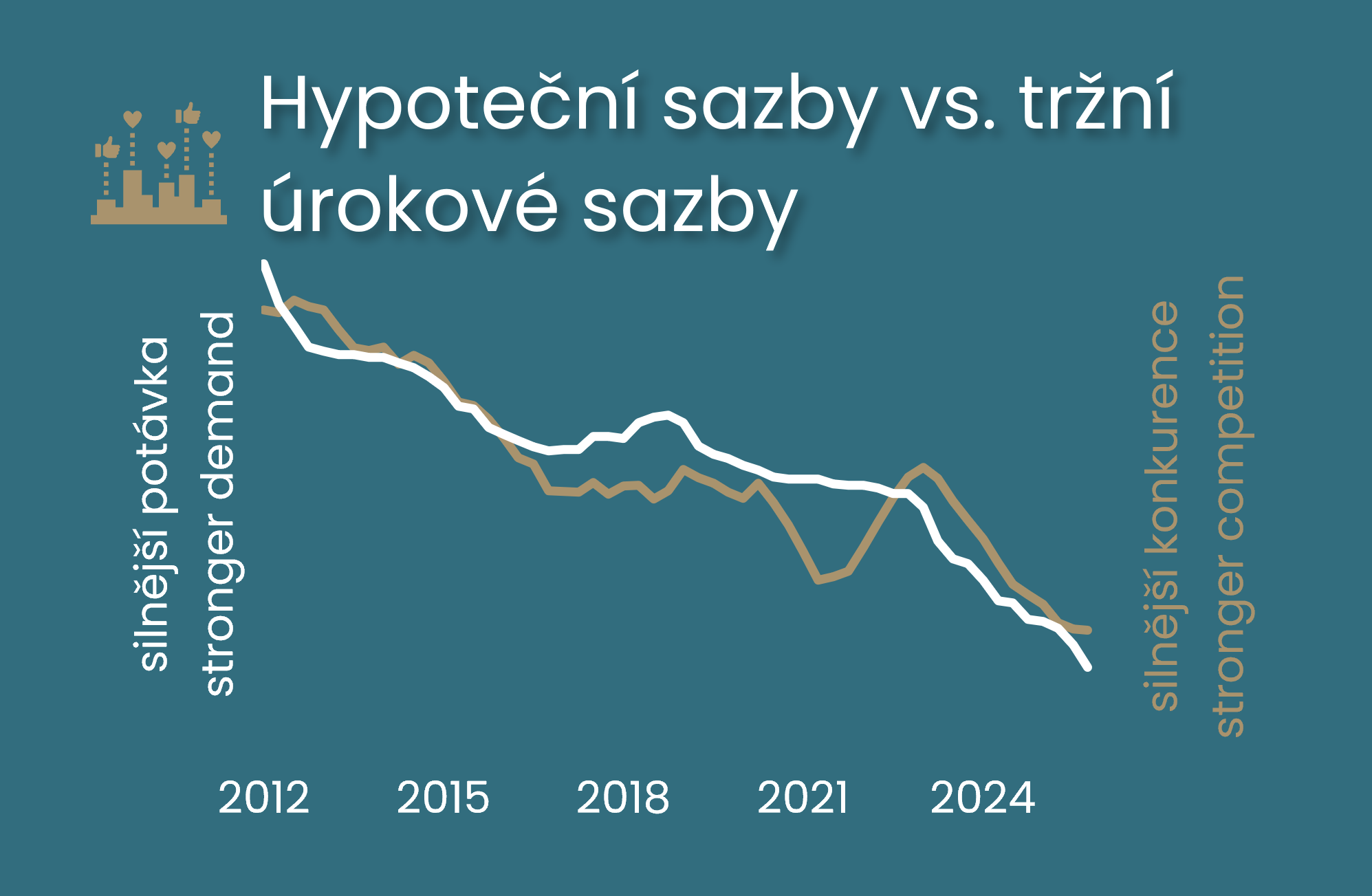
Stronger demand is associated with stronger competition in the CNB's survey on credit conditions ...
... where stronger demand leads - counter-intuitively at first sight - to a more consumer-friendly narrower spread between the mortgage interest rate and the market swap rate
Stronger competition leads to looser lending standards in CNB survey ...
... which, in the case of credit terms, leads to a loosening of credit conditions through a lower margin
Analysis of individual relationships:
- Stronger demand with increasing competition dampens interest rate spreads. The best variable to explain the behaviour of the interest rate spread under study is the banks' assessment of customer demand. Intuitively, stronger demand should lead to a higher spread between mortgage and market interest rates, i.e. a more profitable situation for banks. However, in our environment, where stronger demand is accompanied by increasing competition, the opposite is true. This demand factor has produced more robust results than models working with mortgage numbers, volumes or volumes relative to GDP.
- Competition in the model acts as a corrective factor keeping the mortgage market stable in the long run. Once demand is included, the competition variable does not behave as a pure indicator of price pressure, but also as a disciplining mechanism to preserve the sustainability of the mortgage market, not only in terms of profitability but also financial stability (avoiding the generation of future losses).
- The profitability of the banking sector acts as an intuitive correction mechanism in the model. If profitability (in the form of return on capital) falls below its long-run level, then this leads to a higher mortgage rate spread relative to market interest rates later on. Conversely, the higher profitability of banks is then reflected in a lower interest rate spread, where the competition effect plays a role.
- The inclusion of the interest margin has not yielded a better telling value, which is consistent with the trend decline in the ratio of the interest margin to the bank balance sheet, while the banks' interest margin vis-à-vis households remains subdued in real terms. According to CNB statistics, the net interest margin of banks vis-à-vis households rose to CZK 40.3 billion in 2025. However, it remains significantly lower than the average annual margin of around CZK 47-51 billion in 2015-2021, and this with a noticeably different price level and size of the economy. While in those years this interest margin was 0.9% of GDP, in 2025 it was less than 0.5% of GDP.
- While the loan-to-deposit ratio does not increase the robustness of the model, ample liquidity may be conducive to a strong two-sided role of competition in the model. The inclusion of additional variables such as the loan-to-deposit ratio does not help to increase the robustness of the model, and the aforementioned deposit-to-lending ratio does not come out with an intuitive positive sign, i.e. that mortgage rate spreads widen when lending is relatively higher. On the contrary. This probably reflects excess liquidity in the Czech banking sector, which probably leaves a strong dual role of competition in this model.
The main drivers of the long-term relationship of the deviation of the mortgage interest spread to market interest rates from its long-term average ...
... and their role in short-term changes, where less than 60% of the variation is corrected automatically within one quarter
International comparison
At 4.6%, Czech interest rates on new housing loans are about 1.2 percentage points higher than in the euro area, but significantly lower than in Poland or Hungary.

The interest rate differential on new housing loans vis-à-vis interest rate swaps in the Czech Republic has averaged around 1 percentage point since 2017, similar to the Slovak and euro area averages. Thus, Czech mortgage interest rates, when adjusted for the differential money time premium, are in line with mortgage interest rates in the euro area.
Annex
====================================================================================================
MEASUREMENTS FOR GAP MODEL (excluding 2021Q4-2022Q2)
spread: 131.5094, demand: 529.5283, competition: -305.4340, LTV_DSTI_DTI: 416.7358, ROE: 17.2683, LTD: 69.9057
====================================================================================================
ECM_C2 - LONG TERM EQUATION
=======================================================================================
Dep. Variable:      spread_gap     R-squared (uncentered): 0.861
Model: 	        OLS 	 Adj. R-squared (uncentered): 0.847
Method: 	        Least Squares  F-statistic:102.2
No. Observations: 54 		 Prob (F-statistic):1.03e-24
Df Residuals:     49 		 Log-Likelihood:-252.51
====================================================================================
		 coef 	std err   z  P>|z| [0.025 0.975]
------------------------------------------------------------------------------------
demand_gap 	 -0.3016    0.034   -8.955  0.000   -0.368 -0.236
competition_gap 	-0.5659     0.070   -8.082  0.000   -0.703 -0.429
LTV_DSTI_gap 	-0.0828      0.020  -4.235  0.000   -0.121 -0.044
ROE_lagavg_gap 	-2.6170     1.390   -1.883  0.060   -5.340 0.106
shock_dummy 	-107.299    14.002  -7.663  0.000   -134.743 -79.855
==============================================================================
Omnibus: 0.604            Durbin-Watson: 1.104
Prob(Omnibus): 0.739      Jarque-Bera (JB): 0.660
Skew: 0.234               Prob(JB): 0.719
Kurtosis: 2.726           Cond. No. 1.98e+03
====================================================================================================
ECM_C2 - SHORT-TERM ECM EQUATION
====================================================================================================
Dep. Variable: d_spread_gap 	 R-squared (uncentered): 	0.499
Model: OLS 		 Adj. R-squared (uncentered):    0.446
Method: Least Squares 	 F-statistic: 	          9.339
No. Observations: 53 	            Log-Likelihood: 	          -245.84
Df Residuals: 48 	            Prob (F-statistic): 	          2.91e-06
=====================================================================================
		 coef 	 std err     z     P>|z| [0.025 0.975]
-------------------------------------------------------------------------------------
d_demand_gap 	-0.3708     0.105   -3.525   0.000 -0.577 -0.165
d_competition_gap 	 -0.4558    0.267   -1.705   0.088 -0.980 0.068
d_ROE_lagavg_gap 	-4.5618     2.678   -1.703   0.089 -9.811 0.688
ect_ECM_C2_l1 	 -0.5857    0.134   -4.372   0.000 -0.848 -0.323
shock_dummy 	 -43.453   23.169   -1.876   0.061 -88.863 1.956
==============================================================================
Omnibus: 7.296 	 Durbin-Watson: 2.217
Prob(Omnibus): 0.026 	Jarque-Bera (JB): 6.454
Skew: 0.819 	Prob(JB): 0.0397
Kurtosis: 3.489 	Cond. No. 241.
==============================================================================