Fiscal policy keeps all options open for CNB interest rate movements
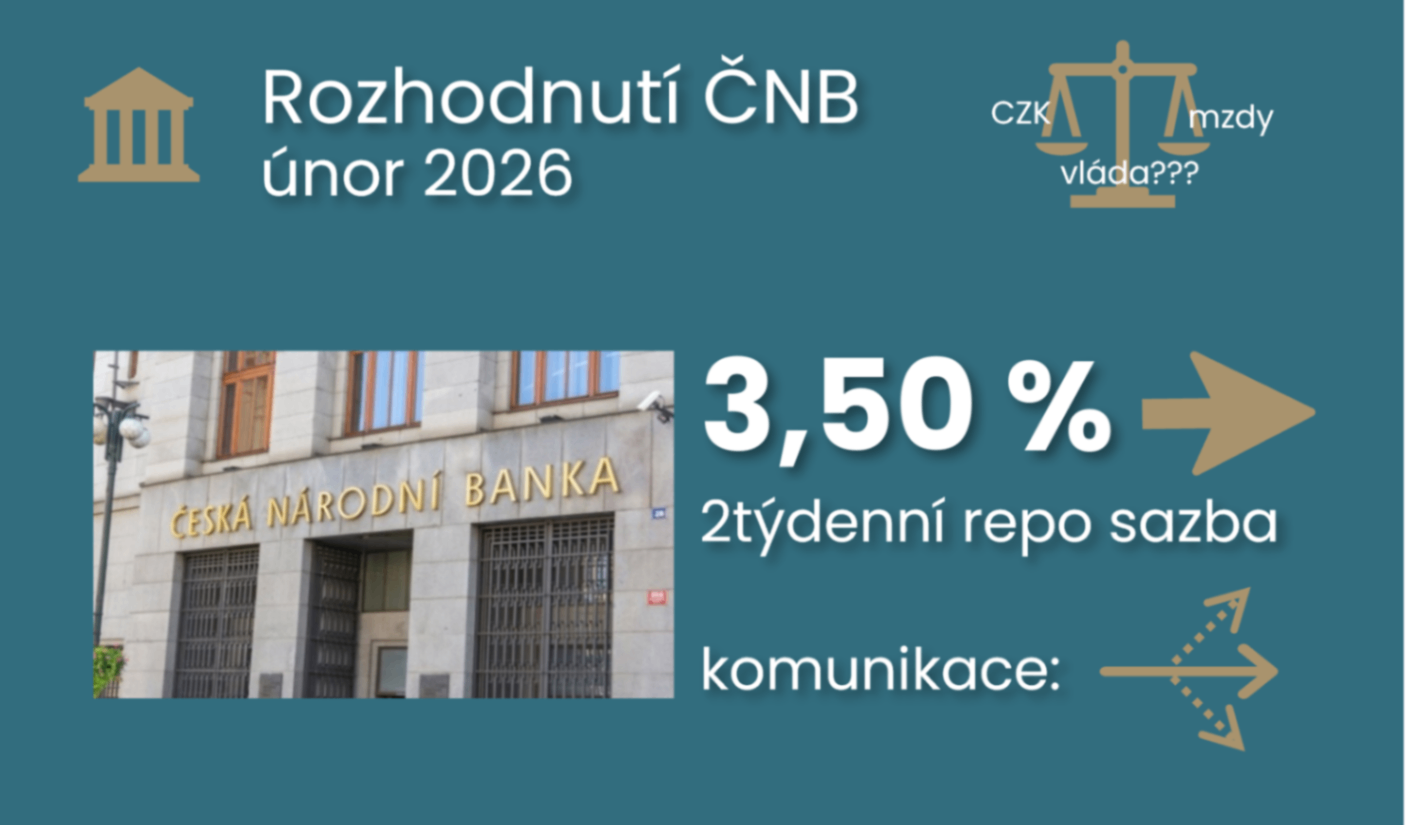
Comment by Jaromír Šindel, Chief Economist of the CBA: The January slowdown in consumer price growth to 1.6% (mainly due to fiscal intervention in regulated energy prices) was accompanied by a discussion of a possible slight reduction in the CNB interest rate in order to fine-tune the recent interest rate cycle. However, persistently higher momentum in core inflation has left its interest rate unchanged, and risks associated with service prices and fiscal policy leave all options open for the central bank to move its interest rate. This is also true in light of the central bank's new forecast outlook, which admittedly encourages a marginal short-term interest rate cut before rising to 4% as early as the end of this year. With its decision and the reiteration of both inflationary and disinflationary risks, the central bank has tempered the dovish expectations of some market participants and the outlook for a 3.5% rate still seems likely. The key is the reiteration of the thesis of the sustainability of a return to the inflation target through softer core inflation.
Getting closer to the 2027 inflation target Although the central bank is looking for consumer price inflation to rise to 2.1% in 2027, close to the inflation target, after a 1.6% rise this year. Although its outlook is about less than half a percentage point lower than in its previous forecast, this is not the result of a slowdown in inflationary pressures, but rather a further cooling of them through tighter monetary conditions. In fact, the central bank is actually expecting stronger economic growth of almost 3% year-on-year, which is cumulatively more than half a percentage point higher over 2026-2027. Looser fiscal policy is also likely to be reflected here.
Tighter monetary conditions. The central bank is responding to these developments with tighter monetary conditions. The koruna is forecast to be less than a percentage point stronger this year and next than in the previous outlook (but marginally weaker against the euro spot), and the outlook for 3M PRIBOR is cumulatively about 30bp higher on average over both years. As a result, monetary conditions are tighter, not only in nominal terms but also more so in real terms given the softer inflation outlook. Today's decision should cool the pricing of the CNB's rate cut, improving the interest rate differential slightly and thus closing the open door for a depreciation of the koruna (see chart here in the analysis of January inflation to 1.6%).
So no interest rate cut? Not necessarily, as the supply side of the economy would surely welcome such a move as well. However, the central bank may move to cut the interest rate if momenta, the seasonally adjusted month-on-month rise in core inflation, slows to or better below 0.2%. This would bring hope for a more moderate than 2.5% annual growth. This could reduce inflationary pressures and lead not only to a decline in the short end of the yield curve, but also in the longer end, which is more important for the supply side of the economy. However, with stronger economic growth, also due to looser fiscal policy, and a further non-strengthening crown, I would consider this scenario less likely in the near one to two quarters. For more on the discussion of the role of the level of core (services) inflation in overall inflation dynamics, see the analysis here.
Comparison of the new CNB forecast vs. November 2025 (details of the new forecast will be available on 6 February)

The return to the inflation target reflects the CNB's tighter monetary conditions ...

... with stronger economic growth

Comparison of the new CNB forecast vs. November 2025 (details of the new forecast will be available on 6 February)
