January inflation slowed, but demand pressures did not
Comment by Jaromír Šindel, Chief Economist of the CBA: The significant slowdown in consumer prices to 1.6% year on year in January did not surprise the consensus and mainly reflects lower energy prices, but also food and fuel prices. On the contrary, I expect core inflation to remain at at least 2.8% growth from the end of last year. Although core retail sales corrected with a 0.6% month-on-month decline in December, annualized momentum, along with household plans, remains strong and does not suggest easing demand pressures. Thus, even in light of fiscal plans, interest rate stability appears to be an appropriate stance for the central bank, at least for the coming months. This is inconsistent with interest rate market targeting, but in my view this would require significantly lower core inflation pressures.
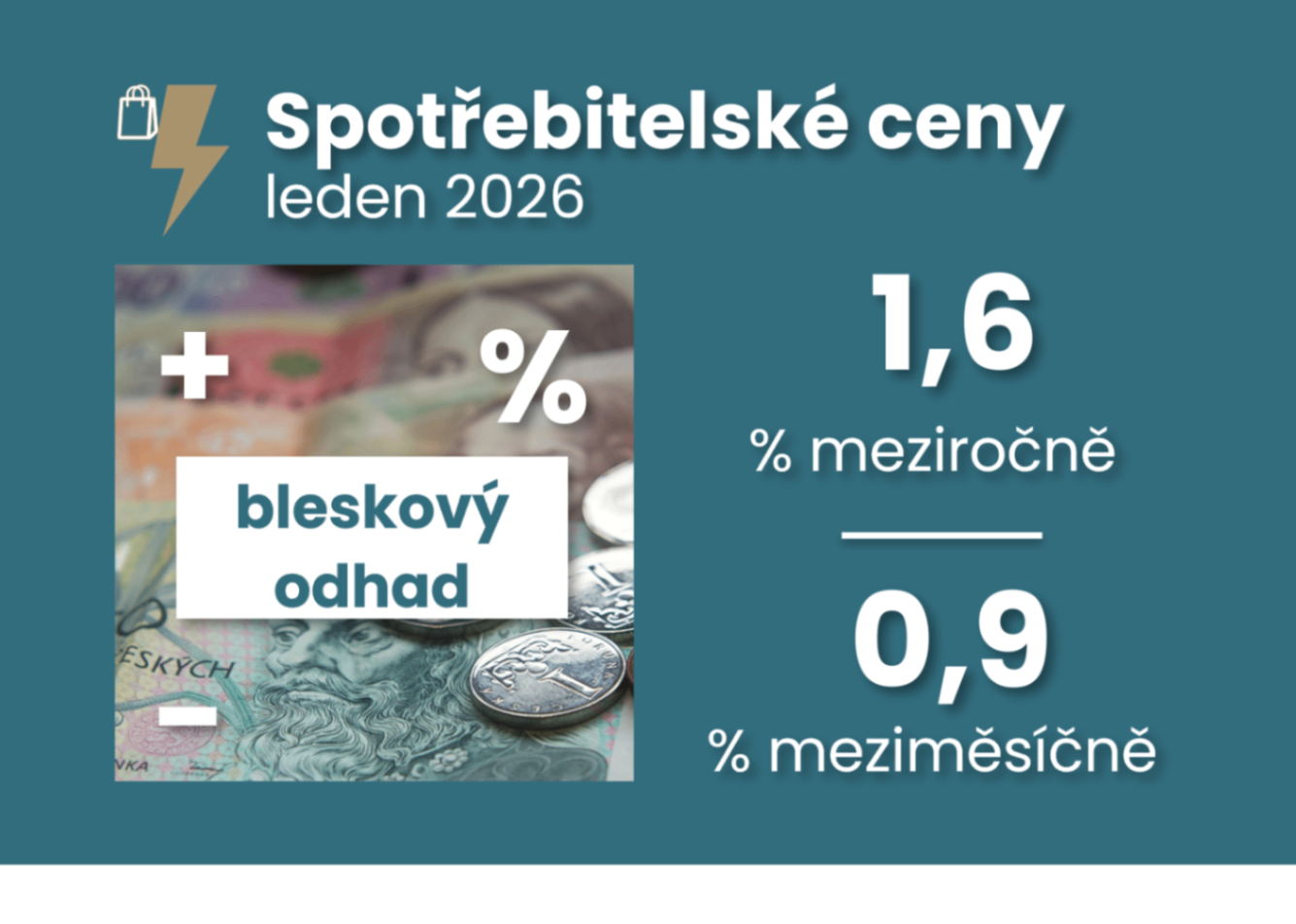
According to the flash estimate, January inflation did not surprise the consensus by falling to 1.6% year-on-year from 2.1% recorded in November and December. January's slowdown mainly reflected lower energy prices, especially due to the transfer of the renewable energy levy to the state budget, which was accompanied by a decline in power prices. This was compounded by a roughly 3% month-on-month decline in fuel prices (my assumption). On the other hand, food, alcohol and tobacco prices have fallen less than I expected, which is probably also true of the arguably stronger growth in non-energy administered prices.
And probably a similar development applies to core inflation, which probably remained at least at 2.8% yoy, but may have risen to 2.9%. This would be slightly above my forecast and the CNB's previous forecast for Q1 (its new forecast will be fully revealed tomorrow, 6 February). If so, it would imply a slight acceleration in the annualized momentum of core inflation over the past three months to 2.9% from 2.8% in December. Which is not the direction the central bank needs to take given the thesis of a sustainable return to the inflation target via core inflation. By the time the CSO releases the January inflation details on February 13, from my perspective this looks like a slowdown in inflation this year to 1.8-1.9% from 2.5% in 2025, but with a re-acceleration to 2.4-2.5% in 2027.


In my view, my view on the prices of services, and especially labour-intensive ones, is more of a reason for the stability of central bank interest rates, especially given the structural change in the expenditure side of the newly proposed state budget. For me, this represents a more significant change than the actual change in the level of its deficit to CZK -310 billion. Although GDP growth in the fourth quarter was not accompanied by employment growth, in my opinion (see discussion here) it is too early to believe in a new disinflationary trend through a recovery in labour productivity, especially given the probably still weak investment activity (although the recovery in newly contracted loans perhaps augurs better times).
December retail sales remained essentially unchanged on a month-on-month basis. However, their year-on-year growth slowed to 2.2% from almost 4% in November. However, stronger wage growth and still solid household plans for larger purchases (which did not change in January - see here) should not lead to further deterioration in core retail sales, which fell 0.6% month-on-month, but after a 1% jump in November. Three-month momentum suggests they are up around 3-4% y/y.


Markets in extremes? While in the autumn the markets seemed too attuned to the CNB's interest rate hikes, they switched to a dovish tone late last year, which intensified with February. Prior to the release of the inflation numbers, the Fed's markets priced in at least one 25bp cut in the CNB's interest rate to 3.25% at the May meeting. The IRS curve also fell significantly (see chart below), but I find its readings consistent with a return of the central bank rate to 3.5% at the near two-year horizon and a further increase to 3.75% at the three-year horizon and later to 4% at the five-year outlook. If the interest rate market were to fully feed through to the krona, then we would probably see the krona about 1% weaker, which would return it to the weaker trajectory originally expected by the central bank.


