Retail sales continued to gain momentum in March, together with construction, in contrast to weaker industrial performance
March retail sales returned to strong growth, while March did not bring a turnaround in the stagnation of services. Industrial production did not build on February's better numbers, and a more significant deterioration was prevented by energy-intensive sectors, which does not look like a robust support in the current energy shock. Export activity also remained weaker. However, the month-on-month decline in imports resulted in the return of a solid foreign trade surplus of CZK 18 billion. Construction output, on the other hand, continued to outperform, especially in the buildings segment. However, despite still weak building permit numbers, the number of construction starts continued to rise. Infrastructure construction, on the other hand, remains weaker, presenting an opportunity for future growth. The output side of the economy thus developed in March in line with the weaker GDP growth of 0.2% q-o-q in the first quarter, which was characterised by a decline in industrial activity and a deterioration in foreign trade. These factors were only partly offset by stronger construction output and solid growth in trade and services sales (still with February data). For the CNB, the data, along with higher unemployment and softer industrial wage growth, signal a less hawkish environment than the still elevated momentum in core inflation suggests.
March retail sales returned to strong growth, with core retail sales reaching annualised growth of 10% over the past three months. Overall retail sales rose by 0.8% month-on-month in March, and by 1.2% excluding cars, reflecting stronger growth in food sales, possibly due to stronger demand amid lower prices, as well as resilient fuel consumption despite a 19% increase in fuel prices. This was accompanied by the already mentioned 1% month-on-month improvement in core retail sales, reflecting still-strong household intentions regarding larger purchases despite a correction in March and April. Services revenues improved slightly (+0.3%), but this did not reverse this year’s stagnation in the sector.
Retail data surprised positively and represent an upside risk to the flash estimate of the economy slowing to 0.2% quarter-on-quarter in the first quarter. In Q1, retail sales accelerated to 1.1% quarter-on-quarter, or 1.6% excluding cars, while services revenues still posted a solid 0.6% increase. This contrasts with the omission of household consumption as a driver of GDP growth in the Czech Statistical Office’s commentary.
On the production side, the economy in March evolved more in line with the weaker GDP growth of 0.2% quarter-on-quarter in the first quarter, which was characterised by a decline in industrial activity and a deterioration in foreign trade.
The March production data confirmed the continuing divergent development of the Czech economy. While construction maintained its strong momentum and foreign trade remained in surplus, industry continued to lose momentum after a weak start to the year. In particular, the month-on-month and annualized development of the manufacturing industry without any significant support from the automotive segment sent a negative signal. In contrast, the energy-intensive sectors indicate continued stabilisation.
Industrial production slowed down to 0.9% y/y in March after 1.3% in February, while manufacturing grew by 1.6% y/y. The automotive segment no longer provided as strong a boost to the economy as at the beginning of the year, as its growth slowed to 1.6% y/y from February's 2.5% and January's 8.1%. In contrast, energy-intensive sectors accelerated to 5.3% y/y, confirming a gradual recovery after the previous downturn.
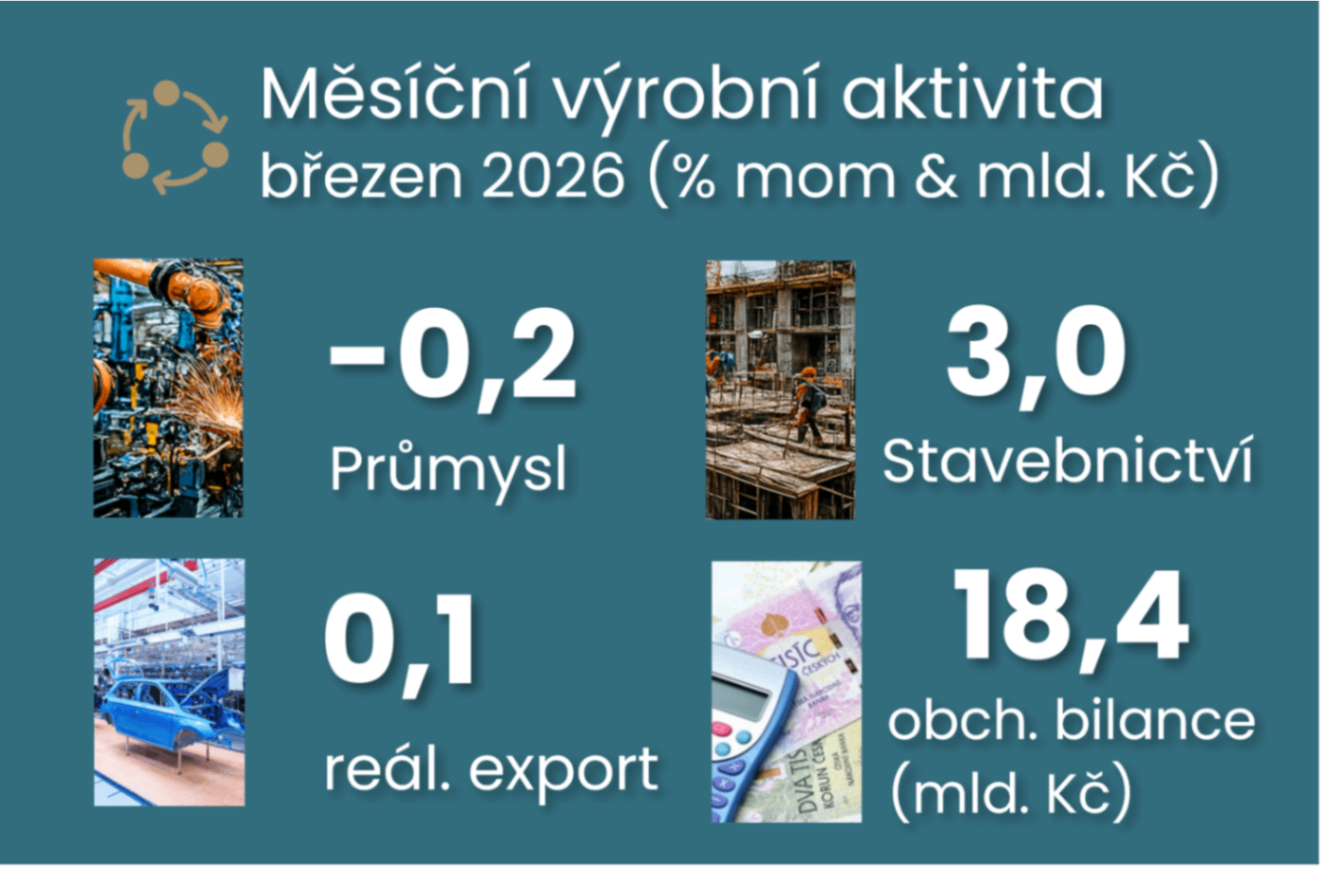
However, short-term industrial momentum remains weak. In March, the industry declined by 0.2% m/m, as did manufacturing, while the automotive segment fell by 2.7% m/m. Three-month annualized industrial dynamics fell to -6.7% SAAR and manufacturing to -8.6%, significantly weaker than the still positive y/y figures. This suggests that year-on-year growth is still partly driven by the lower comparative base of last year, while actual output developments remain subdued.
This is reflected in the quarter-on-quarter decline of 0.7% q/q in industry and 1.2% q/q in manufacturing in Q1 this year. In contrast, energy-intensive industries maintained a moderate growth of 0.5% q/q. Although industry confidence has stabilised slightly in recent months, it remains below the long-term average, mainly due to weak external demand and cautious European industry.
Construction, on the other hand, continues to grow robustly. In March, construction output rose by 4.9% year-on-year and by a strong 3.0% month-on-month. The three-month annualized rate increased to 13.2% SAAR, confirming the sector's strong recovery after a weaker end to last year. On a quarter-on-quarter basis, the construction sector grew by 1.0% q/q in Q1. Confidence in the construction sector remains relatively stable, supported mainly by renewed investment activity as well as a gradual recovery in residential construction.
Foreign trade in goods ended with a surplus of CZK 18.4 billion in March, but quarterly number is weaker. Exports of goods grew by 7.2% y/y in real terms, while imports rose by 6.7%. However, the short-term export growth rate slowed to 0.1% m/m and its annualized rate fell to 3.0% SAAR. Imports, on the other hand, declined by 2.1% y/y following February's growth, but the annualized pace remains relatively elevated at 10.5% SAAR. This may signal continued domestic investment and consumption demand amid a subdued performance of external industrial demand. The current annualized foreign trade surplus stands at 1.9% of GDP, slightly lower than the 2.5% surplus last year.
Retail data contrast with the omission of household consumption among the drivers of GDP growth in the first quarter (according to the Czech Statistical Office).
Retail maintained its growth trend, while services revenues broadly stagnated in the first quarter.
Production relies on construction, less on industry

For the CNB, the data, together with higher unemployment and softer wage growth in industry, signal a less hawkish environment than the still elevated momentum in core inflation suggests.

March's industrial production did not build on February's better numbers ...
... and energy-intensive industries have prevented any significant deterioration. 
Construction output, on the other hand, has continued to outperform, particularly in the buildings segment. Infrastructure construction, on the other hand, remains weaker, presenting an opportunity for future growth. 
However, despite the still weak building permit numbers, the number of building starts is still increasing. 
Export activity also remained weaker. However, the month-on-month decline in imports resulted in the return of a solid foreign trade surplus of CZK 18 billion.
The current annualized foreign trade surplus is 1.9% of GDP, slightly lower than the 2.5% surplus last year.

The retail and services part of the economy envisages slightly better GDP growth than 0.2% q-o-q accoridng to the flash estimate in the first quarter, ...
... that more reflects a decline in industrial activity and a deterioration in foreign trade. These factors were only partially offset by stronger construction output.
