Energy shock divides the mood in the economy
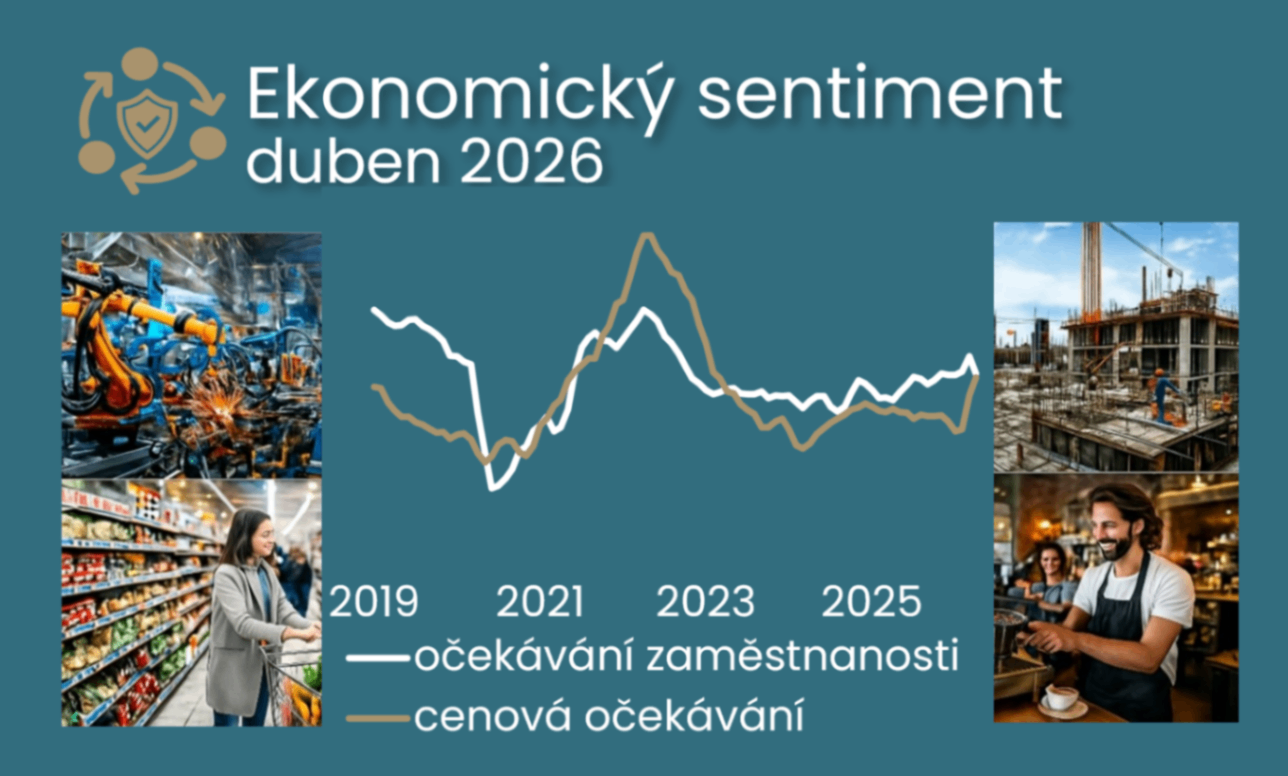
April sentiment already reflects the impact of the Iranian conflict on the Czech economy more strongly, but unevenly across sectors. Sentiment deteriorated as expected in industry, households and retail trade, while services dampened the overall deterioration thanks to stronger demand and construction. Price expectations continued to rise in industry, households and construction, while retail sales remained close to the long-term average and services corrected slightly after the previous increase. Meanwhile, labour market effects remain limited even in the harder-hit sectors and, in fact, the overall slightly worse sentiment still does not provide an immediate signal for worse growth expectations for the economy.
In addition to the intuitive effects of the energy shock, which is still surrounded by a high degree of uncertainty over its expected duration, the April survey offered the following insights:
Demand and key limits
* the decline in industrial sentiment rather reflects a weaker purchasing managers' index for German industry despite a better PMI for euro area manufacturing as a whole, where the different sensitivity of industrial competitiveness to energy prices plays a role.
* industrial demand does not yet represent a more significant limit to growth than in previous quarters, although it remains at weaker levels already seen last year
* this is (finally) translating into lower capacity utilisation, which poses a risk to the expected rebound in investment activity this year (although these expectations have probably eased following better investment data last year).
* disruption in supply chains has not yet been a problem in the economy in the sense that material shortages are hampering production, although the "other" barrier has risen in the construction sector.
Labour market and price expectations
* This, in turn, relates to the shortage of workers in industry, where this factor represents a higher limit to production than in previous months. A similar problem persists in services, while it has eased in construction. While this could reflect lower building permit numbers in construction from a year earlier, employment expectations have improved in construction.
* Employment expectations should work in the direction of a more neutral labour market following the previous gradual rise in the unemployment rate.
* price expectations have risen, indicating a higher rate of consumer inflation above the CNB's target, but this part of sentiment will react quickly to an escalation/de-escalation of the conflict, although disrupted export capacity will hinder any rapid return to previous levels.
* If higher construction price sentiment is sustained and spills over into higher prices in the sector, this would likely sustain the brisk pace of imputed rent growth in the CPI, with higher construction prices replacing any slowdown in house price growth if the mortgage market slows due to higher market interest rates.
* Price expectations in services remain higher, also due to stronger demand, which could be a hawkish boost for the CNB if March's pick-up in core inflation in services was a precursor.
A description of sentiment developments and a chart are available on the CBA Monitor.
Key Charts
Price expectations are rising ...

... but demand does not represent a significant limit to growth
Economic sentiment deteriorated with divergent developments across sectors: industry, trade, households vs. services and construction

Economic sentiment is thus not yet an immediate risk to economic growth
Worse sentiment in business so far contrasts with still solid consumer plans

Even the industry does not have a clear signal from abroad

Weaker capacity utilisation in industry now reflects weaker demand
Barriers from supply chains are not yet apparent
Compared to the long-term average, industry is still plagued by demand, which is not the case for services and construction, which are rather limited by a lack of employees ...

... even though the "other" barrier has grown in the construction sector
Price expectations are higher - industry, consumers and construction
...where it jumped noticeably
Employment expectations (so far?) without a shock
... and signal rather an improvement in the labour market