CBA Hypomonitor: the beginning of 2026 brought strong mortgage volume
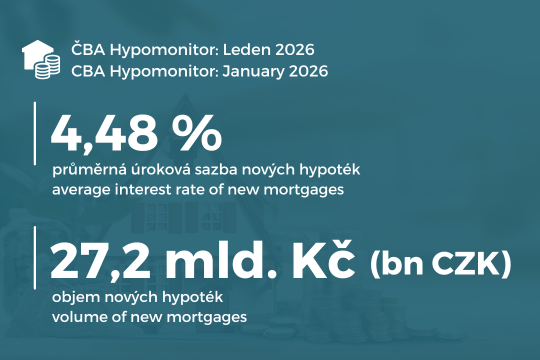
Average mortgage rate fell to 4.48%
CBA Hypomonitor: the beginning of 2026 brought strong mortgage volume ilustrační foto
Prague, 16 February 2025 - In January 2026, banks and building societies granted new mortgages without refinancing for CZK 27.2 billion. However, seasonally adjusted figures show a very strong volume of around CZK 35 billion, which is close to the previous peak at the end of 2021. However, this is not true for the number of new mortgages. These, seasonally adjusted in January, were around the levels seen in 2016-2018, but remained far from the historic 2021 level. The average realised interest rate on new mortgages fell slightly further to 4.48% from 4.49% in December, but has remained broadly stable since October last year. The share of refinanced mortgages returned to over 23% in January.

The strong mortgage volumes also reflect a continued increase in the average mortgage amount to CZK 4.51m. However, January's strong result reflects both the strength of the mortgage market at the end of last year and probably the CNB's November plan to tighten criteria for so-called investment mortgages from April this year. This, together with the continued rise in house prices above household incomes, should tend to dampen the mortgage market, while mortgage interest rates will remain more supportive through the lens of income growth. The next CNB meeting related to the setting of macroprudential mortgage policy will take place on 4 June, and before that the CNB will decide on the countercyclical capital buffer on 5 March (subsequent meetings will be held on 10 September and 26 November).

A 0.3 percentage point year-on-year drop in the mortgage rate reduces the average monthly repayment by almost CZK 800, i.e. by 0.8% of the mortgage applicant's net income. However, the increase in the average amount of the newly granted mortgage raised the average year-on-year repayment by almost CZK 3.2 thousand. CZK, i.e. by approximately 3.3% of income. The average mortgage payment probably exceeded CZK 24 thousand in January, but we estimate its median amount at CZK 19 thousand.

This information is based on data from the CBA Hypomonitor, which captures data from all domestic banks and building societies providing mortgage loans.

Table 1: Summary of mortgage origination volumes and average interest rates for January 2026

monthly values

year-to-date values

Volume
(billion CZK)

Number

Rate
(%)

Volume
(billion CZK)

Number

Rate
(%)

Total

35,5

8 154

4,48

New loans

27,2

6 015

4,48

of which:

for purchase

21,4

4 717

4,48

for construction

3,8

831

4,44

Other

2,0

467

4,57

Refinanced from another institution

6,9

1 792

4,46

Refinanced internally, increased

1,4

347

4,43

Source.

"January's new mortgage numbers may have fallen to CZK 27 billion, but the seasonally adjusted estimate points to a very strong month with new mortgages over CZK 35 billion, which would be a new monthly high. However, this is not the case since the number of new mortgages in January was around the usual values from 2016-2018," estimates Jaromír Šindel, chief economist at the Czech Banking Association.
Note: the outlook to the end of the year is momentary - it is based on the current trend, not on a model forecast.

January slowed slightly, but seasonal adjustment brought very strong numbers, but probably temporary


"January's figures show more than 50 per cent year-on-year growth and the mortgage market continues the positive trend of last year, which was the second most successful in its history.Interest rates have remained at the same level for the fourth consecutive month, slightly below 4.5%, and we do not expect a significant change in February either," says Ondřej Šuchman, product manager for mortgages at Komerční banka.

In January, banks and building societies actually granted new mortgage loans without refinancing for CZK 27.2 billion. Compared to December, new mortgage activity fell by around 5% in volume, but less than usual in January. After seasonal adjustment, January's new mortgage numbers brought a marked improvement to CZK 35.5bn compared to December's CZK 29.6bn. Not only is this well above the average volume of the previous three months (CZK 29.7bn), but it has essentially matched the peak seen at the end of 2022, when mortgage growth was driven by a desire to avoid higher interest rates. Now, the current surge in mortgage volumes seems more likely to reflect an effort to avoid the central bank' s tighter requirements for so-called investment mortgages from late November, effective this April.

The number of new mortgages in January fell 5.5% month-on-month to 6,015, 26% higher than a year ago. We estimate the seasonally adjusted number to be around 7,637, around 15% above the average number (6,653) in the previous three months. While the momentum in new mortgage numbers over the past three months implies a total number of 84k this year, up 10%, we can expect numbers to slow more from Q2 onwards, which at a 7% deceleration would bring this year's new mortgage count to around 79k, around 4% lower than a year ago. Both scenarios remain below the average numbers of around 95k from 2016 to 2018 or 114k from 2021.

"The January figures only confirm the trend we have been following since the end of last year - refinancing is gaining momentum. Compared to January last year, we are registering up to twice as much interest in refinancing. A strong wave of mortgages is now entering the remortgaging period. At the same time, more than half of these clients are leaving at rates around 3%, so they must expect a noticeable increase in interest rates in today's conditions. And an interesting extra detail?The average amount of a refinanced mortgage is also rising," expects Marek Richter, mortgage expert at Air Bank.

The share of refinanced and increased loans is growing. The volume of refinanced and increased loans (internally or from another institution) fell to CZK 8.3 billion in January. However, this is still 17% above the average 7.1 billion refinanced last year and 112% above the 3.9 billion refinanced in 2024. The share of refinanced loans in total mortgage originations then rose to 23.4%, above last year's average of 20.6%. It is thus above the 17.2% share from 2022-2023, but still below the nearly 29% share from 2020-2021, when households refinanced at a mortgage rate of 2.14%. In January 2026, households refinanced at a rate of 4.45%, but that is still 0.28 percentage points lower than the 4.73% rate a year ago. The higher refinancing volumes reflect the confluence of expiring longer fixings from the low interest rate period and shorter fixings from the recent period of higher interest rates.

Overall, banks and building societies granted new and refinanced mortgages worth CZK 35.5 billion in January, 4.4% less than a month earlier. Their total volume so far this year has reached CZK 35 billion, which represents a 57% increase compared to January of the previous year.

Chart 2: New mortgages granted without refinancing
New mortgages fell to CZK 27 billion in January, but seasonal adjustment shows a strong month

Source: CNB, CBA Hypomonitor (pre-2020 volumes are from CNB statistics).

Chart 3: Average mortgage amount by purpose
The average size of a newly granted mortgage rose slightly by almost 1% month-on-month in January and is thus 15% higher than the CZK 3.92 million in January. CZK 1.5 million a year ago.

Source: CNB, CBA Hypomonitor

Average mortgage rate fell slightly to 4.48% in January as market interest rates fell

The average realised interest rate on new mortgages fell slightly further to 4.48% in January from 4.49% in December, remaining more or less stable since October last year. Its January level is thus 0.3 percentage points lower than the 4.78% rate a year ago, which reduces monthly mortgage payments by around 0.8% of the applicant's net income, i.e. by 0.8 thousand euros. CZK. By comparison, the average mortgage rate in 2025 was 4.58% compared to 5.07% in 2024. The January mortgage rate, at 4.48%, was 1.02 percentage points above average market swap rates. This is approximately 0.04 p.p. below the long-term average since 2014 (1.06 p.p.), while in the previous three months the spread to the long-term average was -0.25 p.p.

Czech market longer-term interest rates,[1] which are a key influence on mortgage rates, fell -0.21 percentage points to 3.72% in January for five-year rates from 3.93% in December, below November's 3.95%. Over the past twelve months, Czech five-year swaps have been in a range of monthly averages of 3.29% (April 2025) and 3.95% (November 2025). Compared to the average level of five-year swaps in 2024, January rates were marginally higher. Market rates partially corrected their previous decline after the central bank's February meeting, but returned lower in the second week of February. Prior to the February central bank meeting, FRA markets were pricing in a decline in the CBR rate to around 3.15% in late summer/early autumn. However, the meeting did not confirm expectations of the onset of dovish communication. Nevertheless, the prospect of a rate cut began to be reflected in the consensus of economists. Although the CBA's new macroeconomic forecast is looking for interest rates to hold steady at 3.5% over this year and next, due to higher core inflation and looser fiscal policy, half of the CBA forecast panelists expect one cut to 3.25% over this period.

[1] These are primarily long-dated interest rate swaps (IRS), which reflect the price of money at longer maturities, such as 2 to 10 years.

Chart 4: Average mortgage interest rate - new business
January mortgage rates fell slightly to the level of last October 

Source: CNB, CBA Hypomonitor

Chart 5: The moderation in December and January inflation has lowered the inflation outlook for 2026, which has been reflected in a decline in market interest rates and eased upward pressure on mortgage rates from the end of 2025

Source: LSEG, Macrobond (12 February 2026), CBA

Impact on the average January mortgage payment of around CZK 24.2 thousand, but with a median of CZK 19 thousand

The combination of the fall in interest rates and the higher average mortgage amount in January 2026 compared to the 2025 averages increased the average monthly mortgage payment by £1.4k. Kc. The scenarios of the evolution of the monthly payment for different mortgage maturities are shown in Table 2. It suggests that a fall in mortgage rates of over 0,1 percentage point relative to their average rate of 4,58 % in 2025 has resulted in a more modest reduction in the monthly instalment of less than CZK 300 to around CZK 24,2 thousand. This is a 0.3% decrease in the applicant's net income compared to the average payment in the previous year. Compared to the average mortgage rate of 5.07% in 2024, the savings due to the interest rate amounted to less than CZK 1 600 for a mortgage at its current average value. However, the current average mortgage amount is 7% higher than its average amount in 2024, which contributes to an increase in the monthly payment of CZK 1.6k. The average monthly mortgage payment in the previous year, based on the previous year's average mortgage amount, but at the current interest rate.

Conversely, when compared to the average 2.8% mortgage rate for new mortgages in 2019, the current refinance mortgage rate of 4.45% when the loan term is shortened raises the monthly payments on the average mortgage by more than 1,600k, or about 3.3% of the current gross average wage.

Table 2: Illustration of the average and median monthly mortgage payment by maturity and interest rate

Average amount of a new mortgage in CZK:

4 513 790

Median amount in CZK:

3 761 490

Average interest rate in %:

2,0

4,0

4,48

5,0

6,0

2,0

4,0

4,48

5,0

6,0

Average monthly instalment:

Median monthly payment:

Mortgage maturity in years:

15

29 050

33 390

34 490

35 690

38 090

24 210

27 820

28 740

29 750

31 740

20

22 830

27 350

28 520

29 790

32 340

19 030

22 790

23 760

24 820

26 950

25

19 130

23 830

25 050

26 390

29 080

15 940

19 850

20 870

21 990

24 240

26,75

18 170

22 920

24 160

25 530

28 270

15 140

19 100

20 140

21 270

23 560

30

16 680

21 550

22 830

24 230

27 060

13 900

17 960

19 020

20 190

22 550

Source: CBA [1]

Note: The colored bar corresponds to the interest rate of the latest CBA Hypomonitor combined with the usual maturity, other rates are illustrative. The coloured row corresponds to the average and median maturity of new mortgages according to CBA data; amounts are rounded to the nearest ten kroner. The median repayment amount is based on the median mortgage size. It is calculated on the basis of the ratio of the average and median size of new mortgage loans over the last three quarters according to CNB statistics. The calculation also assumes an average maturity of 30 years (corresponding to the median) and an average interest rate, since the difference between the average and median rates is negligible in the long run (approximately 0.045 percentage points). The median, unlike the average, represents a "typical" value - half of the loans are lower and half are higher - and is not affected by outliers.


[1]The table is available in an xls file attached on the CBA Hypomonitor website

The average size of a newly granted mortgage has increased with January's 4.51 million. CZK is on a growth trajectory

The average size of an actual newly granted mortgage rose slightly to CZK 4.51 million in January. CZK, i.e. by almost 1% month-on-month. Its size is thus 15% higher than the CZK 3.92 million in the same period last year. CZK a year ago. A gradual decline in mortgage rates or a gradual increase in real household wages (4.5% y/y in Q3-2025 or charted here), but with slower growth in disposable income, is making it possible to achieve a higher mortgage. Also reflected here is the continued relaxation of macroprudential income limits by the CBN to date (only the 80% LTV limit applies, or 90% for applicants under 36). These will be tightened to 70% LTV and 7x DTI for so-called investment mortgages from April 2026.

Mortgage levels are then also linked to house price trends, which continued to show strong growth of almost 11% year-on-year in Q3 2025, or 16% in the case of house prices. Supply prices slowed quarter-on-quarter to 2.4% in the final quarter of 2025, the lowest increase since mid-2024. However, the pace remains above the long-term average of 1.8%. According to data from Flat Zone, the average transaction price of apartments, both new and older, in the Czech Republic reached 97.5k in Q4. This reflects a 2% quarter-on-quarter and 11.3% year-on-year increase.

Chart 6: Illustrative comparison of the average monthly mortgage payment with a year ago, depending on the interest rate, mortgage size and maturity in years
In ayear-on-year comparison, the fall in the mortgage rate resulted in a saving of CZK 770 on the average monthly mortgage payment, but the increase in the average mortgage amount caused an increase of CZK 3 150.

Source: CBA
Note: Amounts are rounded to tens of crowns.

Chart 7: Seasonality of new mortgage loans

Source: CBA Hypomonitor
Note: These are actually new mortgages (i.e. excluding refinancing and increases). The underlying data is available in the xls file attached on the CBA Hypomonitor website. The outlook to the end of the year (fcst) is a snapshot - based on the current trend, not a model prediction.

Chart 8: Distribution of new mortgage loans by purpose

Source: CBA Hypomonitor
Note: The last figure represents the average for the last 12 months.

Mortgage market to deliver strong volume growth of 41% in 2025 and nearly a quarter in numbers

In the full year 2025, banks and building societies provided new mortgage loans worth CZK 321 billion. This is CZK 93 billion more than the CZK 228 billion created in 2024. This year-on-year jump corresponds to a 41% increase. On top of that, mortgages were refinanced to the extent of CZK 85 billion, bringing the total mortgage market to CZK 406 billion in 2025 from CZK 275 billion in 2024. If we adjust the volumes for the increase in house prices of around 15-16% (according to various statistics), the volume of new mortgages grew slightly less in real terms. This corresponds to a more moderate increase in the number of new mortgages in 2025, by less than a quarter to more than 76.11 thousand, and a nearly 15% increase in the average amount of a new mortgage granted to CZK 4.21 million.

New mortgages were financed at an average rate of 4.58% in 2025, half a percentage point lower than in 2024, with the spread to the market swap rate curve less than one percentage point, slightly below the long-term average. The average monthly mortgage payment in 2025 was just under CZK 22,800, up 8.6% from 2024, and slightly above the likely more than 7% increase in average nominal wages last year. The average year-on-year increase in the monthly mortgage payment of around CZK 1,800 in 2025 mainly reflected the higher average mortgage level with an increase in the payment of almost CZK 2.9k. CZK, while the lower mortgage interest rate reduced the average monthly payment by more than CZK 1.2 thousand. CZK.

Chart 9: Annual volume, number and average amount of mortgages granted between 2020 and 2025

Source: CBA Hypomonitor
CBA publishes summary statistics for the entire banking market
The Czech Banking Association, in cooperation with its member banks, publishes new aggregate statistics on the housing market. These are mainly the volumes and numbers of newly granted and refinanced mortgages and the respective interest rate. These statistics are published by the CBA in aggregate form for the entire banking sector on a regular basis around the middle of each month. All domestic banks and building societies providing mortgages in the Czech Republic participate in the survey. The data are available from January 2020 in the attached file on the website www.cbaonline.cz, where the relevant statistics can also be found separately for banks and building societies. The above figures are for the sector as a whole, which can also be viewed in a simple graphical form on the cbamonitor.cz website.
Methodology of the CBA Hypomonitor

The CBA Hypomonitor divides mortgage loans granted by banks and building societies to households into several categories in order to distinguish new loans from refinanced or internal refixations. New loans are then reported in categories according to the purpose of the loan:

1. new loans
These are loans whose full volume enters the economy for the first time. This category does not include loan consolidations or loan refinancing. It is divided into three categories:
  • Purchase of real estate
  • Property construction - including property renovation
  • Other new arrangements - only new loans that are in no way related to the purchase or construction of the property, e.g. so-called American mortgages, settlement of a JVM, repayment of the purchase price, settlement of an inheritance share, settlement of a cooperative share, etc.
2. Refinanced loans from another financial institution
These are loans that have been originated by refinancing one or more loans from a financial institution other than the reporting one. Irrespective of the amount refinanced and regardless of the amount of any increase, the total amount of the newly originated loan is reported in this category.

3. Loans increased or internally refinanced
These are loans that were already part of the reporting entity's portfolio in the previous reporting period and have undergone one of the following changes during the reporting period:
  • an increase in the agreed amount
  • changes such that the original loan has been refinanced/converted into a new loan within the reporting entity. This is a genuinely new contract and not, for example, just a new arrangement in the context of a refixation of an existing contract. Therefore, the volume of such loans in the CBA statistics is lower than 'other new arrangements' in the Czech National Bank statistics.
The following banks and building societies provide data for the CBA Hypomonitor: Air Bank, Banka Creditas, Česká spořitelna, ČSOB, ČSOB Stavební spořitelna, Fio banka, Hypoteční banka, Komerční banka, mBank, Modrá pyramida, MONETA Money Bank, MONETA Stavební spořitelna, Oberbank, Partners Banka, Raiffeisen stavební spořitelna, Raiffeisenbank, Stavební spořitelna České spořitelna, UniCredit Bank.