Is the unchanged CNB interest rate at 3.50% a sign of the coming bonanza or the calm before the storm?
Comment by Jaromír Šindel, Chief Economist of the CBA: The central bank did not surprise by unanimously leaving interest rates unchanged, i.e. with the two-week repo rate at 3.50%, for the fifth meeting in a row after a 25bp cut in May. Although the Board did not change its view of the risks and uncertainties surrounding the CNB's November forecast, it did assess the risks to inflation as balanced, given the risks in financial markets and the removal of the renewable energy levy, following November's upside assessment.
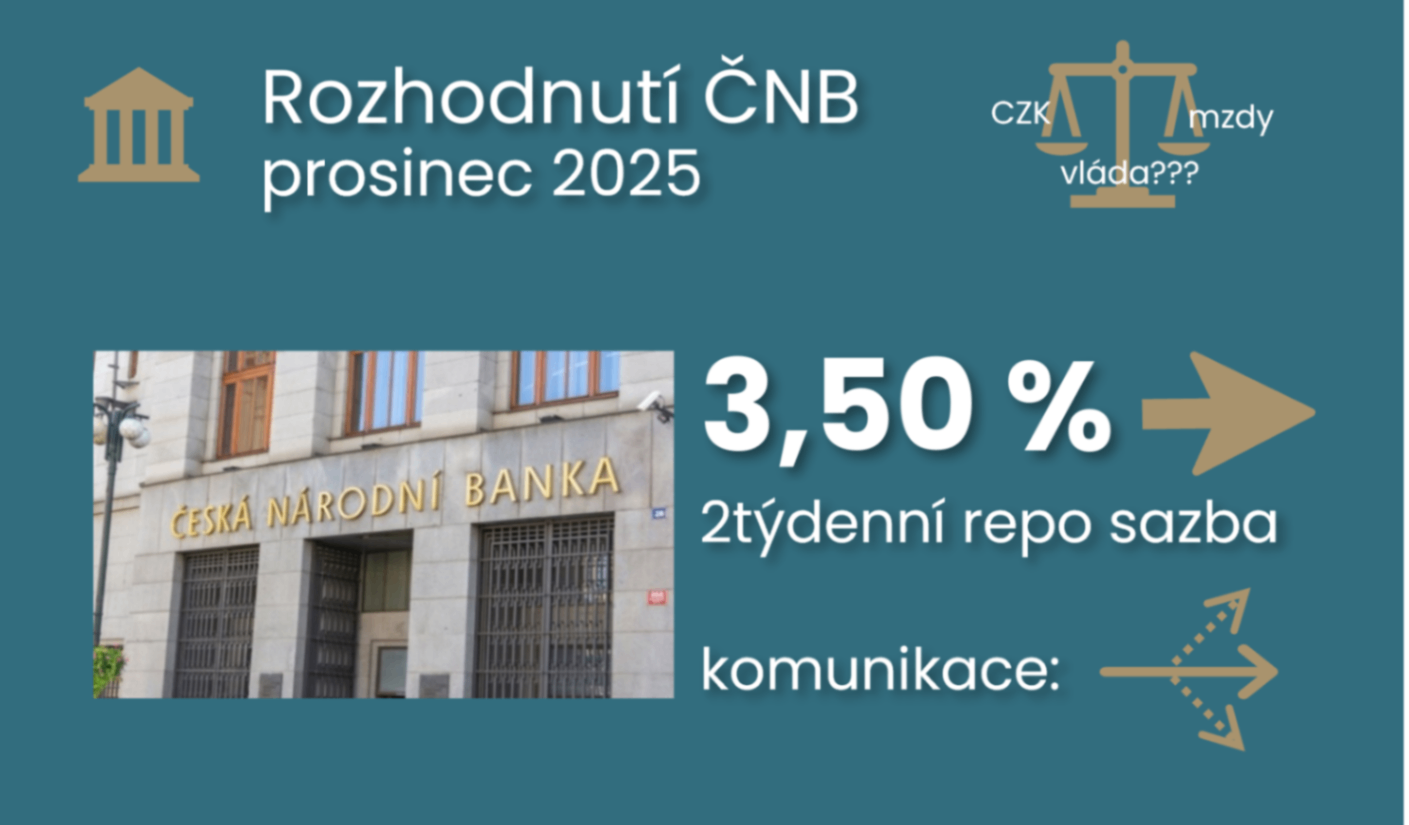
In addition, our baseline scenario assumesthat CNB interest rates remain unchanged during 2026 and probably also in 2027, for which, however, market interest rates are already pricing in an increase (approximately one 25bp increase over two years and two over three years).
The current interest rate hold reflects a mixed picture of economic data. The hawkish tone stems from stronger GDP growth without a corresponding acceleration in hourly productivity, still robust wage growth and continued (more than) brisk house price growth. In contrast, some relief in early December came from lower November inflation, including the core component, accompanied by weaker performance in the manufacturing (not consumer) part of the economy.
However, neither 2026 nor 2027 may prove as dull as our projected stability in the CBR interest rate may make it seem. And the CNB Bank Board's deliberations on both monetary and macroprudential policy settings will certainly no longer be boring. Apart from the "normal risks" that beset a small open economy, it will be mainly due to:
- the still strong growth in house prices, which is impacting both of the aforementioned CNB instruments and has already been reflected in a "hawkish" manner in monetary policy during 2025 and in November in macroprudential policy (see the commentary Higher house prices spark a richer debate over the central bank's macroprudential policy than it first appears).
- the new government's implemented mix of fiscal and structural economic policies,
- its actions in the area of energy prices will be disinflationary, although in the case of the abolition of the POZE for households, rather one-off and therefore less significant for the CNB from a monetary policy perspective. However, setting energy pricing policy for businesses may provide a longer-term disinflationary impulse that could be relevant for monetary policy at the monetary policy horizon, i.e. 12-18 months. In both cases, however, the positive income effect, driven by higher real household income net of energy expenditure, as well as the increase in corporate value added (due to lower intermediate consumption in the form of lower energy costs), also play a role. Its impact on inflation will depend on whether higher value added is translated inflationarily into wage growth or disinflationarily through higher investment activity by firms (due to a better business environment).
- Also relevant on the monetary policy horizon will be the actual fiscal impulse of the new government in the areas of social, wage and pension policy. This relationship appears at first sight to be inflationary, which the financial markets reflected after the holidays, but its impact may not be so clear-cut. See, for example, in the context of my thesis about lower government (public) sector productivity (see Chart 9 here) due to relatively and absolutely low real wages (see Charts 5 and 6 here).
- The government should, and indeed must, align the timing of its arguably looser fiscal policy with structural reforms that will support the supply side of the economy through higher productivity, so that it can avoid creating further inflationary breeding grounds that will later "reward" it - and the economy as a whole - with higher interest rates both at the short end of the yield curve (due to higher central bank rates) and at the longer end (due to higher inflation expectations).
- The monetary policy settings of other central banks, which in turn may be more disinflationary if the US Fed and Polish central bank interest rate cuts support the koruna. However, this is only on the assumption that Czech fiscal and monetary policy does not increase the Czech koruna's risk premium or weaken it through a rise in inflation expectations.
Market interest rates with longer maturities have eased somewhat with the start and size of rate hikes
The US Fed and the Polish central bank should move closer to the CNB interest rate next year, while the ECB - like the CNB - should remain unchanged
The exchange rate of the koruna against the euro (red line) seems to be "where it should be"

Comparing the key variables with the CNB forecast does not tell you to raise interest rates, but what is missing here (and in the model) is probably new fiscal policy