The CNB's hawkish wait-and-see will continue in May, but this does not hold for markets
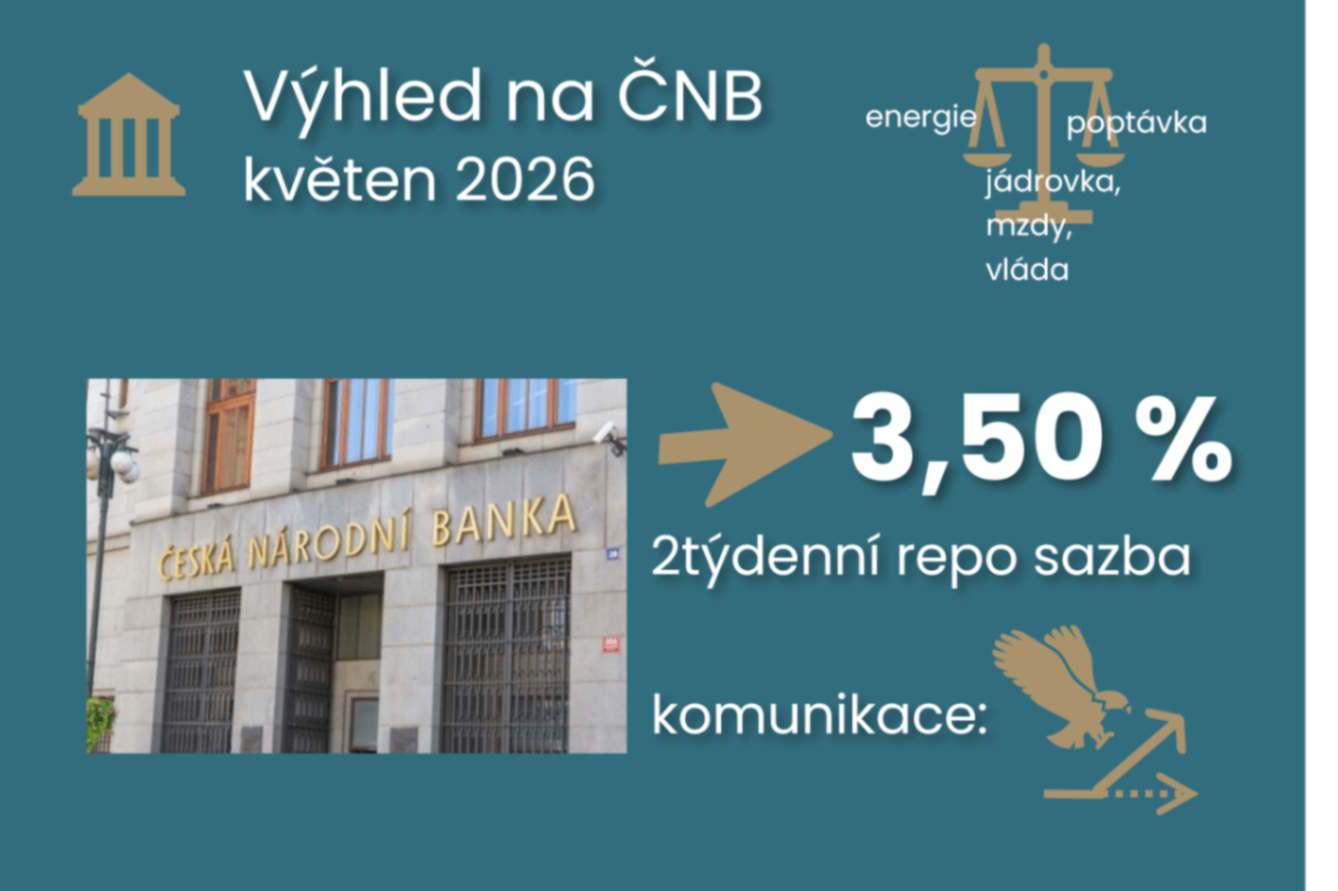
At its meeting on 7 May, the Czech National Bank is likely to leave its interest rate unchanged at 3.5% and the tone of its communication is likely to be hawkish. This will neither surprise nor offend, but neither will it please. In the meantime, long-term market rates are rising, pricing in not only an unresolved Iranian conflict but also upside risks that may allow the effects of an energy shock to seep through. This is reflected in a further rise in the long-term equilibrium interest rate, which is at levels seen in 2023 when the central bank rate was double, which is bad news for long-term investments. Data at the end of May and beginning of June will show the state of the inflationary underpinning in the Czech economy. This will be crucial not only for the market interest rate reaction but also for the monetary policy stance if the Hormuz closure continues. In the meantime, economic policy should respond with structural changes to ease long-term interest rates.
How long the CNB is willing to "sit out" the energy shock will depend not only on developments in the situation in the Strait of Hormuz, but above all on economic data and the government's fiscal policy response. However, these are also moving in an inflationary direction - see the March recovery in the momentum of core inflation and proposals to loosen fiscal rules with an uncertain outlook for the government's budget next year. This may make it easier for the second-round effects of the energy shock to seep into the economy.
Markets are reacting to the renewed rise in energy prices by "pricing in" an expected increase in the CBR interest rate to 3.75% at the August meeting and up to 4% in the last quarter of this year.
In addition, although the CNB repo rate is at 3.5%, half the level of 2023, when it stood at 7%, the 10-year interest rate swap is hovering around 4.5% due to the above factors, close to 2023 levels, when its rise was in turn dampened by tighter central bank policy. And if we look at the evolution of the implied 5y5y forward rate on interest rate swaps, they are at similar levels to the previous inflation shock in the Czech Republic and also in the euro area, although central bank interest rates are half as high.
However, the CNB is not alone in this qualitative shift. We observe a similar trend in short- and long-term rates at the European Central Bank.
The CNB will also revise its economic outlook. In addition to the baseline scenario with a slight upward revision of headline consumer inflation and a downward revision of GDP growth for this year and next year (both towards 2.5%), it is likely to offer an alternative scenario with higher inflation, slower GDP growth and a monetary (probably tighter - although the previous forecast assumed a modest cut in the interest rate, it also indicated a relatively rapid move to 4% in 2027) and fiscal policy response (probably looser, with the previous forecast assuming a structural deficit of almost 3% in 2027). The market reaction will then suggest what it thinks about the CNB's ability to ride out the current energy shock.
Key charts
Core inflation returned to higher momentum in March, including a March rebound in core services after their surprising slowdown in January and February

Although CNB or ECB interest rates are at half the level of three and four years ago, implied long-term equilibrium rates are at similar levels (which is not the case for Poland or Hungary) and about one percentage point above the current interest rate

The core CPI slightly undershot the CNB's forecast in Q1, but this does not hold for wages, their relative performance to productivitiy or for oil prices


The EURCZK is now reacting to oil in a similar way to natural gas four years ago

However, the CNB is not alone in this qualitative shift. We observe a similar trend in short- and long-term rates at the European Central Bank.


The oil price shock is comparable to 2022 ( though smaller than the cumulative change from 2020 to 2022), but still significantly smaller in the case of natural gas (and hence electricity) prices or global food prices


Economic growth
Economic sentiment remains resilient, although already diverging across sectors in April

The CNB Momentum Index remains indicative of slightly weaker momentum than at the close of 2025 ...

Which is also true for the monthly data, which (not only because of negative net exports) indicate ...

... also slower GDP growth

