March core inflation showed the CNB unpleasant news
The March acceleration in consumer price inflation to 1.9% was not surprising in itself, but the acceleration in core inflation to 2.9% was less favourable, including the momentum across key segments. This indicates that price pressures in the domestic economy remain strong, especially for labour-intensive services and imputed rents, but also the koruna no longer provides a disinflationary factor for goods prices, amid strong household demand. For the Czech National Bank, the March core inflation is a hawkish signal that may reinforce interest rate growth expectations, especially if the current energy shock persists.
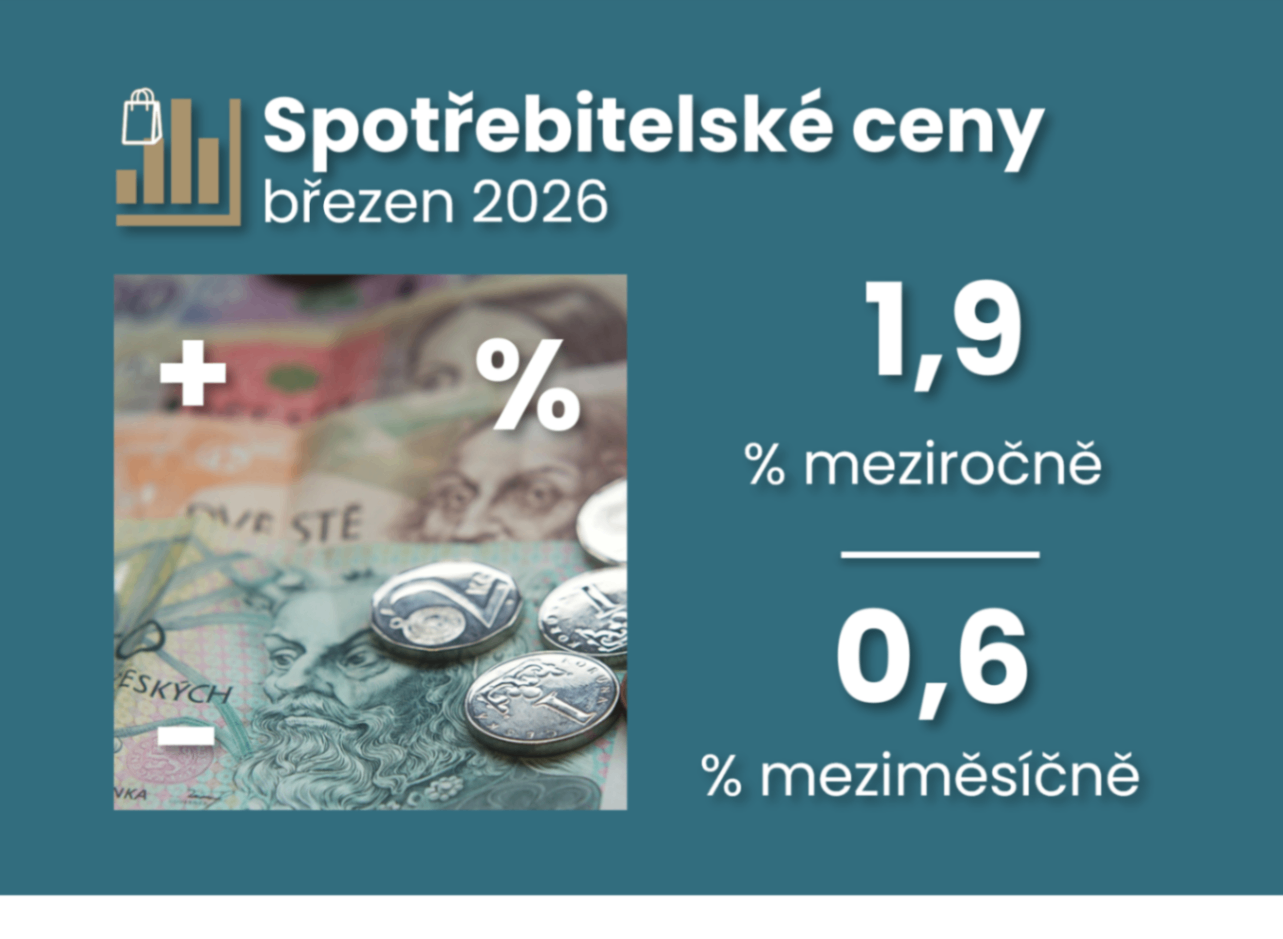
While the March acceleration in consumer prices to 1.9% year-on-year was not surprising, the acceleration in core inflation to 2.9% was less pleasant, including its composition. Higher oil prices and the unwelcome impact on consumer price acceleration from February's 1.4% y/y increase were dampened by lower food prices.
However, core inflation (excluding food, fuel and energy) accelerated from February's 2.6%. Its acceleration to 2.9% in March is one tenth more than the preliminary estimate suggested and than the CNB expected for March.
By my estimates, this implies a month-on-month acceleration in core inflation of over 0.3%, rather near 0.4% from January's 0.2%, reflecting strong growth in imputed rents, but also an acceleration in prices of core goods (admittedly to 0.2%, but their prices have been essentially unchanged on average over the past year).
This is compounded by again stronger growth in prices of core services. Although at 0.3% m-o-m it does not represent a key risk for the CBN, our estimate points to persistently stronger growth in prices of labour-intensive services, consistent with persistently stronger growth in unit labour costs in the economy. And industrial wage growth in the new year so far suggests no change, although its momentum is slower than the economy-wide wage growth of late last year.
All in all, this is a hawkish signal which, in my eyes, confirms that January's expectation of an interest rate cut was a dead end and which, in turn, may intensify the hawkish calls in the Czech central bank if the situation with energy prices does not calm down.
While the March acceleration in consumer prices to 1.9% year-on-year was not surprising, the acceleration in core inflation to 2.9% was less pleasantly surprising

The higher oil price was dampened by lower food prices.

By my estimates, this implies a month-on-month acceleration in core inflation of over 0.3% across key segments

With annualized core inflation far from the inflation target, largely due to imputed rents

While core services show slightly less momentum, labour-intensive services do not confirm this

And industrial wages maintained solid momentum in the new year
