The economy slowed in the first quarter, but its structure remains encouraging
The Czech economy grew by 0.2% quarter-on-quarter in Q1. The weaker result was mainly due to technical factors, including the negative contribution of net exports and the budget provisionality. However, the structure of growth remains favourable thanks to continued growth in household consumption, investment and exports. In addition to the Iran war, weaker industry and persistent wage inflation pressures with slower productivity growth pose risks to the recovery to 2% economic growth this year.
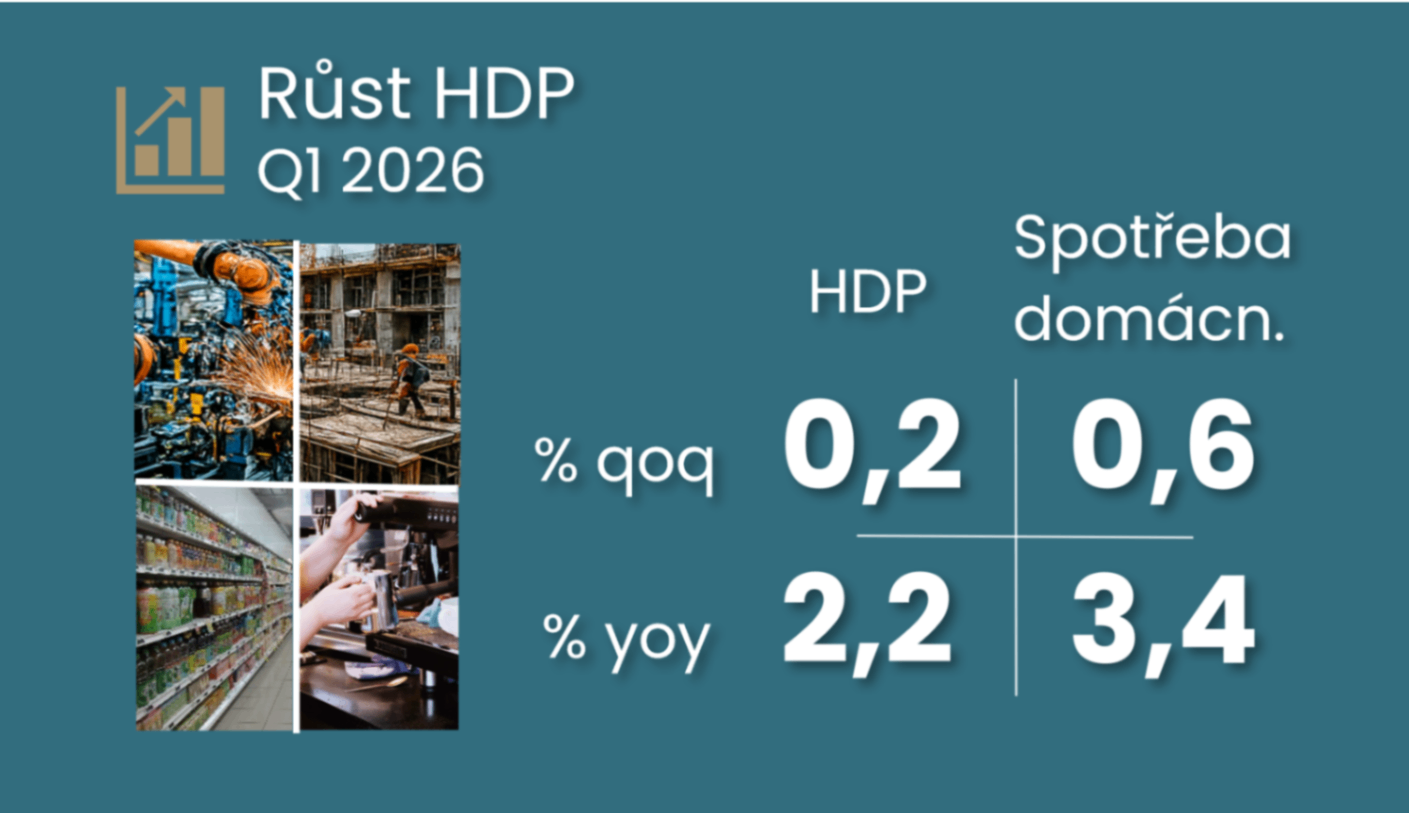
The Czech Statistical Office confirmed the flash estimate of 0.2% quarter-on-quarter economic growth in the first quarter of this year. This worse result, after an average quarter-on-quarter improvement of 0.7% last year, is in line with expectations, although better March data from the retail and construction sectors suggested the possibility of slightly stronger growth.
However, the better March numbers were reflected in the growth structure itself, which looks relatively favourable. Household consumption continued to support the economy, adding 0.6% quarter-on-quarter after 1.2% at the end of last year. The services sector also played a significant role.
Fixed investment, particularly in transport equipment, also contributed positively. By contrast, investment in construction and machinery and equipment stagnated.
Industry, including manufacturing, fell by 0.7% at the start of the year, following a surprisingly strong recovery at the end of last year.
Net exports, the difference between exports and imports, reduced GDP growth by 1 percentage point. This reflects higher inventory formation (+0.5 pp) but also still solid domestic demand. Nevertheless, exports were a pleasant surprise, adding almost 4% quarter-on-quarter.
The budget proviso also contributed to the weaker economic momentum, leading to a decline in government consumption. This reduced quarter-on-quarter GDP growth by 0.1 percentage point.
Thus, on a year-on-year basis, due to the moderation in quarter-on-quarter growth, the economy slowed to 2.2% from 2.7% at the end of last quarter (having added 2.6% last year after 1.1% in 2024). This was underpinned by a 3.4% increase in household consumption spending in Q1 (although the current annualized pace was 2.4%) and a 7.3% y/y jump in fixed investment, which was followed by a near 6.4% jump in exports.
The weak quarter-on-quarter growth of the economy, however, was accompanied by a 0.4% increase in employment. However, this growth was not fully exploited by the increase in hours worked. Thus, labour productivity in the economy was essentially stagnant. However, compensation of employees, i.e. their gross wages including insurance premiums, continued to grow at a brisk 2.5%.
This was again reflected in an inflationary increase in unit labour costs, which was again stronger than the central bank had expected in its forecast. This included their stronger pace in market services, which is consistent with brisk price increases in the labour-intensive consumer services segment.
The more technical nature of the slowdown in GDP growth (see negative net exports vs. rising exports and the impact of the budget proviso) in Q1 is in line with the expectation of a gradual return to slightly stronger GDP growth portrayed in the CBA's May Forecast, which foresees a slower 2% growth in the Czech economy this year followed by 2.4% in 2027.
A milder recovery is also suggested by May sentiment, especially due to stagnant industrial confidence and a drop in plans for larger household purchases. The prolonged closure of the Strait of Hormuz poses downside risks, which we have indicated in our 1.6% outlook for Czech economic growth this year.
Stronger growth in unit labour costs poses an upside risk to the outlook for core inflation, reflected in the CBA's forecast of core inflation at 2.6% y/y in 2027, above the CNB's 2.2% forecast.
Economic growth slowed to 0.2% growth ...
... which, however, largely reflects a fall in net exports despite still strong export growth and solid growth in household consumption
The supply side showed continued growth in private services, while industry offset a stronger finish to last year and construction stagnated 
The economy is benefiting from continued export and investment activity underpinned by a solid recovery in consumption
However, it is tempered by more modest gains in productivity, implying stronger growth in unit labour costs
Productivity relies on its strengthening in the financial and ICT sectors, but it needs support from other sectors, especially including manufacturing
Nominal wage growth of 1.3% quarter-on-quarter reflected a decline in public services, while private services as well as industry and construction showed a strong pace 
Investment in the first quarter was underpinned by stronger investment in transport equipment, but investment in machinery stagnated 
Growth in unit labour costs exceeded the CNB forecast ... 
... and its pace in business services is in line with the still strong pace of consumer prices in labour-intensive services 
Despite the strong contribution of stocks, they can continue to support economic growth 
Profit margins in the economy have fallen somewhere due to the decline in activity, but the main reasons are persistent higher wage growth and low productivity