Low inflation may be misleading. Domestic pressures could prompt the CNB to raise interest rates.
Consumer price inflation slowed to 2.1% year on year in May, close to the CNB's target. However, domestic inflationary pressures continue to operate beneath the surface. Core inflation remained at 2.9% y/y and its short-term dynamics suggest an acceleration closer to 4%. The latest economic numbers do not suggest a reversal and thus a relief of the inflationary nature of the Czech economy due to strong wage growth and weak productivity growth. This constellation, together with the ongoing Iranian conflict, reinforces the rationale for a 0.25 percentage point increase in the central bank's interest rate to 3.75% at the June meeting. This will not be an easy decision for the Board.
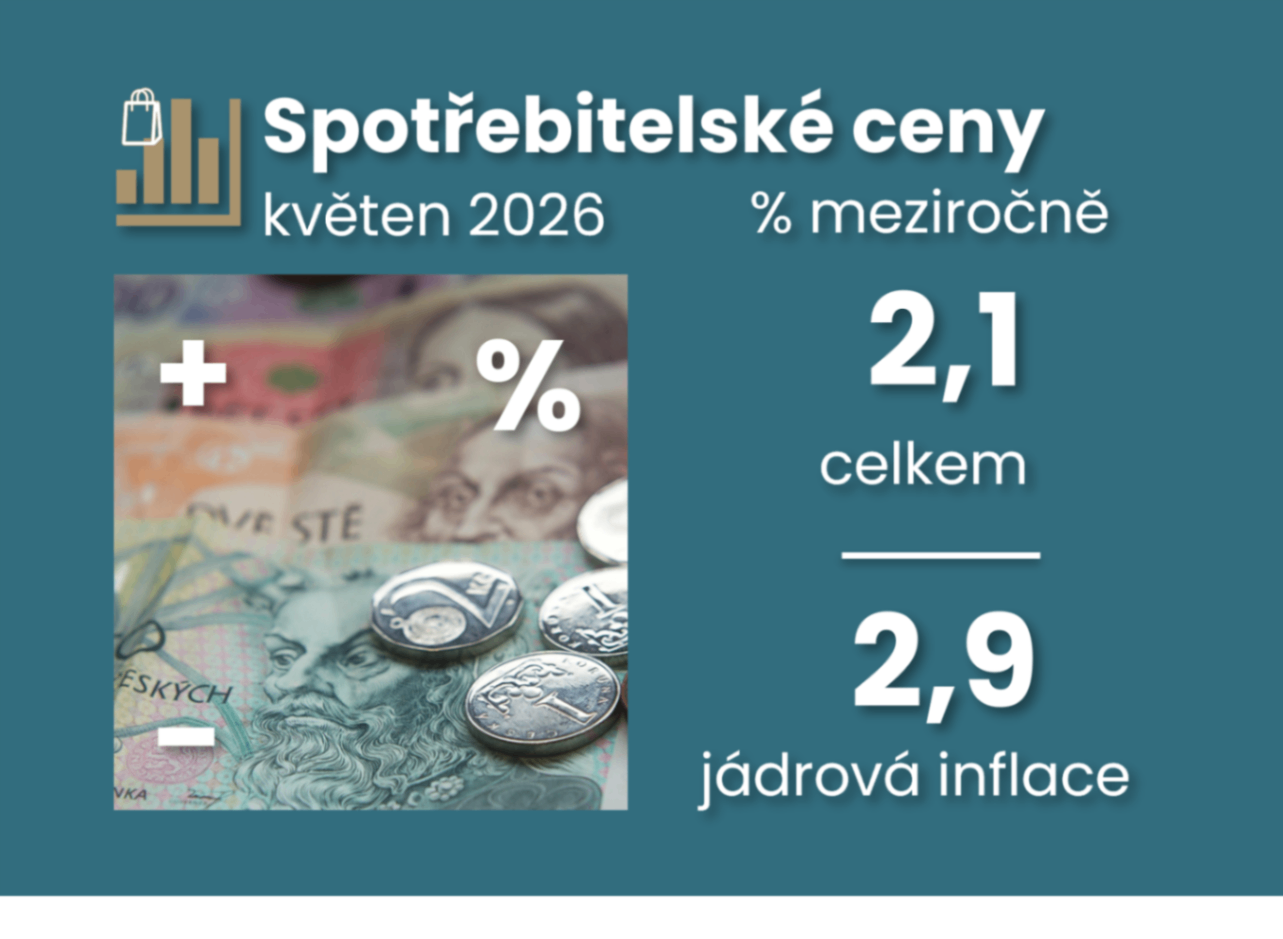
The CNB's June interest rate hike to 3.75% will not be easy for the Board, due to the unclear future developments with a possible disinflationary scenario and also due to recent communication pressure from the Prime Minister, accompanied by less clear communication from the central bank.
1) Part of the Board will take into account the possibility of a negative impact of the Iranian conflict on foreign demand, which is an intuitive and legitimate disinflationary factor in the case of the small open Czech economy. However, this factor could be offset by a looser local fiscal policy. This reason is likely to intensify in the event of a negative energy shock to economic activity, probably not only in the Czech Republic but also in Europe.
2) An interest rate hike with one of the lowest consumer price increases in the EU and essentially on target for the central bank will pose a communication challenge for the CNB. Both to the public and to the government. Indeed, its chairman has seen the low consumer price growth in the EU in recent weeks as the reason for bringing the CNB interest rate closer to the ECB. However, the ECB is likely to raise its deposit rate in June, which would narrow the current 1.5-point interest rate differential. Currently, the CNB is at 3.5% vs. the ECB deposit rate at 2%.
3) I sense a change in sentiment in conversations with foreign investors in recent days. Investors are more confident of a rate hike in June given the CNB's communication, whereas they also did not expect such a hike in May due to the CNB's communication. This is consistent with the forward market's keen pricing of a June CNB rate hike, which expects the CNB rate to rise to 4.5% at the nine-month horizon.
Core inflation growth in May was admittedly slightly higher than expected in the CNB's baseline forecast scenario. However, persistent pressure from service prices and stronger growth in unit labour costs pose a problem for the CNB's forecast. Moreover, the CNB forecast is "fighting" higher core inflation with a higher CNB interest rate of around 4%. To avoid the risk of a future needed interest rate hike as priced in by the market, the CNB may decide to dampen rising core inflation now. Such a move, accompanied by clear communication, can dampen the impact of a CNB rate hike on long-term interest rates.
A stronger koruna with still solid export activity (the foreign trade surplus is smaller, but this is more a question of domestic demand) may also help disinflation. Here, both a higher CNB rate and a possible increase in the volume of regular sales of CNB foreign exchange reserve proceeds from the current EUR 300mn per month may play a role, but this is unlikely to be on the table in June.
The slowdown in consumer inflation towards the CNB's target reflects the asymmetric effect of energy and food prices, while core inflation (excluding food, energy, fuels and administered prices) maintains an inflationary picture driven by services and labour prices. For a closer look at the risks to food prices and wage growth, see here: lower May inflation with stronger wage growth poses a triple dilemma for the CNB. On weak productivity growth, see here: the economy slowed in Q1, but its structure remains encouraging, even for inflation.


Growth in core inflation has picked up again in recent months, with annualized growth both above the inflation target and well above the CNB's forecast at the monetary policy horizon.


Composition and drivers of the May increase in Czech consumer prices


Comparison of the CNB's forecast with reality: core inflation rate in line, but wage growth without productivity represents an inflationary impulse
