CBA Hypomonitor: A slight increase in the mortgage rate to 4.67% sustained solid activity in May
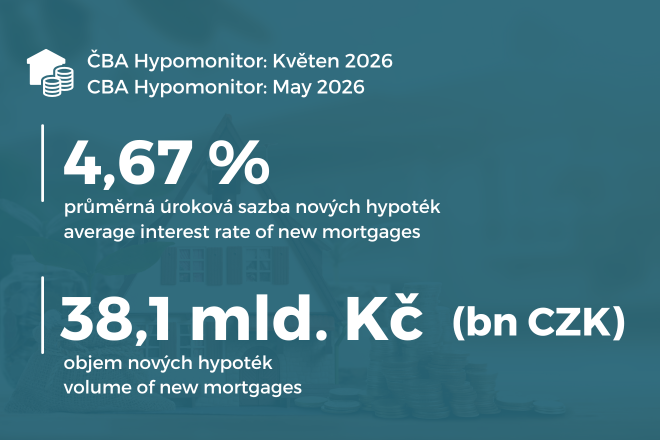
In May 2026, banks and building societies actually issued new mortgages (excluding refinancing) totaling CZK 38.1 billion.
CBA Hypomonitor: A slight increase in the mortgage rate to 4.67% sustained solid activity in May ilustrační foto
Prague, June 12, 2026 – In May 2026, banks and building societies issued new mortgages (excluding refinancing) totaling CZK 38.1 billion. Compared to April, activity declined by 14% in terms of volume, reflecting a correction following the strong performance of the previous months this year. Since the beginning of the year, the total volume has reached CZK 179 billion, which is CZK 59 billion more than a year ago. The average interest rate on new mortgages rose further to 4.67% from 4.52% in April, which, however, represents a relatively modest increase compared to market interest rates. This information is based on data from the CBA Hypomonitor, which tracks data from all domestic banks and building societies providing mortgage loans.

The May figures were likely influenced by efforts to avoid higher interest rates following a pre-stocking effect, due to the CNB’s tightening of conditions for so-called investment mortgages in April. This left the average mortgage size above 4.7 million crowns, which is also reflected in higher monthly payments. In May, the monthly payment for newly granted mortgages exceeded 26,000 crowns, while the median stands at around 21,000 crowns.

The next CNB meeting regarding the setting of macroprudential mortgage policy will take place on September 10. While the settings remained unchanged in June, the Bank Board decided to increase the countercyclical capital buffer by 0.25 percentage points to 1.5% starting in July 2027. For more details, see CNB Tightens Banks’ Capital Buffer. Responding to Faster Loan Growth and New Risks

Table 1: Summary of the volume of mortgages granted and average interest rates for May 2026

Monthly figures

Values since the beginning of the year


volume (CZK billion)

Number


rate (%)

Volume
(CZK billion)

Number


rate (%)

Total

52.6

11,449

4.63

245.3

54,434

4.50

New loans

38.1

7,871

4.67

179.4

37,727

4.52

of which:

for the purchase

26.2

5,399

4.68

129.5

27,281

4.51

for construction

7.5

1,557

4.59

29.2

6,188

4.47

other

4.4

915

4.77

20.7

4,258

4.59

Refinanced from another institution

12.4

3,095

4.50

55.6

14,205

4.43

Refinanced internally, increased

2.1

483

4.64

10.3

2,502

4.47

Source: CBA Hypomonitor. Note: seasonally unadjusted data

“Mortgage activity slowed in May, which is not surprising given the likely strong build-up in demand in previous months. However, both the number of new mortgages—over 7,000—and the volume—around 35 billion—remained higher than at the end of last year after seasonal adjustment. This was also aided by a relatively modest increase in mortgage interest rates to 4.67% for new mortgages and 4.5% for external refinancing,” adds Jaromír Šindel, chief economist of the Czech Banking Association.
Note: The outlook for the rest of the year is based on current conditions—it reflects the current trend rather than a model-based forecast. However, it anticipates a 7% decline in the number of mortgages for the remainder of the year.
Activity slowed in May but returned to the still-strong levels seen at the end of last year

Overall, banks and building societies reported new unconsolidated business in the form of new and refinanced mortgages totaling CZK 52.6 billion in May, which is 14.5% less than a month ago. Year-over-year, it rose by 54%. Their total volume so far this year has reached CZK 245 billion, representing a 66% increase compared to January through May of the previous year.

In May, banks and building societies actually provided new mortgage loans (excluding refinancing) totaling CZK 38.1 billion. Compared to April, new mortgage activity thus declined by approximately 14% in volume, reflecting a correction following the strong previous months of this year. This also corresponds to seasonally adjusted figures. This resulted in a 12.7% decline to CZK 35.4 billion compared to April’s CZK 40.5 billion and is also below the average volume of the previous three months (CZK 36.7 billion). However, the volume of newly granted mortgages in May reached a level approximately 46% higher than in the first half of last year and also remains at the average volume of CZK 30 billion seen in the final quarter of last year.

The number of new mortgages in May also fell by 13% month-on-month to 7,871, which is nevertheless still 20% higher than a year ago. We estimate that, after seasonal adjustment, the number stands at around 7,284, approximately 6% below the average (7,729) for the previous three months. Since the beginning of the year, the number of new mortgages has reached 37,700, which is more than a quarter higher than last year. The growth in the number of new mortgages over the last three months—March through May—would imply an increase of over 92,000 this year. That would be close to the levels seen from 2016 to 2018, but still well below the 114,000 recorded in 2021. However, following the CNB’s tightening of conditions in April, a lower number of new mortgages can be expected. With a 7% downward adjustment to the number of new mortgages by year-end, this would bring the total for this year to around 81,000, which would be 6.3% more than last year.
“The mortgage market continues to face pressure from external factors. The current geopolitical situation in the Middle East is contributing to uncertainty in the financial markets and keeping mortgage interest rates at elevated levels. Unfortunately, we do not yet see any clear signs that the situation will improve significantly in the near future,” adds Michal Neubauer, mortgage specialist at UniCredit Bank.

Chart 2: Newly Granted Mortgages (Excluding Refinancing)
May saw more moderate, but still above-average volumes, even as a percentage of economic output.
Source: Czech Banking Association, CNB, CZSO, Flat Zone.
Chart 3: Average Mortgage Amount by Purpose
In May, it rose slightly, then fell by 1% month-on-month, but remains 17% higher than the CZK 4.15 million recorded a year ago.

Source: CNB, CBA Hypomonitor
The volume of refinanced and increased loans (whether internally or from another institution) fell to CZK 14.5 billion in May.

However, this is 105% more than the average of CZK 7.1 billion refinanced last year and nearly three times the refinancing volume in 2024. The share of refinanced loans in the total volume of mortgages granted then fell slightly below 28%, but remains significantly above last year’s average of 21%. This places it above the 17.2% share from 2022–2023, though still below the nearly 29% share from 2020–2021, when households refinanced at a mortgage rate of 2.14%. In May 2026, households refinanced at an interest rate of 4.52%, which is still 0.05 percentage points lower than the 4.57% rate a year ago. This rate also rose less than the interest rate on new mortgages. Higher refinancing volumes reflect the convergence of expiring longer-term fixed-rate periods from the era of low interest rates and shorter-term fixed-rate periods from the recent period of higher interest rates. For more on the rising wave of refinancing, see CBA Focus: The wave of mortgage refinancing is gaining momentum, but the interest rate shock is subsiding. Higher inflation remains a risk.
“The mortgage market remains active, but the main concern for clients is no longer just the interest rate itself. Rising property prices are playing an increasingly significant role, as they increase both the average mortgage amount and the requirements for down payments. Rates continued to fall slightly from January through March, but rose again in April, a trend reflected in our offerings. Further significant rate cuts are being constrained by trends in longer-term market rates. From the clients’ perspective, therefore, the key factors in the coming months will be not only the rate itself, but primarily the overall affordability of the payments and sufficient financial reserves. “We continue to see strong demand in the real estate market amid limited supply, which is keeping prices high—particularly for apartments—and further complicating housing affordability,” notes Miloš Jelínek, head of mortgage lending at Fio Bank.
The average mortgage rate rose to 4.67% in May, a relatively modest increase compared to the rise in market interest rates

The average interest rate on new mortgages rose further in May to 4.67% from 4.52% in April. The May rate is 0.07 percentage points higher than the 4.6% rate a year ago, which increases monthly mortgage payments by CZK 200, or approximately 0.2% of the applicant’s net income. For comparison, the average mortgage rate was 4.58% in 2025 and 5.07% in 2024.

At 4.67%, the May mortgage interest rate was only 0.36 percentage points above average market swap rates. This is significantly 0.7 percentage points below the long-term average one-percentage-point spread between mortgage and market interest rates (since 2014, this average spread has been 1.05 percentage points). Maintaining a similar spread in June would imply a mortgage rate of around 4.75% given current market interest rates. In our study, we highlighted structural factors—primarily the strength of demand in a competitive market—that influence the impact of market interest rates on mortgage rates.

Among the domestic factors that primarily influenced the development of interest rate swaps were persistently high core inflation, higher wage growth without corresponding labor productivity gains, and the ongoing uncertainty surrounding the Strait of Hormuz. This is reflected in market expectations of a CNB interest rate hike. For more on these factors, see the analyses on CBA Monitor: Low inflation is misleading. Domestic pressures may force the CNB to raise rates; Lower May inflation amid stronger wage growth presents a threefold dilemma for the CNB; The economy slowed in the first quarter, but its structure remains encouraging.

Czech longer-term market interest rates,¹ which have a key influence on mortgage rates—where three-year fixed-rate terms predominate—remained high in June as well. Czech five-year interest rate swaps rose by 0.2 percentage points in May to 4.39% from 4.19% in April and remained above March’s 4.19%. Their preliminary June levels exceeded 4.4%, which are again the highest values in the last twelve months, while the lowest values were around 3.54% last June. In the case of U.S. five-year interest rate swaps, they rose to 4.13% in May from 3.89% in April and were 0.27 percentage points above their 2025 average. Euro-denominated five-year swaps rose to 2.89% in May from 2.85% in April and were 0.55 percentage points above their average level of 2.34% last year.

1 These are primarily long-term interest rate swaps (IRS), which reflect the cost of money over longer maturities—in recent years, around 3 to 5 years— but the entire 2- to 10-year curve remains relevant, even though 10-year maturities are less relevant due to higher central bank rates compared to the previous decade, as well as due to the costs incurred upon early mortgage repayment.
Chart 4: Average Mortgage Interest Rate – New Loans
May mortgage rates began to reflect the rise in market rates to some extent …

Source: CNB, CBA Hypomonitor
Chart 5: The U.S. attack on Iran has significantly increased market swap rates
… which have surpassed mid-2024 levels due to the unresolved situation in the Strait of Hormuz
Source: LSEG, Macrobond (June 10, 2026), CBA
The impact on the average monthly mortgage payment is over 26,000 CZK, though the median is around 21,000 CZK

The combination of rising interest rates and higher average mortgage amounts in May 2026, compared to the average values from 2025, increased the average monthly payment on newly issued mortgages by CZK 3,600. Table 2 illustrates scenarios for the development of monthly payments for various mortgage terms. This suggests that an increase in mortgage rates of nearly 0.1 percentage point from their average of 4.58% in 2025 resulted, for an average mortgage size with its typical repayment term of approximately 26.9 years, an increase in the monthly payment of just under CZK 200 to approximately CZK 26,300, or 0.2% of the applicant’s net income compared to the average payment last year.

Compared to the average 2.33% mortgage interest rate for new mortgages in 2021, the current refinancing rate of 4.52% , when the loan term is shortened, increases monthly payments on an average mortgage by nearly CZK 3,100, or about 5.9% of the current average gross wage. We discussed the impacts and circumstances in Fokus CBA: The wave of mortgage refinancing is growing, but the interest rate shock is subsiding. Higher inflation remains a risk.

Table 2: Illustration of monthly payments for an average and median mortgage based on loan term and interest rate
Source: CBA (the table with values is available in an XLS file attached to this report)
The average size of newly issued mortgages remained above CZK 4.8 million in May

The average size of newly originated mortgages fell slightly in May to CZK 4.84 million, a decrease of nearly 1% month-over-month. However, it is still 17% higher than the CZK 4.15 million recorded a year ago, marking a slight slowdown from April’s 20% year-on-year increase. The higher average mortgage size at the beginning of this year likely reflects the lingering effect of pre-stockpiling for so-called investment mortgages, where the CNB tightened requirements in April (LTV to 70% and DTI to 7x). At the same time, the pre-stocking effect will likely remain relevant due to the shift in market interest rates, i.e., the continued use of lower mortgage interest rates. Also playing a role in the background is the gradual growth in real household wages (8.1% year-on-year in Q1 2026; see chart here).

The size of mortgages is also linked to the development of real estate prices, which continued to grow strongly in the fourth quarter of 2025, with a year-on-year increase of nearly 11%. Asking prices in the first quarter of 2025 accelerated slightly to 2.7% quarter-on-quarter, which still exceeds their long-term average increase of 1.8%. According to data from Flat Zone, the average transaction price of apartments, both new and older, in the Czech Republic reached CZK 97,500/m² in the fourth quarter of 2025 (see charts on CBA Monitor), reflecting a 2% quarter-on-quarter and 11.3% year-on-year increase.

Chart 6: Illustrative comparison of monthly payments for the current average newly issued mortgage versus the same period a year ago, based on the interest rate, loan amount, and loan term in years
In a year-over-year comparison, the decline in mortgage rates resulted in a savings of CZK 210 on the average monthly payment; however, the increase in the average mortgage amount caused it to rise by CZK 3,760.
Source: CBA. Note: Amounts are rounded to the nearest ten crowns.
Statistical Appendix
Chart 7: Seasonality of New Mortgage Loans

Source: CBA Hypomonitor

Note: These are truly new mortgages (i.e., excluding refinancing and loan increases). The underlying data is available in an XLS file attached to the CBA Hypomonitor website. The outlook through the end of the year (fcst) is momentum-based – it is based on the current trend, not on a model prediction. However, for the remainder of the year, it anticipates a 7% correction in the number of mortgages.

Chart 8: Breakdown of New Mortgage Loans by Purpose
Source: CBA Hypomonitor
Note: The latest figure represents the average for the past 12 months. The interpretation of the “other” segment may be distorted by the inclusion of so-called mortgages without real estate, arranged without a specific purpose. For more details, see the methodological note below.

The mortgage market in 2025 saw strong growth of 41% in volume and nearly a quarter in the number of loans

Throughout 2025, banks and building societies provided new mortgage loans totaling CZK 321 billion. This is CZK 93 billion more than the CZK 228 billion generated in 2024. This year-over-year jump corresponds to a 41% increase. In addition, mortgages totaling CZK 85 billion were refinanced, bringing the total mortgage market to CZK 406 billion in 2025, up from CZK 275 billion in 2024. If we adjust the volumes for the rise in apartment prices of around 15–16% (according to various statistics), the volume of new mortgages increased by slightly less in real terms. This also corresponds to a more moderate increase in the number of new mortgages in 2025—by just under a quarter to more than 76,110—and a nearly 15% increase in the average amount of new mortgages granted to CZK 4.21 million.

New mortgages in 2025 were financed at an average interest rate of 4.58%, which was half a percentage point lower than in 2024, while the spread relative to the market swap yield curve reached just under one percentage point, which is slightly below the long-term average. The average monthly mortgage payment in 2025 reached just under CZK 22,800, which is 8.6% more than in 2024, and slightly exceeded last year’s increase in the average nominal wage, which was likely more than 7%. The average year-over-year increase in the monthly mortgage payment of approximately CZK 1,800 in 2025 primarily reflected a higher average mortgage amount, with an increase in the payment of nearly CZK 2,900, while the lower mortgage interest rate reduced the average monthly payment by more than CZK 1,200.
Chart 1: Annual volume, number, and average amount of mortgages granted from 2020 to 2025

Source: CBA Hypomonitor

The Czech Banking Association Publishes Aggregate Statistics for the Entire Banking Market

The Czech Banking Association, in cooperation with its member banks, publishes new summary statistics on the housing market. These primarily cover the volumes and numbers of newly granted and refinanced mortgages, as well as the corresponding interest rates. The CBA publishes these statistics in aggregated form for the entire banking sector on a regular basis, typically around the middle of each month. All domestic banks and building societies providing mortgages in the Czech Republic participate in the survey. The data is available starting in January 2020 in the attached file at www.cbaonline.cz, where the relevant statistics can also be found separately for banks and building societies. The figures above are for the sector as a whole and can also be viewed in a simple graphical format on the website cbamonitor.cz.
Methodology of the CBA Hypomonitor

The CBA Hypomonitor categorizes mortgage loans provided by banks and building societies to households into several categories to distinguish new loans from refinanced loans or internal rate adjustments. New loans are then reported in categories based on the purpose of the loan:

1. New Loans
These are loans whose entire volume enters the economy for the first time. This category does not include loan consolidation or loan refinancing. They are divided into three categories:
  • Real estate purchase
  • Real estate construction – including real estate renovation
  • Other new agreements – only new loans that are not related to the purchase or construction of real estate (which does not apply in the case of so-called mortgages without real estate agreed without a purpose), i.e. so-called American mortgages, settlement of SJM, refund of the purchase price, settlement of inheritance shares, settlement of cooperative shares, etc.
2. Refinanced loans from another financial institution
These are loans created by refinancing one or more loans from a financial institution other than the reporting one. Regardless of the amount refinanced and regardless of the amount of any increase, the total amount of the newly created loan is reported in this category.

3. Increased or internally refinanced loans
These are loans that were already part of the reporting entity’s portfolio in the previous reporting period and for which one of the following changes occurred during the reporting period:
  • an increase in the agreed amount
  • changes occurred such that the original loan was refinanced/converted into a new loan within the reporting entity. This constitutes a truly new contract, not merely a new arrangement within the framework of a refixation of an existing contract. Therefore, the volume of such loans in the CBA statistics is lower compared to “other new arrangements” in the Czech National Bank’s statistics.
Data for the CBA Hypomonitor are provided by the following banks and building societies: Air Bank, Česká spořitelna, ČSOB, ČSOB Stavební spořitelna, Fio banka, Komerční banka, mBank, Modrá pyramida, MONETA Bank, Oberbank, Partners Banka, Raiffeisen stavební spořitelna, Raiffeisenbank, UniCredit Bank.