Mortgage standards have tightened, but not only strong demand has mitigated the impact on lending conditions
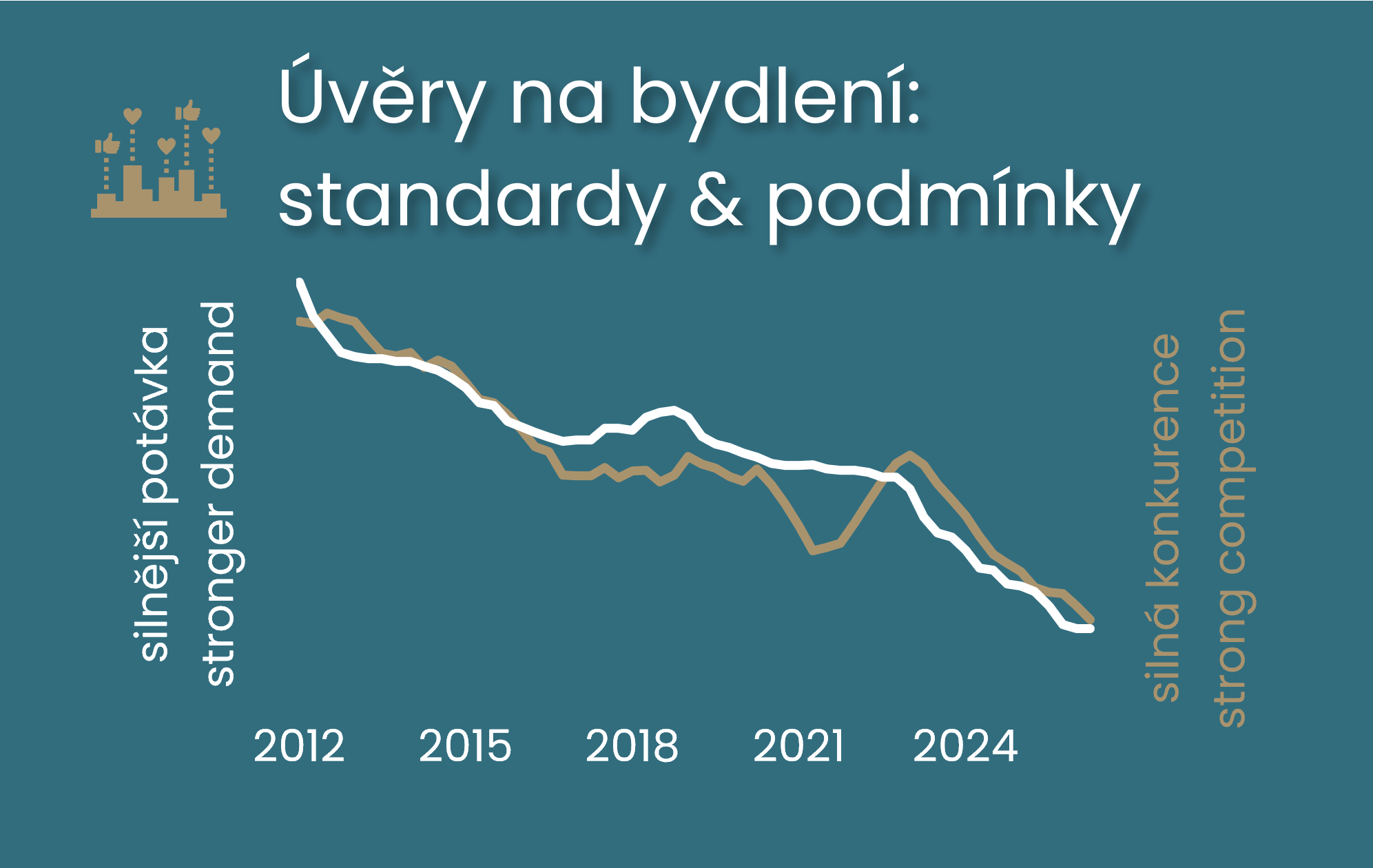
Stricter criteria for so-called investment mortgages—regarding a lower 70% LTV and a debt-to-net-annual-income ratio of 7 times have not only tightened banks’ standards for housing loans but have also temporarily boosted demand, which remains strongly influenced by positive expectations regarding the real estate market’s development. In addition, the CNB’s stricter macroprudential criteria tightened lending conditions for housing loans, but the impact was offset by lower bank margins and more favorable repayment terms.
The evolution of lending conditions thus played the expected role in narrowing the spread between mortgage interest rates and significantly higher market interest rates. In the second quarter, the difference between the mortgage interest rate (below 4.7% in the second quarter) and market interest rates reached nearly half a percentage point. This is significantly less than the 0.8 percentage points or 1 percentage point recorded in the previous quarter and last year, respectively. Our model continues to show that the main force pushing the spread down is exceptionally strong demand combined with intense competition; the setting of credit and macroprudential conditions also plays a significant role. The short-term component of the model now confirms a statistically significant impact of both changes in demand and competition, and above all, a strong return to equilibrium: roughly half of the previous spread deviation is corrected in the model within a single quarter (for more details on the model, see the link below).
The current spread, however, remains about a quarter of a percentage point below the model’s long-term equilibrium. This is also important for the third quarter. If the exceptionally strong demand in Q2 was partly a one-time phenomenon that occurred ahead of the tightening of macroprudential measures, and banks expect it to decline in the third quarter, then both mechanisms of the model—weakening demand and a return from an exceptionally low level toward equilibrium—are working to widen the mortgage spread, not to further compress it. However, this is an implication of the model regarding the spread relative to market interest rates, not a forecast of the mortgage rate itself. We will also see how profitability has evolved; in the past, when it was favorable for banks, it contributed to a narrower spread between mortgage interest rates and market interest rates. I would like to point out that the downward trend in the net interest margin relative to banks’ assets is not linked to the impact on mortgage interest rate spreads.
The impact on the CNB’s macroprudential policy will likely be neutral, meaning it will retain the hawkish tone that led to an increase in the countercyclical buffer in June . Stronger demand for housing loans, despite the CNB’s stricter criteria, is unlikely to please the Bank Board, but the expected decline in demand for the third quarter and the June slowdown in mortgage activity will temper this perception. The survey on consumer loans, particularly the more moderate interest margin, will likely reinforce the CNB’s hawkish stance on macroprudential policy.The survey of lending conditions for loans to non-financial corporations showed slightly looser standards due to increased competition, specifically in the small and medium-sized enterprise segment. Demand in this segment remains solid, as expected, partly due to the impact of lower bond issuance. This could foreshadow more moderate corporate growth, a factor that played a hawkish role in the CNB’s June meeting regarding macroprudential measures.
For more details on the model, see the CBA Focus: Market Forces in Mortgage Rates: The rise in market interest rates has only partially been reflected in mortgage rates. Strong market competition is helping.
Stronger demand for home loans continues to be driven by the outlook for the real estate market; however, this stronger demand—likely temporarily stimulated by borrowers stocking up on loans while conditions are more favorable—is not being matched by new competition

Stronger demand for housing loans was driven by “other factors,” which stem from changes—in this case, tighter ones—in the CNB’s macroprudential policy (here, the loan-to-income ratio, or DTI, on the right axis)

Source: CNB, Czech Banking Association
Other factors have led to stricter standards for home loans ...

... which, given the evolution of lending conditions, reflect stricter DTI/LTV requirements, a trend offset by lower margins and more favorable repayment terms

Stronger demand in the second quarter, as reflected in our model, helped narrow the spread between mortgage interest rates and market interest rates

Source: Czech Banking Association
... which was also evident in the model's short-term dynamics, which are significantly influenced by a correction mechanism that naturally pushes them toward a return to normal

Source: Czech Banking Association
The decline in expected demand in the third quarter suggests a slowdown in new mortgage activity following stabilization in the second quarter, particularly due to the slowdown in June

Banks expect weaker demand for housing loans, consistent with the Q3 trend extrapolated from June levels

Demand for loans to non-financial corporations remained strong, which was also reflected in a rebound in newly originated corporate loans
