Weaker consumer spending, business investment, and productivity hindered a stronger economic recovery
The GDP figures are weaker than the monthly production datahad indicated . Growth in the Czech economy accelerated slightly in the second quarter, from 0.2% to 0.4% quarter-over-quarter, but this still does not represent a particularly strong recovery. By contrast, year-over-year GDP growth slowed from 2.2% to 1.9%, slightly below our expectations. The composition of growth reveals several weak spots, particularly in household consumption and business investment in machinery and equipment. On the other hand, continued growth in investment in housing and infrastructure, combined with strong export activity, provides support.
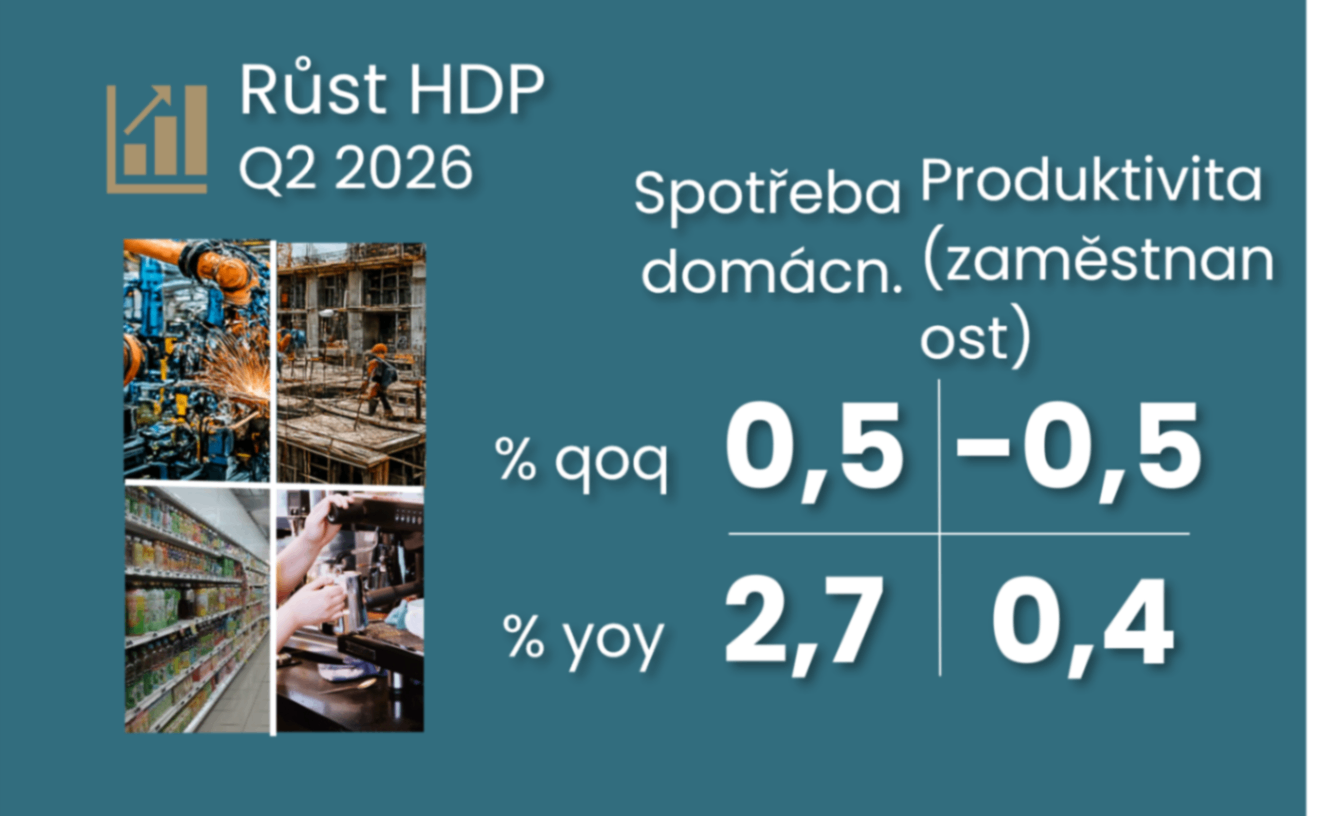
Although household consumption accelerated to 0.5% quarter-on-quarter in the second quarter, it grew by an average of only 0.4% quarter-on-quarter in the first half of the year. This is roughly half the pace seen last year. This is surprising given the stronger retail sales figures, continued solid growth in real wages, and milder inflation. Weaker consumption therefore poses a slight downside risk to this year’s GDP outlook, and it will be important to monitor whether it is driven by higher savings or other changes in household disposable income.
Fixed investment, on the other hand, continued to grow solidly, though its structure remains less favorable. The recovery was driven primarily by investment in housing and infrastructure, while investment in machinery, equipment, and ICT corrected sharply downward following previous strong results. Investment activity related to the expansion of production capacity thus remains a weak spot in the economy.
At the same time, GDP growth in the second quarter was dampened by a more pronounced drawdown of inventories. However,this cannot automatically be extrapolated to future quarters. Given their markedly negative cumulative contribution in recent quarters, it can, on the contrary, be expected that inventories may support GDP growth in the coming period. Net exports made a positive contribution in the second quarter, thanks in part to surprisingly weak import growth. This was surprising given the strong growth in effective domestic demand (consumption and investment excluding inventories).
Labor productivity remains a significant weakness of the Czech economy—both for growth and for inflation. With employment and the number of hours worked continuing to rise, productivity per worker is growing at a much slower year-over-year rate than GDP, and productivity per hour worked is actually declining year-over-year. This is also important from an inflation perspective. Although growth in unit labor costs is below the CNB’s forecast, the combination of weak productivity and still solid wage growth represents a persistent inflationary pressure on core inflation.
Inflationary pressure may intensify further in light of the proposed changes to the pay scales for public-sector employees. This will likely result in stronger wage growth next year than predicted by the Czech Banking Association (5.8%) or the central bank (5.7%). From the private sector’s perspective, there has been a further slight decline in the operating surplus’s share of GDP, which can be viewed as a rough indicator of the economy’s “profitability.” In the context of the past decade, however, this development appears more like a normalization following elevated levels in the post-COVID period during the energy price shock. As such, it does not necessarily represent a major obstacle to continued strong wage growth.
The current figures thus represent only a slight downside risk to our GDP growth outlook of around 2% for this year. The forecast anticipates an acceleration in quarter-over-quarter growth to approximately 0.6% in the second half of the year, supported by continued strong export activity and construction investment. Conversely, weaker household consumption, subdued business investment in production capacity, and higher market interest rates pose risks to our outlook. Added to this are ongoing geopolitical risks related to energy commodity prices, which pose a risk to our outlook for a 2.3% recovery in the Czech economy next year. For more details, see the CBA Macroeconomic Forecast for the Third Quarter of 2026.
A moderate recovery in GDP growth ...

... still below long-term or recent average

GDP is growing thanks to stronger exports and fixed investment, but household consumption has increased less, and inventories have dampened GDP growth

But productivity growth remains sluggish

Although unit labor costs rose more slowly than the CNB had expected ...

... they still represent inflationary pressure also as the weaker ULC growth is accompained with weaker productivity

Low levels of investment in production capacity probably won't help ...

... reverse the clear post-COVID pro-inflationary trend

Viewed through the lens of the past decade, the share of companies' operating surpluses is normalizing rather than declining

Inventories have been eating into GDP in recent quarters, and significantly so from a long-term perspective
