Focus: Mortgage Rates: Not All Rates Are the Same
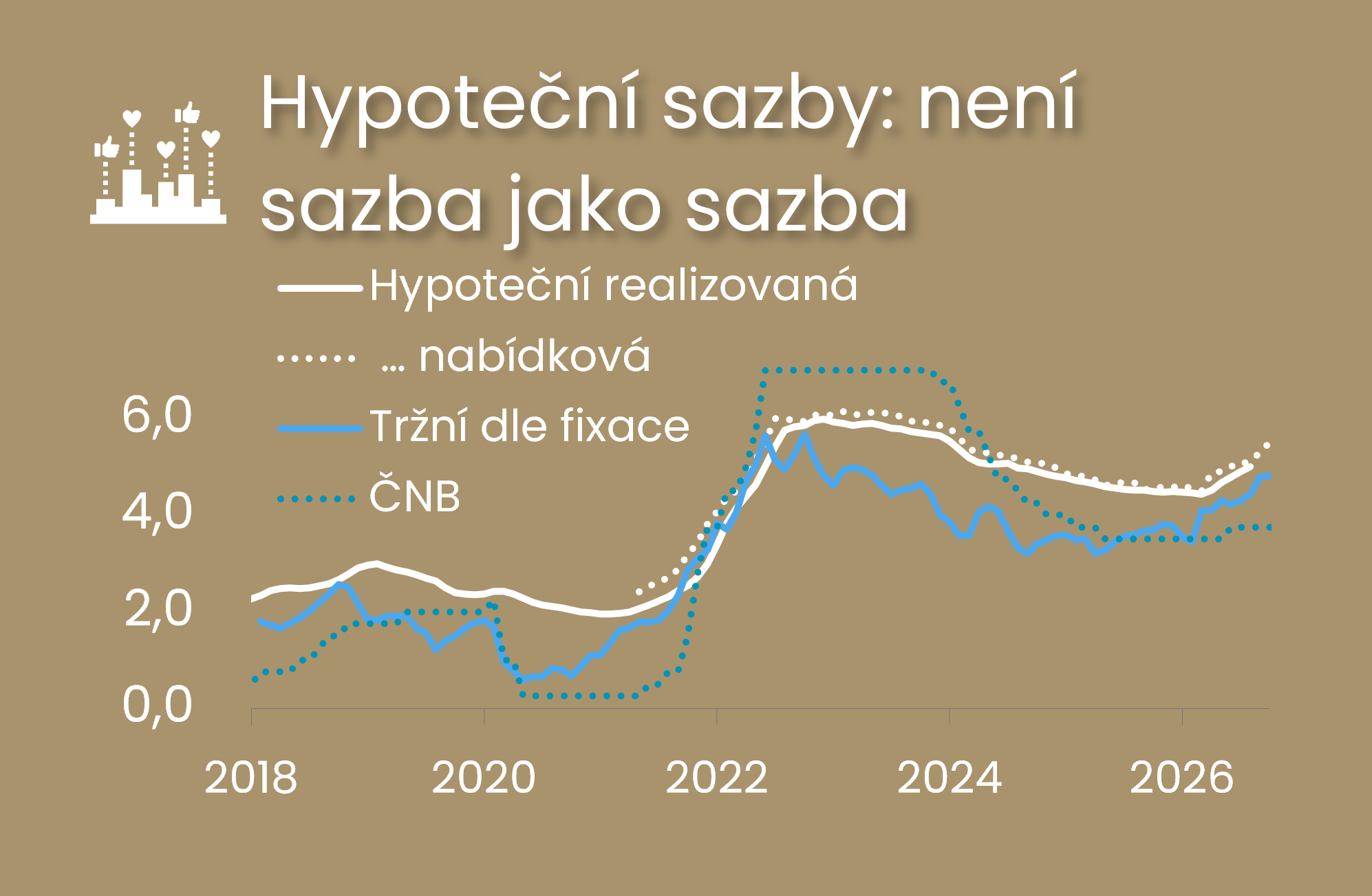
The current rise in mortgage rates primarily reflects the rise in market interest rates. Three-year koruna swap rates have risen from 3.46% in February to over 4.8%—an increase of roughly 1.4 percentage points—while mortgage rates for three-year fixed-rate loans have risen by approximately one percentage point. Thus, the rise in market rates has so far been only partially reflected in mortgage offers.
Which mortgage rate are we tracking?
The advertised mortgage rate for the most common three-year fixed-rate term rose in October to around 5.4–5.5%. This is approximately three-quarters of a percentage point above the September level of three-year koruna interest rate swaps. This spread between mortgage interest rates and interest rate swaps is among the better averages within the European Union; over the longer term, the spread between Czech mortgage interest rates and interest rate swaps has been among the narrowest in the EU (see charts below).
The aforementioned offered rate of around 5.4–5.5% corresponds to the three-year fixed-rate term frequently chosen by clients and is lower than the aggregate offered interest rate cited by the media, which rose to 5.8% in October. However, that figure also includes five-year and ten-year fixed-rate terms without directly reflecting their share among mortgages actually granted. In fact, the share of fixed-rate terms longer than five years for new mortgages hovers around 1% (the same as a year ago), not a quarter as in the aggregate index.
This aggregate offered rate therefore describes the interest rate level across all offered fixed-rate terms. However, it says less about the interest rate on the mortgages that clients typically take out.
What the Choice of Fixed-Rate Term Might Indicate
Longer-term fixed-rate periods could gain in importance if clients began to expect higher inflation over the long term and more significant increases in the CNB’s policy rate. In exchange for the certainty of unchanged monthly payments over a longer period, they might then be more willing to accept a higher rate. In such a case, the aggregate offered rate could better reflect the composition of mortgages being arranged.
Conversely, the current choice of fixed-rate periods is consistent with the expectation that inflationary pressures will be contained and that the current rise in rates will not be permanent. At the same time, however, clients are making less use of fixed-rate periods of one year or less. Their share in the second quarter of 2026 stood at 0.9%, compared with more than 6% a year ago. This may indicate that clients are not counting on a rapid decline in rates, as was the case last year.
For mortgages with multi-year fixed rates, the current CNB rate alone is not a sufficient guide for the cost of the loan. What matters is the cost of money over the period for which the client’s interest rate is locked in. The CNB rate would have a more direct impact on loans whose interest rates are not fixed for an extended period. The preference for multi-year fixed-rate periods reflects clients’ efforts to avoid significant changes in interest rates and monthly payments.
The quoted rate is not the final price
In any case, the actual interest rate is typically, on average, 0.2 percentage points lower than the quoted rate—which reflects the length of the fixed-rate period— from the previous month (in the case of the aggregate interest rate, this difference is approximately 0.4 percentage points). This difference reflects individually negotiated terms as well as the composition of the mortgages granted. In addition to the LTV—that is, the ratio of the loan amount to the value of the mortgaged property—the final rate is influenced by the client’s creditworthiness, the mortgage amount, the use of other bank services, and the bank’s business policy. These factors affect credit risk, costs, and the terms of the loan. The difference between the mortgage interest rate and the swap rate is not pure profit for the bank. It also covers the costs of processing and managing the mortgage, credit risk, and the costs of capital and financing.
Competition and Room for More Favorable Offers
The Czech Banking Association’s (CBA) analysis,“Market Forces in Mortgage Rates,” highlights the importance of a competitive environment in which even growing demand for loans can be accompanied by a narrowing of the spread between mortgage and market rates in favor of the customer. Without an intensifying competitive environment, rising demand would otherwise intuitively lead to a widening of this spread. Bank profitability also plays a role in this relationship. But not in the sense that a wider spread equals higher profits, but rather in the sense that higher profitability creates room for banks to offer more attractive deals that narrow the spread relative to market interest rates.
Not all rates are the same: instead of a blanket offer rate, it is advisable to reflect the typical terms used by clients

Given the higher interest rates, clients continue to prefer fixed-rate terms of around 3 years rather than variable-rate agreements or longer fixed-rate terms

Market interest rates have risen significantly, exceeding the CNB's rate

And this is happening not only in CEE region

The spread between interest rates on new home loans and market interest rates is the lowest in the region and below Euro area average

And the same applies to mortgage interest rates on new mortgages

The spread between mortgage interest rates and market interest rates has been below the long-term average in recent years

... which is consistent with the lower ratio of banks' net interest income to their assets

Source: Czech Banking Association, CNB