September inflation marked the start of a return to the upper limit of the CNB’s tolerance band
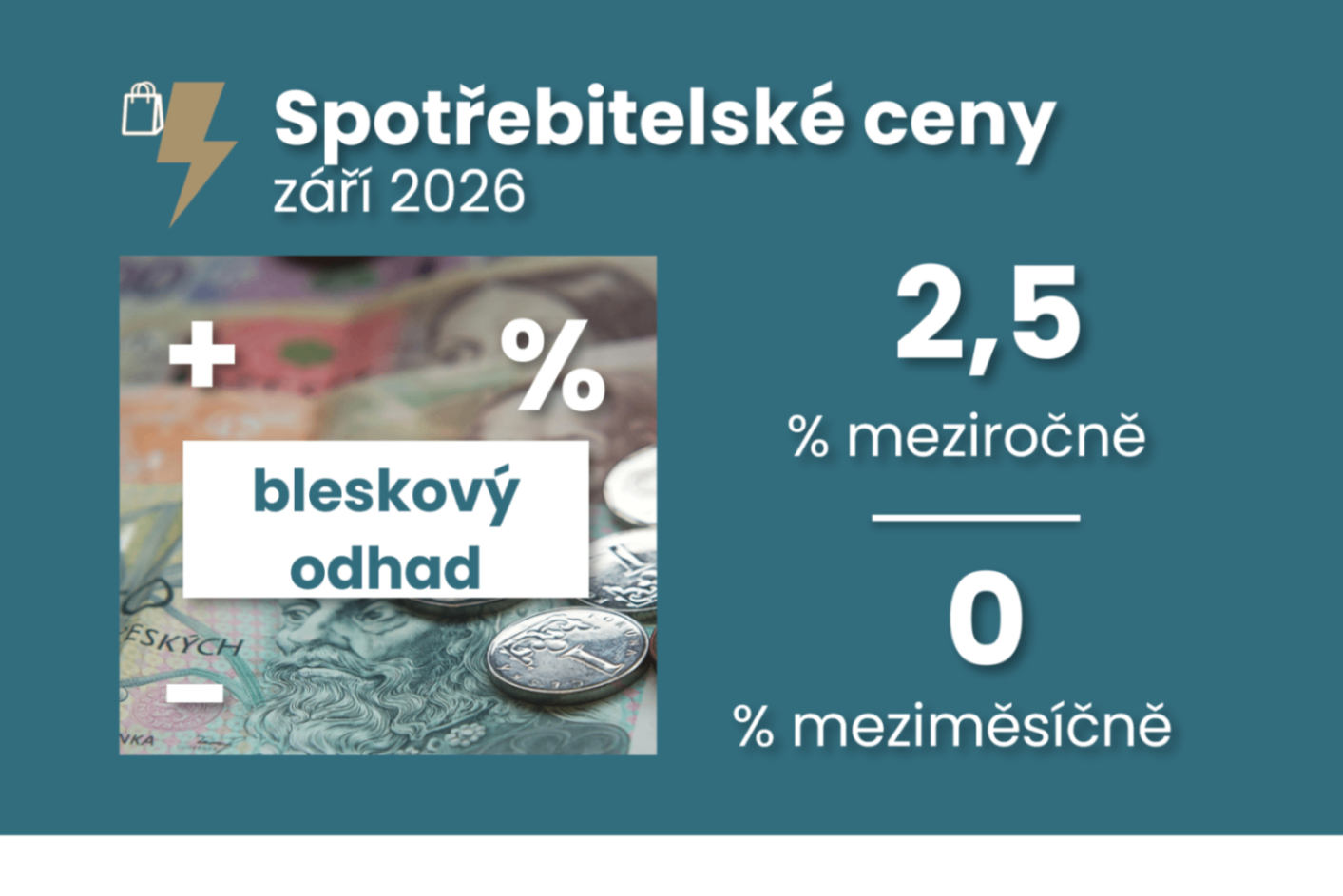
According to a preliminary estimate by the Czech Statistical Office (CZSO), September inflation accelerated from 1.9% to 2.5% year-over-year, slightly exceeding market expectations. About half of this acceleration reflects a lower base of comparison. However, while consumer prices fell quite sharply month-over-month last September—more than usual—this year the price level remained unchanged compared with August. The rise in year-over-year inflation alone is therefore not evidence of a sudden intensification of price pressures in the economy.
The structure of inflation, however, offers several signals worth noting. Food prices continued to fall, which dampened overall inflation. On the other hand, prices for alcohol, tobacco, fuel, and energy had the opposite effect; if confirmed by detailed data, this would represent the first major impact of higher wholesale prices resulting from the war with Iran.
From a monetary policy perspective, however, the development of core inflation remains more significant. September data suggest continued elevated price pressures in services, as well as a rise in goods prices within core inflation. The data so far do not indicate a return of core inflation toward 2 percent. Preliminary data suggest to me that the three-month annualized rate of core inflation has returned to 3 percent. The detailed data to be released on October 13 will show to what extent the September result actually confirms persistent domestic inflationary pressures.
In the coming months, we therefore expect inflation to hover in the upper half of the CNB’s tolerance band and likely exceed 3 percent year-over-year growth around the turn of the year. This is especiallytrue if the current decline in food prices subsides while elevated energy prices persist. Such an environment would not be comfortable for the central bank, and the case for keeping monetary policy at a more restrictive level would strengthen due to persistently high core inflation.
Real estate asking prices returned to a brisker pace in the third quarter, which is, however, consistent with future year-over-year growth of 8 percent. Quarter-over-quarter, asking prices accelerated to 2.1% from 1.4% in the second quarter (see charts below), while asking prices in Prague slowed their growth to 1.2% from 1.6%. However, the rest of the country returned to a 3% pace after a 1.2% increase in the second quarter. As a result, the year-over-year growth rate slowed to below 9% from 10.7% in the second quarter (Prague: 7.6%; the rest of the country: 10.3%). This picture does not alter the conclusions from our previous analysis of real estate prices in the second quarter.
This adds to the arguments for a debate on further tightening of monetary policy at the CNB’s November meeting. Following the June hike, the central bank has kept the benchmark rate at 3.75% and signaled as early as its September meeting that it would decide between keeping rates stable and raising them at its next meeting. If detailed inflation data confirm the persistence of domestic price pressures, raising the repo rate to 4% will become a very real possibility.
Other factors are also pointing in the same direction. The Czech economy continues to grow; although the economic recovery in the first half of the year was by no means strong (0.4% cumulatively), it is accompanied by solid wage figures but not by corresponding productivity growth. However, the survey-based unemployment slightly increased to 3.4 % in Q3 (see picture below). Adding to inflationary pressures there is planned easing of fiscal policy and stronger wage growth in the public sector. In an environment of relatively high foreign interest rates , the koruna exchange rate is also important for the CNB, as a more significant weakening of the currency could increase koruna-denominated prices of imported goods and energy—a trend that was already evident in September.
Consumer price inflation accelerated in September with likely diminishing contribution of energy prices.

This reflects higher energy and fuel prices, as well as the continued rise in core inflation

Consumer price inflation accelerated in September

Survey-based unemployment slightly increased to 3.4 % in Q3

Ask prices accelerated quarter-over-quarter to 2.1% from 1.4% in the second quarter, while ask prices in Prague saw their growth slow to 1.2% from 1.6%

As a result, their year-over-year growth rate slowed to below 9% from 10.7% in the second quarter

A Seasonal Perspective on Month-over-Month Consumer Price Growth
