Slower growth in the Czech economy in the first half of the year was once again accompanied by weak productivity and a high savings rate
Impact on the economic growth outlook? Second-quarter economicgrowth of 1.8% year-over-year and a weaker recovery in the second quarter, combined with persistently high energy prices, pose a downside risk to our outlook for a recovery in GDP growth to 2.3% in 2027, following this year’s 2%. However, this is offset by the outlook for a more accommodative fiscal policy. Both factors pose a risk of a higher CNB interest rate, likely in the range of 4–4.25% rather than the 3.75% to 4% projected in the August forecast.
The Czech Statistical Office has slightly lowered its estimate for economic growth in the first half of the year to a total increase of 0.4% instead of the originally estimated 0.6%. However, the revision largely reflects more precise estimates of indirect tax revenues rather than growth in value added. Slower GDP growth thus now aligns with the earlier, slower pace of value-added growth.
Gross domestic product growth in the second quarterthus saw a more moderate recovery of 0.3% quarter-over-quarter, rather than an acceleration to 0.4% following a slowdown to 0.1% in the first quarter (originally estimated at 0.2%). This follows an average quarter-over-quarter growth rate of 0.7% last year. Year-over-year GDP growth thus slowed to 1.8% from 2.1% in the first quarter, following an average growth rate of 2.7% last year.
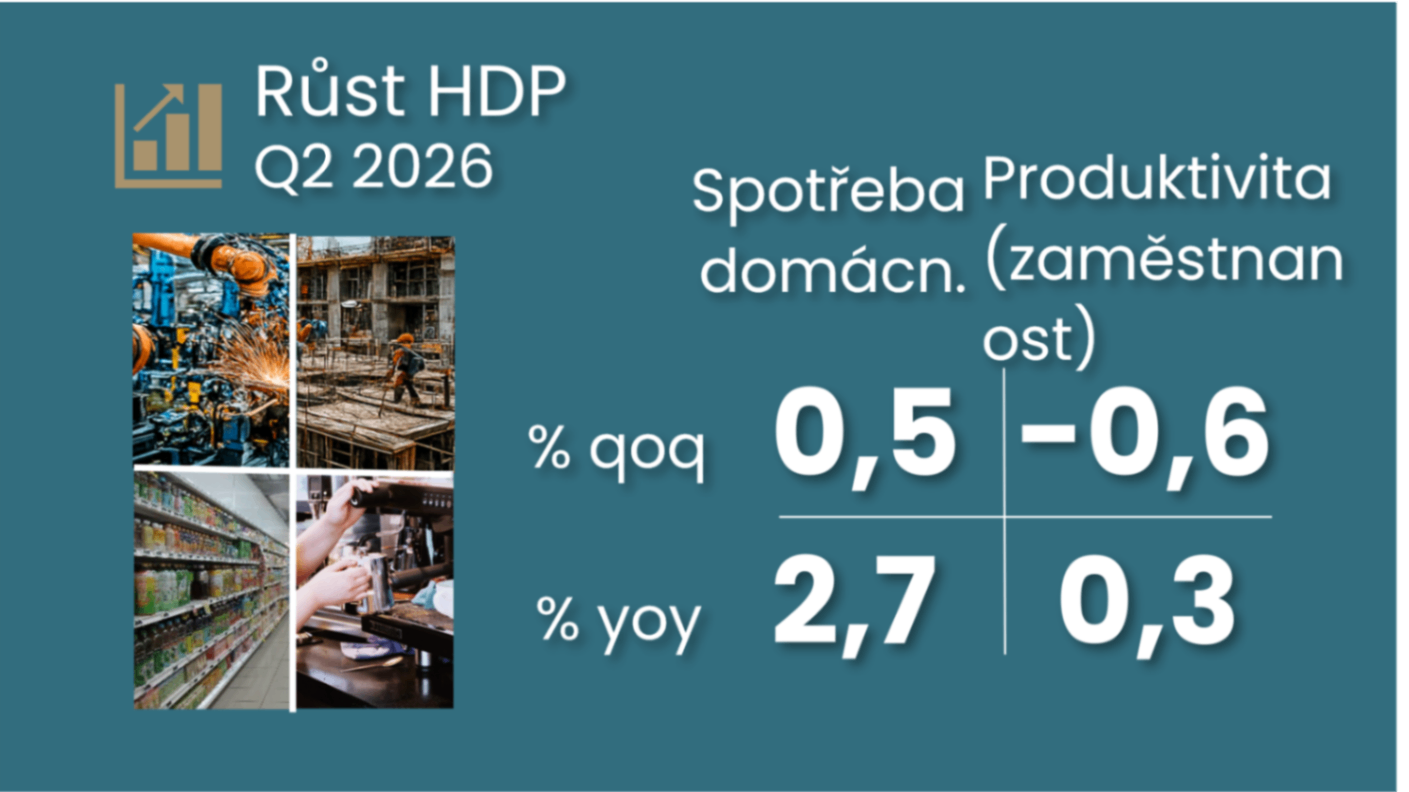
The modest recovery in household consumption to 0.5% quarter-over-quarter from 0.3% in the first quarter remained unchanged, government consumption grew more strongly in the first half of the year by 0.2 percentage points, or 0.6% during the first half of the year (the sum of two quarter-over-quarter growth rates). Fixed investment showed unchanged growth of 3.5% during the first half of the year. It also remains true that fixed investment is driven by construction, while investment in ICT, machinery, and weapons declined in the second quarter, falling even below pre-COVID levels. Inventories cut more from growth in the second quarter, specifically 1.1 percentage points that envisages improvement in future. Foreign trade activity remained unchanged. This means that net exports (exports minus imports) added 0.6 percentage points to quarter-over-quarter GDP growth, after subtracting 0.8 percentage points in the first quarter.
The aforementioned value added ( which is GDP excluding taxes on products and adjusted for subsidies on products, or the sum of the operating surplus and compensation of employees) was revised downward by “only” 0.1 percentage points in the second quarter. It stood at 0.3% after 0.1% in the first quarter. Year-over-year, growth thus slowed to 1.7% from 2% in the first quarter, following 2.8% growth in 2025.
The downward revision to GDP was also reflected in persistently weaker productivity gains. In the second quarter, productivity per hour worked fell by 0.4% quarter-over-quarter and by 0.9% year-over-year, while productivity per employee fell by 0.6% quarter-over-quarter and rose only slightly by 0.3% year-over-year.
This reflects continued strong employment growth of nearly 1% quarter-over-quarter and 1.5% year-over-year. The growth was even stronger in the case of estimated hours worked, at 0.7% quarter-over-quarter and 2.8% year-over-year.
By sector, the ICT sector remains the main driver of productivity growth, with the financial sector serving as another key contributor. Industrial productivity sawa positive impact in the second quarter, driven by the manufacturing sector, while construction, public services, as well as the energy and trade sectors all declined.
And since the downward revision of quarterly wage growth in the first quarter of this year did not affect the wage data in the national accounts, growth in unit labor costs remained high at a year-over-year rate of 5.7%. However, this is in line with the CNB’s forecast, due to slower labor productivity growth. Stronger growth in unit labor costs, which poses an inflationary risk, may therefore not necessarily stem solely from accelerating wage growth, but also from weak productivity growth.
Disposable income is maintaining last year’s growth momentum, as is the savings rate, which remains at around 20% of disposable income. Household disposable income rebounded by 1.0% in real terms quarter-on-quarter in the second quarter, following a 0.3% decline in the first quarter, and thus maintained last year’s average quarter-on-quarter growth rate (+0.6%). Growth in real disposable income per capita was slightly more moderate in the second quarter (+0.7% quarter-on-quarter) and thus again outpaced growth in consumption per capita (+0.6%).
As a result, the savings rate rose slightly to 19.9% from 19.5% in the first quarter and remains both above the 19.3% recorded during the pandemic years of 2020–2021, as well as well above the long-term pre-COVID average of 11.9%. The higher savings rate in the second quarter occurred despite a recovery in the household investment rate to 10.9%—closer to the long-term average—from 10.5% last year.
Economic growth, although weaker, continued to be driven by household consumption in the second quarter ...
... as well as fixed investments and improvements in foreign trade
Fixed Investment? A Different Story: Construction vs. ICT and Machinery
Inventories cut more from growth in the second quarter, but it envisages improvement in future
Productivity growth remains weak
The industry landscape hasn't changed much
Households have increased their savings rate
A Stronger Rebound in Average Disposable Income
The interest rate cycle helps households
But employment is the main driver of income