Real estate price growth has slowed to below 8% on an annualized basis, but older properties are maintaining a 10% growth rate
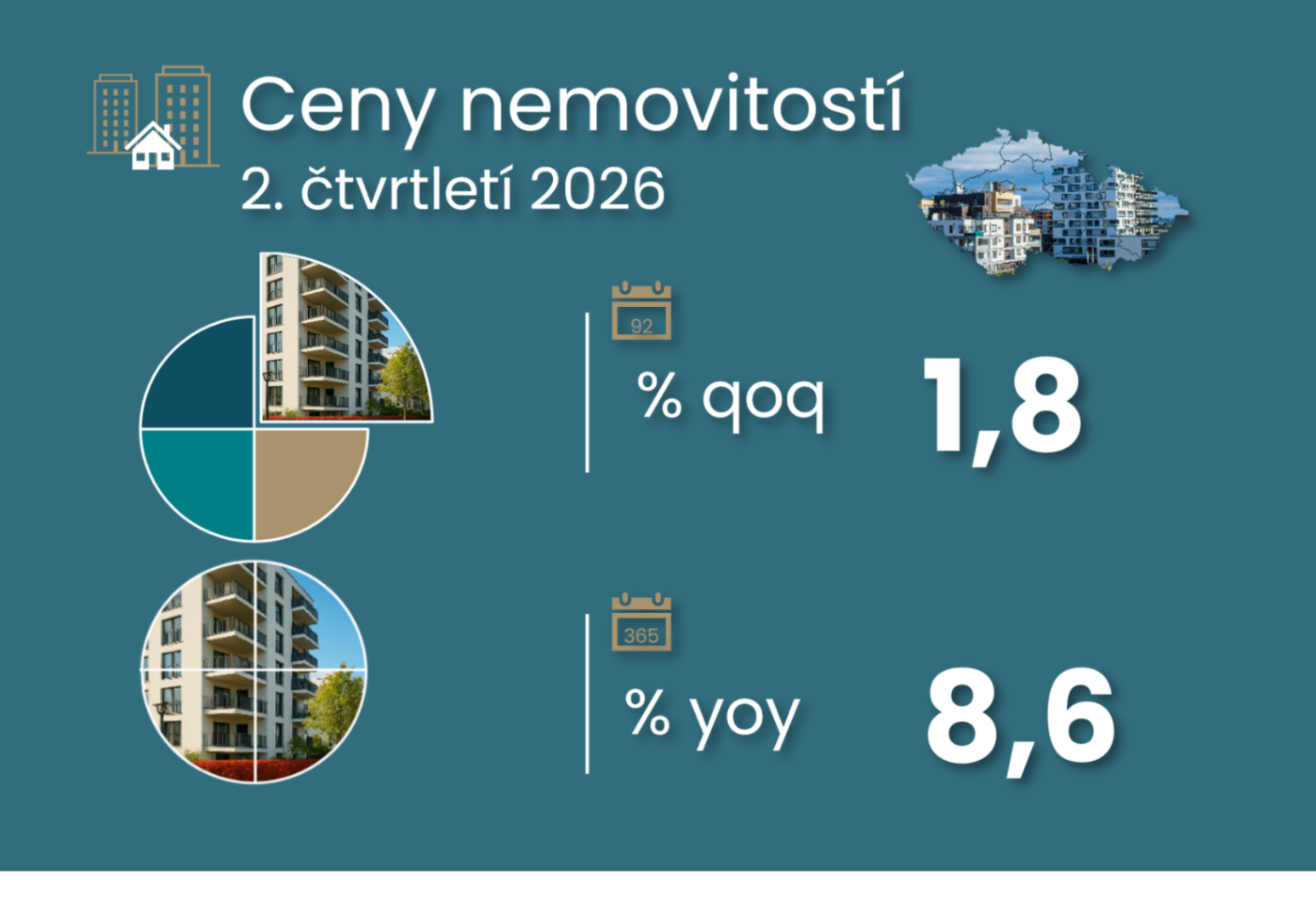
The Housing Price Index (HPI; older properties in the Czech Republic, including land, and new properties in Prague) slowed slightly in the second quarter to 1.8% quarter-over-quarter, down from 2.1% in the previous quarter. This reflects exclusively the previously discussed slight decline in actual prices of new apartments in Prague (see “Surprising Slowdown in Price Growth for New Prague Apartments Did Not Extend to Older Apartments”). Prices of new properties thus fell by 0.6% quarter-over-quarter. However, purchases of older homes posted a 2.4% growth rate, essentially unchanged from the 2.3% average that has held for more than two years since the second quarter of 2024.
As a result, the year-over-year rate of real estate price growth slowed to 8.6% from 10% in the first quarter. This reflects the previously announced slowdown in the growth of prices for new properties in Prague to 3.5% from 10%, while older properties maintained a 10% year-over-year growth rate for nearly four consecutive quarters.
According to CZSO statistics, housing purchase prices (including older properties with land and new properties—though the latter are essentially limited to Prague —for the rest of the country, see our statistics on the CBA Monitor from Flat Zone) rose by 8.6% year-over-year over the past four quarters, having increased by one-fifth over the past three years and by nearly half (48.6%) over the past five years. Over the past decade, the increase was 151%, and 175% over the past 15 years.
Mixed signals for real estate prices. In the coming weeks, we will see how prices for new properties fared in the third quarter, which will indicate the sustainability of the decline in Prague apartment prices—a trend suggested by data from the Czech Statistical Office (CZSO) but not as clearly evident in transaction data (see here for more). However, the decline in the average new mortgage amount back to 4.6 million crowns in the third quarter signals a further slowdown in real estate price growth, partly due to higher market interest rates, which are gradually feeding through into new mortgage interest rates. However, the strong wave of pre-stockpiling with new mortgages this spring will likely keep demand in the real estate market solid even toward the end of this year. The supply side remains solid in terms of new construction but is traditionally weaker when it comes to building permits (see the latest chart here: Industry started the third quarter on a weak note, though not across the board. Infrastructure supported the resilience of the construction sector).
A look at prices—or rather, the cost of home ownership (OCH index), which also includes self-help construction and home repairs—traditionally showed a more moderate pace of growth than the real estate price index. But growth remained brisk, at 1.6% quarter-over-quarter, slightly higher than in the first quarter. This reflected higher prices for building materials. Year-over-year growth in the OCH index thus remained at 4.7%, for the third consecutive quarter. The OCH index has risen by 9.7% over the past three years and by 35.9% over the past five years. Over the past decade, it has risen by 72%, and by 85% over the past 15 years. Over those fifteen years, this increase in the cost of acquiring real estate—including owner-occupied housing and repairs—has amounted to a 51% rise in the house price index.
Data on household disposable income for the second quarter of this year will be published at the end of September.
Real estate prices are once again showing varying rates of change

Real estate prices are rising at a slower pace compared to apartments, particularly older real estate, not new

Land prices reduce the volatility of the real estate price index compared with apartment price indices

The decline in the average mortgage amount indicates a slowdown in real estate price growth, but demand remains strong due to the mortgage market's excess supply.

Real estate prices are outpacing the growth in purchasing power

Over the past fifteen years, the increase in the cost of acquiring real estate—including owner-occupied housing and repairs—has amounted to a 51% rise in the house price index.

Overview of Real Estate and Apartment Prices from the Czech Statistical Office
