Expect the CNB to hold in August—but keep a September hike to 4% on the radar
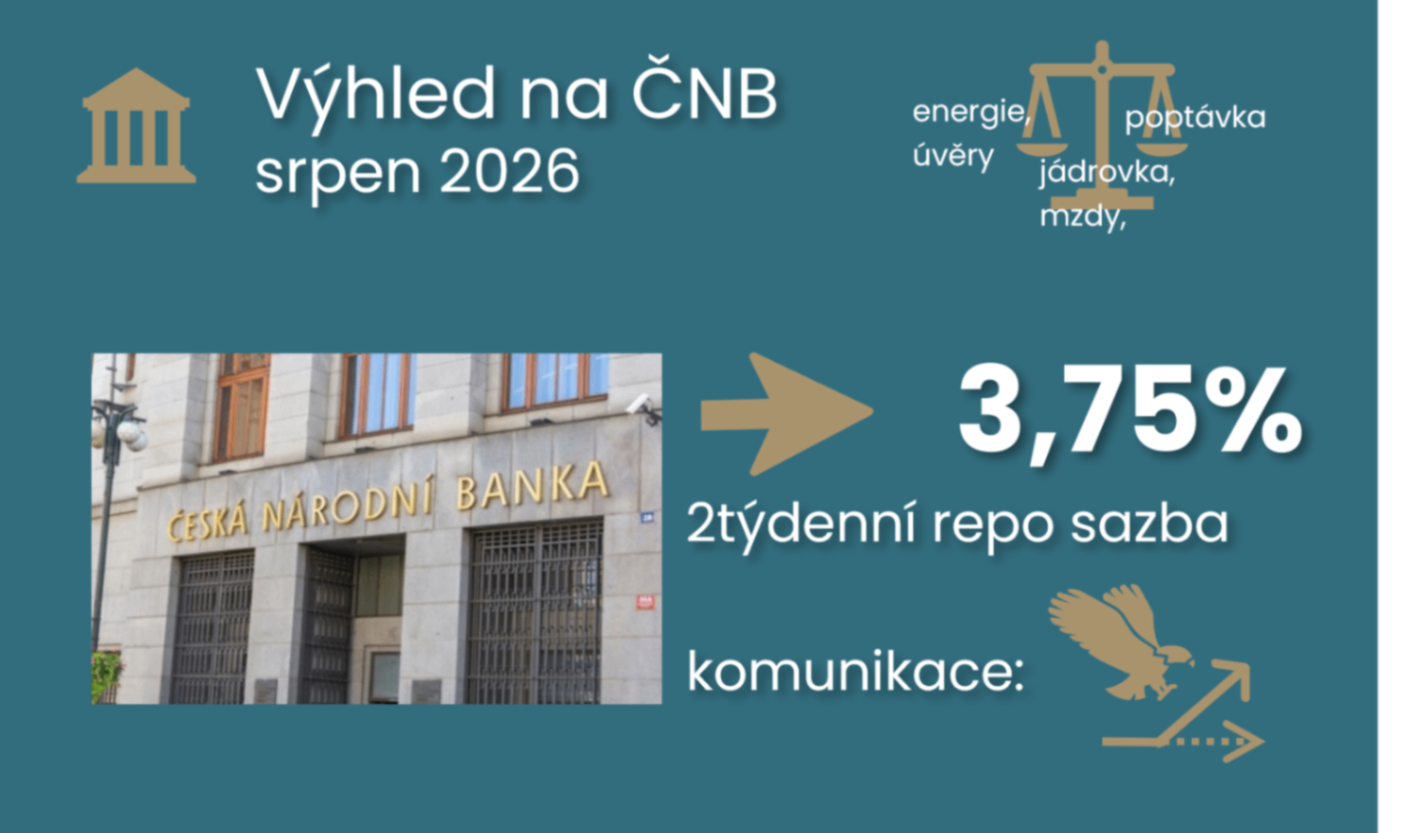
If the market is pricing in an ECB interest rate hike this fall, then it comes as no surprise to expect the CNB to raise its interest rate to 4% this fall.
Core inflation—the segment of the overall CPI most influenced by demand—remains the main reason for maintaining a tighter monetary policy. Core inflation has shown a slowdown in its growth momentum over the past three months, with the projected annual rate—based on month-over-month growth—now at 2.9%. The CNB is not alone in this. The momentum of Polish core inflation is also roughly one percentage point above the midpoint of the inflation target. However, at this pace, the momentum of Czech core inflation remains high in terms of meeting the inflation target, given the high volatility of energy, fuel, and food prices. Price expectations in July eased slightly, thus representing a mild dovish risk to my assessment of inflation trends.
Economic activity remained solid, but I do not viewthe 0.4% quarter-over-quartergrowth in Czech GDP as strong. This is true even from the central bank’s perspective, as it had expected the economy to be in stronger shape (by half a percentage point) for the first half of this year. The economy itself, therefore, does not send a hawkish message to the central bank.
The labor market is not sending a clear new signal either, but the likely continuing gap between wage growth and productivity certainly is. The registered unemploymentrate stabilized at 5% in June, while the survey-based rate rose slightly to 3.3%. Wage growth in the industrial sector, unless it remained more subdued in June, does not represent a deviation from the trend. And so, the slight recovery in productivity growth in the second quarter does not alter the pro-inflationary nature of the Czech economy’s weak growth.
Stronger Czech lending activity will keep the central bank’s stance hawkish, but the composition of loans is shifting in a more favorable direction. Although June saw a slowdown in the volume of new loans, both corporate loans and housing loans remained on an upward and strong trend, respectively. The survey of lending conditions suggests continued lending activity in the corporate loan segment, while expected demand in the housing loan segment signals a slowdown amid higher market interest rates—a trend that was also evident in the consumer loan segment during the second quarter (see chart below).
And the ECB? Following its rate hike in June,the ECB opted for a wait-and-see approach this time and left its key rates roughly one and a half percentage points below the CNB’s rate. While the June slowdown in both headline and core inflation in the eurozone reduced the need for further immediate monetary tightening, inflationary risks have not disappeared, as evidenced by the return of eurozone consumer price growth to 2.9% year-over-year in July.
Strong growth in producer prices for intermediate goods and consumer goods, coupled with renewed increases in oil prices, keeps the possibility of further ECB rate hikes on the table, especially if the eurozone economy’s currently slightly improved condition continues to strengthen. Conversely, a potential economic slowdown—which could be driven by tighter credit standards, weaker demand for credit compared to the Czech Republic, or ongoing structural problems—would likely lead the European Central Bank to keep interest rates unchanged.
New lending to the Czech economy continues to show a strengthening trend , and its ratio to GDP reached approximately 19.4% during the second quarter of 2026, up from the 17.3% of GDP estimated for the first quarter of 2026.

The growth rate of outstanding loans remains above long-term averages

The recovery is also evident in investment loans ...

Stronger lending activity thus also provides a positive supply-side stimulus; it’s not just about mortgages

Markets and Central Banks
Markets are pricing in another interest rate hike, as in the case of the CNB ...

..., as in the case of the ECB, where the final rate could end up half a percentage point higher in this cycle

The koruna is not influenced solely by differences in interest rates ...

... but even a slight narrowing of the interest rate spread compared with Poland and Hungary contributed to its greater stability

A Comparison of the Czech Economy with the Eurozone
Economic activity in the eurozone improved during the second quarter. According to the ECB, this was driven by stronger performance in the services and retail sectors, as well as resilience in the industrial sector.

... although there is no question of robustness in terms of GDP growth

Zero GDP growth in the eurozone in the first quarter was accompanied by a slight uptick in productivity and a higher level of labor utilization…

... which reduced average GDP growth and stabilized the growth of unit labor costs, while the ECB’s indicator for negotiated wage growth remains subdued, with no signs of acceleration—that is, no signs of secondary effects from the price shock

The unemployment rate in the eurozone remains at 6.2%, significantly higher than the 3% rate in the Czech Republic (this is the sample unemployment rate)

Higher service prices do not signal a hawkish stance—except in the case of the Czech central bank
