The surprising slowdown in the rise of prices for new apartments in Prague has not carried over to older apartments
Data on actual apartment prices for the second quarter painted a rather mixed picture across different market segments. In our aggregate estimate of actual prices for new and older apartments, prices rose by 2.5% quarter-over-quarter in the second quarter, the same pace as in the first quarter. However, year-over-year growth slowed to 12.3% from 14.0% in the first quarter and from 15.6% at the end of last year. Overall, we are seeing a gradual slowdown from very high growth rates rather than a broad reversal of the price trend.
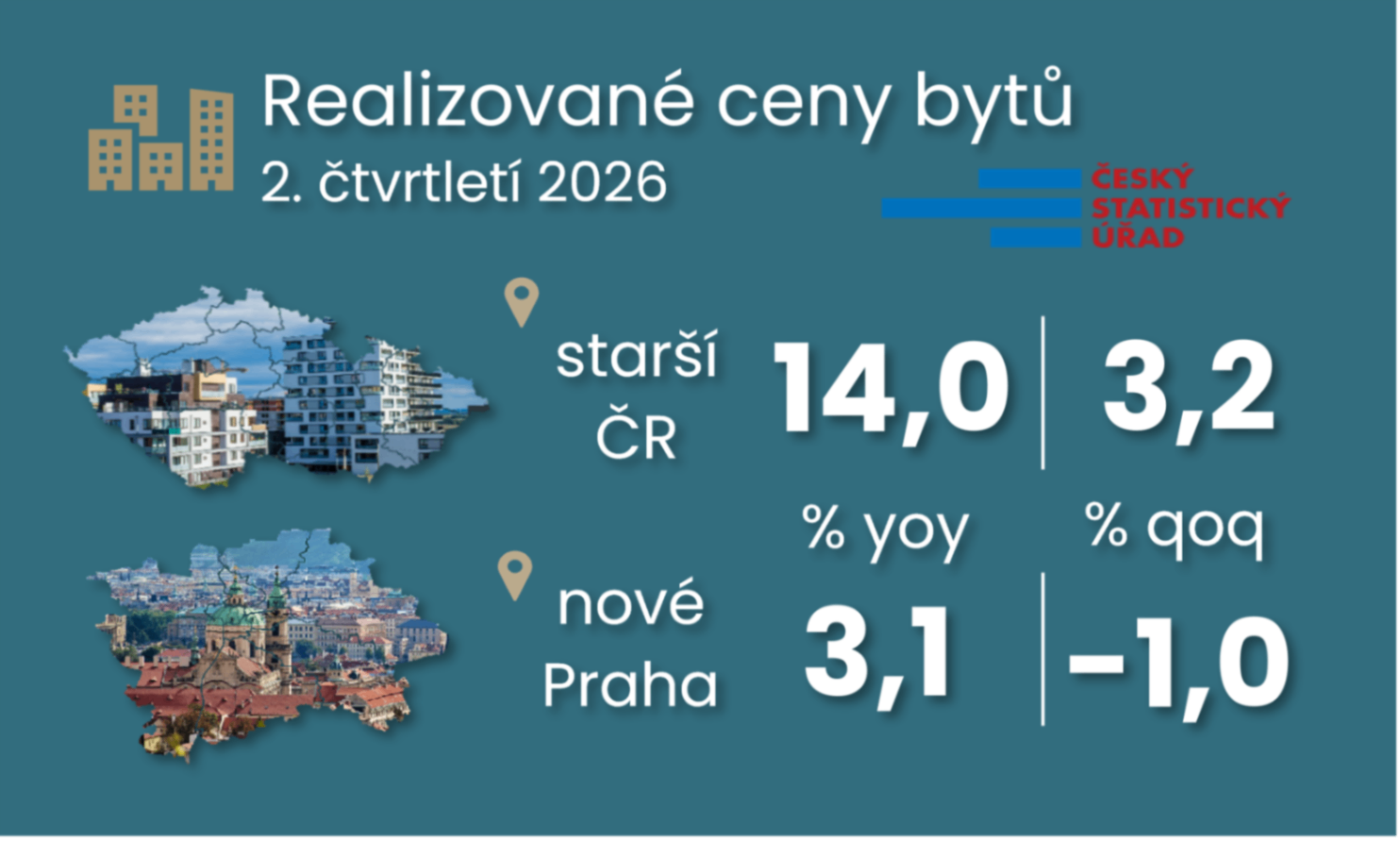
The biggest surprise of the second quarter is the trend in new apartments in Prague. According to the Czech Statistical Office (CZSO), their realized prices fell by 1% quarter-on-quarter, whereas in the previous three quarters they had risen by an average of approximately 1.3%. Year-over-year growth thus slowed significantly to 3.1% from 11.1% in the first quarter.
In fact, transaction data from Flat Zone for the second quarter show a 2.3% quarter-over-quarter increase in prices, following an average growth rate of nearly 3% in the previous four quarters. It is true, however, that Flat Zone’s data also show a quarter-over-quarter decline in Prague 8–10, but other areas (except for Prague 1, which is volatile in terms of transactions) maintained stronger growth rates. According to this data, year-over-year growth slowed only slightly to 11.3% from 12% in the first quarter. According to the Czech Statistical Office (CZSO), asking prices for apartments in Prague (both new and older) slowed to 1.2% quarter-over-quarter in the first quarter, down from 3.1% in the first quarter. These data sources thus send a different signal for assessing the trend this time around.
However, the trend for older apartments does not yet indicate a significant cooling of the market. Their prices rose by 3.2% in the second quarter, following a 2.7% increase in the first quarter. Compared with the average growth of 3.5% over the previous four quarters, this represents a slower pace, though it remains very brisk. Year-over-year, prices for older apartments rose by 14.0%, just slightly slower than the 14.5% increase in the first quarter. If their current quarter-over-quarter growth rate were to persist, year-over-year growth would mechanically hover around 13% in the coming quarters as well.
A different trend is also evident between Prague and the rest of the country. Prices for older apartments in Prague rose by 2.6% in the second quarter, following a 1.5% increase in the first quarter. The pace thus accelerated quarter-over-quarter but remained slightly below the average of the previous four quarters, which was 2.8%. Year-over-year, price growth for older apartments in Prague accelerated slightly to 11.9% from 11.5%.
In the rest of the Czech Republic, prices for older apartments rose by 3.3%, following a 3.1% increase in the first quarter. Here, too, there was a slight acceleration compared to the previous quarter, but the current pace is lower than the average of 3.7% over the previous four quarters. At the same time, year-over-year growth slowed to 14.5% from 15.4%.
Further analysis for discussion: Apartment transaction prices did not slow down significantly in the second quarter
Real Estate Price Dashboard According to the Czech Statistical Office

Real Estate Prices vs. Income

Trends in realized Real Estate Prices

Average size of new mortage sends "cooling" signal

A different annual dynamics of realized prices of older flats ...

... in comparison to new Prague flats

While the actual prices of older apartments, according to the Czech Statistical Office, increased slightly stronger than the transaction prices reported by Flat Zone ...

... a more pronounced deviation is evident in the case of new apartments in Prague
