Focus: Bank Profits: A Large Number Deserves a Broader Context
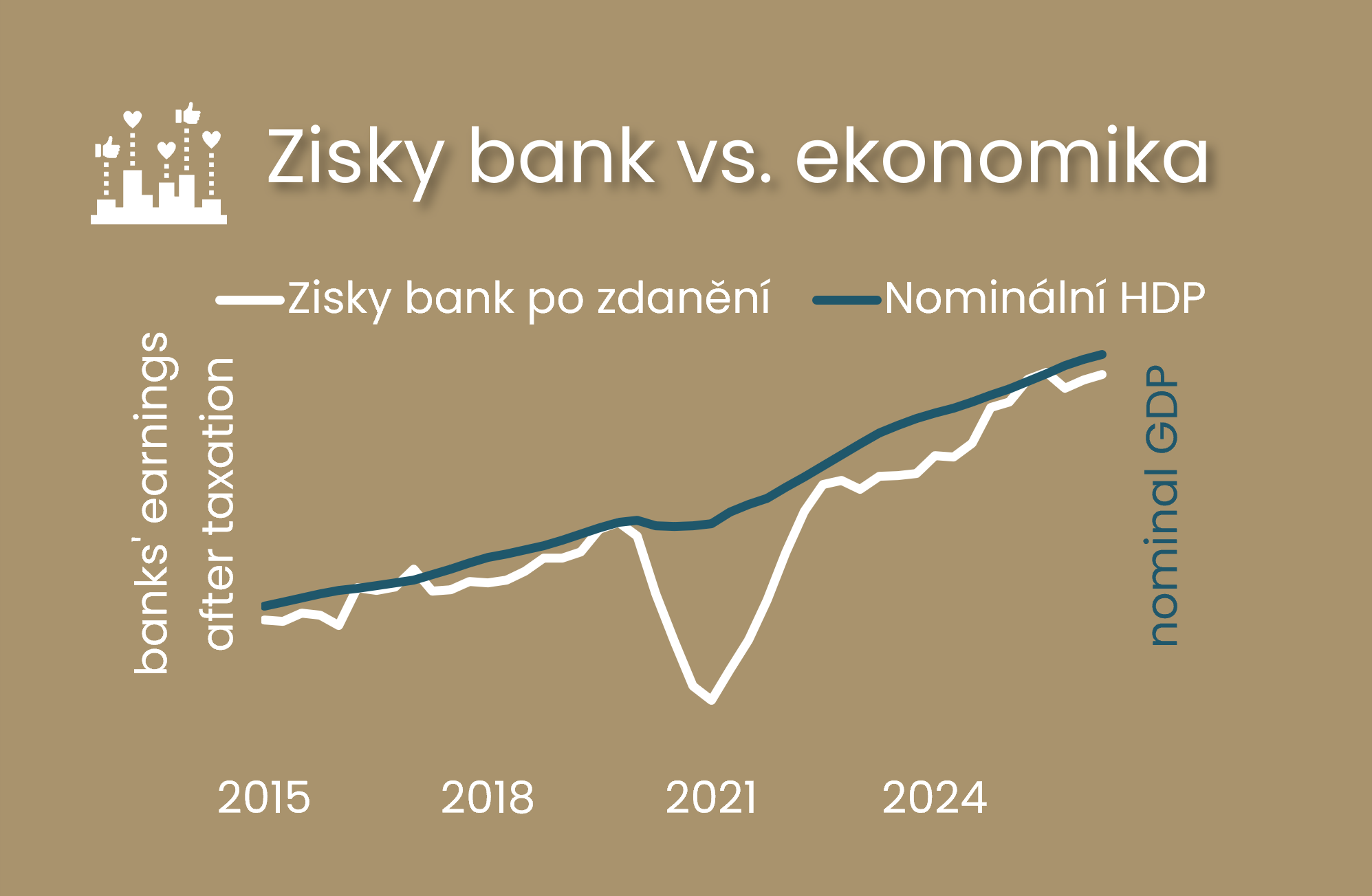
Just over 130 billion crowns in after-tax profit. Who wouldn’t be blown away by that number? Even though it’s a nominal figure, adjusted for inflation. Nominal figures have been rising across the economy in recent years. For example, the average wage rose from 34,500 crowns in 2019 to 50,000 in the middle of this year, and nominal GDP shifted from just under 5.9 trillion crowns to nearly 8.8 trillion.
However, we do not see similar figures discussed in public debate regarding other sectors. So how should the growth in bank profits be viewed in the context of the Czech economy’s development? The attached graph attempts to illustrate this—though, of course, not perfectly.
◽ It depends on the base year. A comparison with the approximately 70 billion crowns in 2021 primarily reflects a recovery from a deep pandemic-induced slump. The decline in profits was more pronounced in the banking sector than in the economy’s overall nominal output. Of course, other sectors affected by COVID-19 also faced similar difficulties. The year 2021 is part of the comparison, but we also need to look at the period before the pandemic.
◽ Since the end of 2019—that is, in the pre-pandemic period, when bank profits reached 91 billion— their profits grew more slowly than the nominal GDP of the entire economy, as well as the monitored wage income of households and tax revenues of government budgets. If we compare the performance of bank profits and the economy relative to the end of 2018, the increase in current bank profit levels compared to 2018 corresponds to the increase in the economy’s nominal GDP.
Banks’ net interest income lagged even more significantly behind this trend. The recovery in bank profits is therefore not driven by higher net interest income, but rather by streamlined processes within banks, higher productivity, and a prudent lending policy in the resilient Czech economy. Higher productivity was also aided by a reduction in the number of employees from 42,000 in 2018 to under 38,000 today. For a more detailed breakdown, see the “Focus” section of the CBA Monitor.
The average annual profit over the past five years has lagged behind to a lesser extent. One thing is to compare current profitability levels with those at the end of 2019. It is another matter to compare the average annual profit in the post-COVID years 2020–2026 with the profit level in 2019. From this perspective, banks’ average annual profit in the post-COVID years increased by 10% compared to 2019, while GDP, profits, and revenues rose by 20–30% (see Chart 2). If 2018 were used as the basis for comparison, the average annual increase in bank profits (including 2019) would have been 22%, compared to a 33% increase in nominal GDP.
A record amount in Czech crowns does not necessarily mean a record profit relative to the size of the economy. Bank profits as a percentage of GDP remain this year around the five-year pre-COVID average of 1.5% of GDP (in 2020–2024, they did not reach 1.3% of GDP).
As it is temporarily not possible to insert charts directly into the text, please refer to the chart available on LinkedIn: Post | LinkedIn, or on CBA Monitor: Banking sector.