Focus: Higher Diesel Prices as a Structural Problem That Price Regulation Does Not Solve
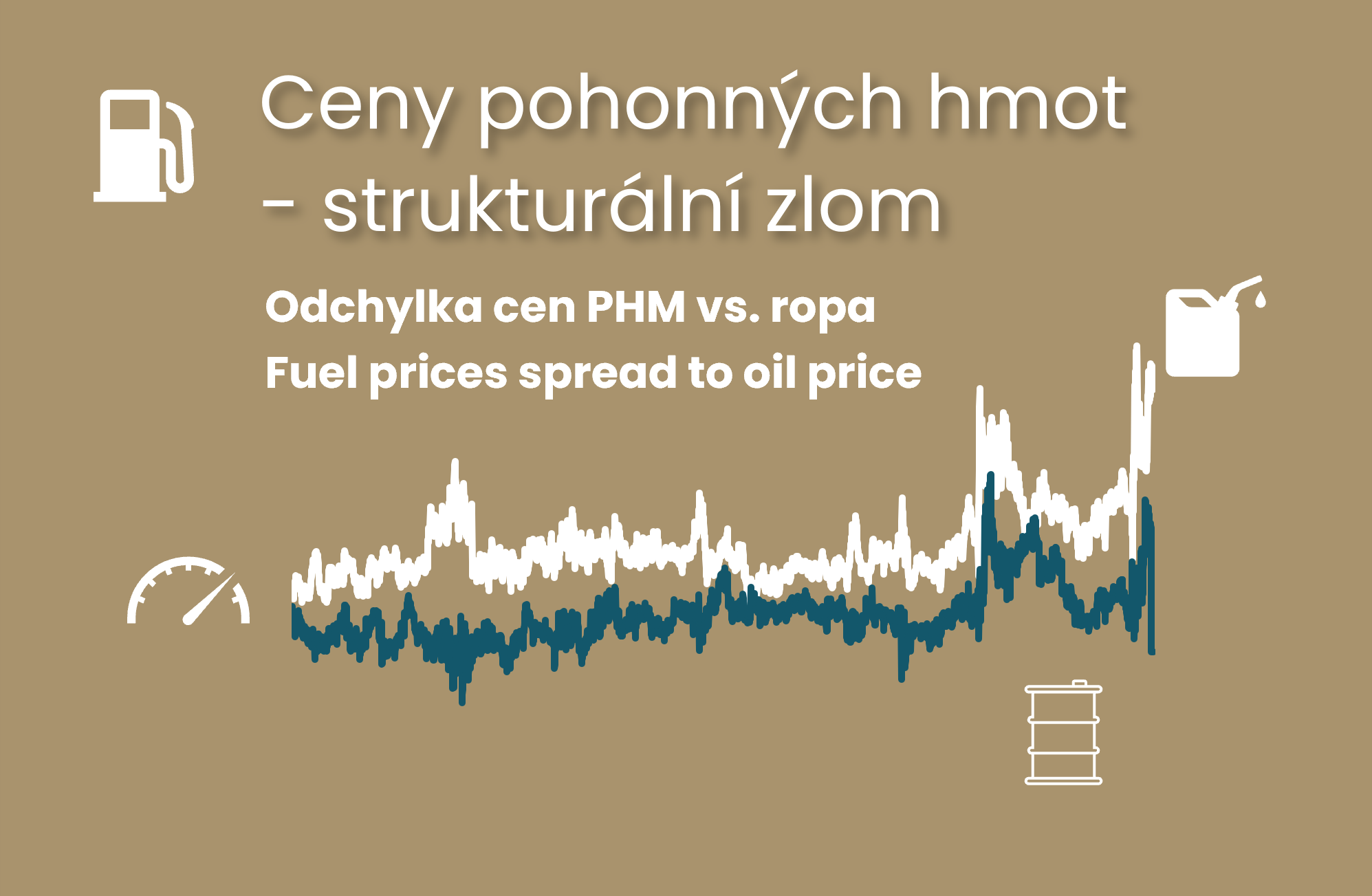
The Russian invasion of Ukraine marked a turning point in how fuel prices are determined based on the price of oil (see Charts 1 and 2). If we apply today the same model that, prior to 2022 (i.e., before Russia’s invasion of Ukraine) to explain fuel price trends excluding taxes based on oil prices in crowns, fuel prices today are 8 crowns per liter higher for gasoline and nearly 12 crowns higher for diesel. That is how much higher they are than they would have been before 2022 at today’s oil prices. In other words, if the oil industry were functioning the same way it did before 2022, gasoline prices would be nearly one-fifth lower and diesel prices nearly one-quarter lower. Similar differences in fuel pricing are also evident in Europe.
In any case, the available statistics do not indicate significant deviations in average retailer margins, as the change in pricing occurred in the European refining and wholesale markets ( see Figures 3–10).
Higher diesel prices at gas stations are not only the result of higher crude oil prices but also of higher markups in the production and supply chain. However, this is primarily the result of structural factors that are more pronounced in the Czech Republic and the Central European region. These include both the disruption in Russian oil supplies and uncertainty regarding the return on investment for a potential expansion of production capacity due to the significant trend toward electromobility (see Charts 16 and 17). However, this transition is more gradual in Central Europe than in Western Europe and is also reflected in the steadily growing number of diesel-powered cars (see Chart 18) , which, together with the relatively higher growth in Central European freight transport (Chart 19), sustains rising demand for diesel supplies to the Central European market (Chart 15).
These opposing trends are reflected in lower self-sufficiency in diesel supplies, with the Czech market, among others, becoming more dependent on imports (see Chart 11). Countries that previously had surpluses, such as Slovakia, are showing increasingly smaller surpluses (see Charts 13 and 14). However, this self-sufficiency remains unchanged at the pan-European level (see the lower part of Figure 12 and Figures 13–14), which likely reduces the return on any investments in expanding European production capacities. Furthermore, such investments must take into account the expected long-term decline in demand for motor fuels, which is linked, among other things, to the current framework of European regulations governing new automobiles. Under current legislation, this effectively prohibits the registration of new conventional gasoline and diesel vehicles starting in 2035; the currently proposed revision would slightly ease this restriction to a 90% reduction in CO₂ emissions for new passenger cars and vans.
The diesel market thus resembles the housing market in many ways. Strong demand and inflexible, limited supply. This is an environment where price regulation does not deliver the desired solutions in the form of long-term sustainability and the resilience of lower prices. You cannot satisfy higher demand with limited supply while prices remain unchanged. Conversely, a price increase due to a shortage of raw materials can cool demand to lower levels—even structurally—which (unless the problem is addressed on the supply side) also leads to the necessary return to equilibrium.
At the same time, a price shock can cause unnecessary distortions, which justifies stabilization measures by the government—but not measures that create distortions. That is, not through price regulation, which does not address the root of the problem, but through a fiscally neutral reduction in the excise tax on fuel, in this case diesel. This can be offset by higher VAT revenue resulting from the higher price of the commodity—i.e., crude oil—or a higher price mark-up along the production chain. This is further reflected in corporate income tax, which can be reinforced by the introduction of a so-called windfall tax, i.e., a tax on unexpected profits (the current government proposal would tax 50% of the increase in gross margin compared to 2025). However, a windfall tax has negative impacts on future investment activity in any sector.
Czech fiscal neutrality regarding lower excise taxes must, however, take the following into account:
higher government spending due to higher fuel prices (whether directly on fuel costs or indirectly through the indexation of spending levels caused by higher prices in the economy), which is, however, partially offset by this measure itself.
Lower excise taxes mean lower revenues for the transportation infrastructure fund, which receives 9.1% of the excise tax collected on fuel, after accounting for tax rebates, the most significant of which is the so-called “green diesel” rebate.
Although VAT collection—which is calculated based on the total price of fuel sold, i.e., including excise tax—inevitably increases when fuel prices rise, “only” 63.84%, while the remainder—more than one-third, or over 36%—is allocated through tax earmarking to the regions (over 10%) and municipalities (nearly 26%).
And the fuel discount—in the form of a reduction in the excise tax of nearly two crowns per liter of diesel—roughly fulfills this requirement. Rising fuel consumption (see Chart 21), combined with rising oil prices and markups along the supply chain, implies that tax revenues from fuel will remain slightly higher despite the lower excise tax on diesel. Illustrated in Charts 20–23. The lower excise tax on diesel remains a so-called “blanket” measure that is not targeted and is therefore less effective; however, given its impact throughout the supply chain, it has a greater effect on other segments of consumer goods and intermediate goods than a potential reduction in the excise tax on gasoline.
It would be appropriate to reform the structure of the fuel excise tax into a rule that helps mitigate oil price shocks and takes into account possible deviations from the central bank’s inflation target. Establishing such a fiscally neutral rule would help make the stabilizing role of fiscal policy more effective across the policy cycle.
A Turning Point in the Role of Oil in Fuel Prices After 2022
Chart 1: One way to illustrate the changes in the oil industry is to show how oil prices accounted for pre-tax fuel prices before 2022 and how they account for them today—the difference is 8 to 12 crowns per liter of gasoline or diesel, respectively...

Chart No. 2: ... which is approximately one-fifth to one-quarter of the total price, including tax

Structural Decomposition of Fuel Price Markups Relative to Crude Oil
Chart 3: As in the case of rising oil prices ...

Chart No. 4: ... as seen in the gasoline market, there is a clear widening of margins outside the retail network

Chart No. 5: Although prices at Czech gas stations are rising more than oil prices on global markets...
Chart No. 6: ... but on average, this is not the result of higher margins for gas station operators above wholesale prices ...
Chart No. 7 ... nor in the Czech wholesale market, which, however, follows European prices ...
Figure 8: ... since the premium is set on the European market
Figure 9: Graph showing changes in price markups along the supply chain from crude oil to the Czech gas station following Russia’s invasion of Ukraine
Chart 10: Price markups are rising not only in absolute terms but also relative to the total price of gasoline (excluding tax) at Czech gas stations
Structural Problems in the Czech Fuel Market
Chart 11: The Czech diesel market is significantly in deficit
Chart 12: ..., which also holds true for the European market, where, however, demand for diesel is not trending upward
Figure 13: Europe, as well as our region, has a crude oil production deficit, and countries such as Hungary and Slovakia are no longer experiencing a surplus
Chart 14: The Czech diesel market (dark blue bars), along with the Austrian and Polish markets, is among those with the largest deficits

Chart No. 15: Diesel as a fuel continues to gain popularity in Central and Eastern Europe...

Figure 16: ... which reflects structural factors such as a share of electric vehicles that remains significantly below the European average ...

Figure 17: ... another perspective on the change in the share of electrification among new vehicle registrations and fuel sales

Chart No. 18: Or we can look at this in terms of registered cars per person: that is, the number of diesel passenger cars in Central Europe is not declining

Figure 19 ... or due to the faster growth in the volume of road freight transport in Central Europe

Fiscal neutrality of lower excise taxes on fuel, specifically diesel?
Chart No. 20: Fuel consumption in the Czech Republic continues to rise ...

Figure 21: ... and with it, implicit state budget revenues, despite the lower excise tax on diesel (data for the first half of each year; calculated as volume multiplied by the average price) ...

Chart 22: ... , which is offset by higher commodity prices and margins that maintain revenue through higher VAT despite lower excise taxes ...

Chart No. 23: ... however, state budget revenues must take into account the budgetary allocation of taxes and tax refunds on motor fuels (primarily green diesel, etc.)
