Stronger wave of mortgage refixing, while the interest-rate shock eases. Higher inflation remains a risk.
This year is bringing a strong wave of expiring mortgage rate fixations, while the shorter fixation periods agreed in recent years will further increase these volumes in the years ahead. Building on the central bank’s latest estimate that mortgage fixations worth an average of CZK 534 billion per year will expire between 2026 and 2028, we present alternative interest-rate shock scenarios depending on the path of mortgage rates. In 2027–2028, the negative interest-rate shock is expected to ease to 0.1–0.6 percentage points, down from 1.1–1.4 percentage points this year. However, we also outline a more adverse scenario involving a stronger interest-rate shock. This year, the negative interest-rate shock affecting expiring mortgage fixations from the low-rate period will amount to roughly 3.5% of the average household income of mortgage applicants, although across all households the average impact will be about half that level. In both cases, the expected real growth in wages and salaries should be sufficient to offset the shock.
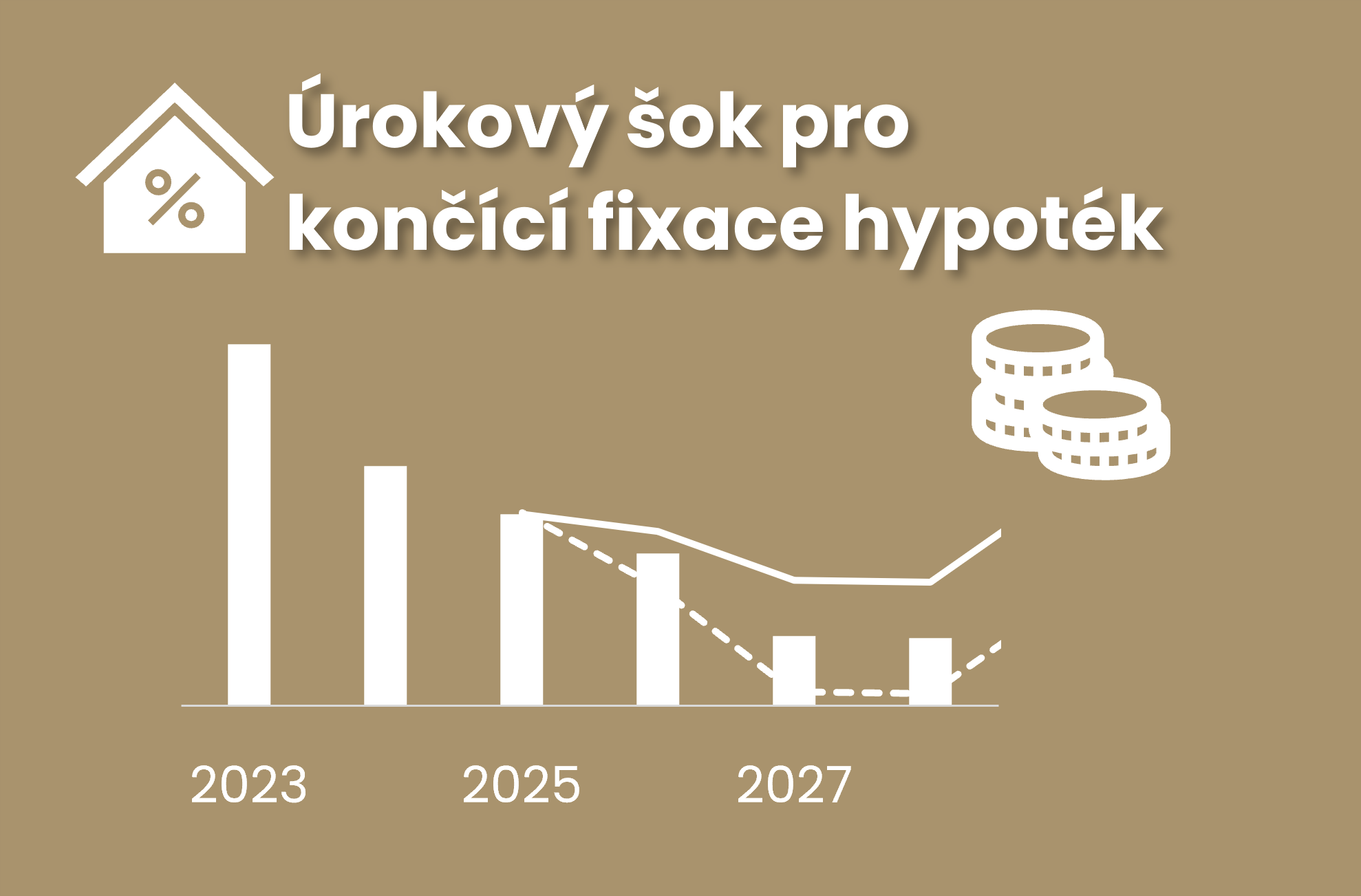
According to the central bank' s updated estimate, this year's expiring mortgage fixings (new and already refixed or refinanced) will reach CZK 472 billion, i.e. around 5.3% of GDP. This is almost double last year's volume of CZK 238 billion (2.8% of GDP).
However, fixations on newly granted mortgages (including refinancing) have shortened significantly in recent years. While according to CNB data, the share of fixations up to and including three years was around 6% of the volume in 2017-2022, this share quickly climbed to over 80% in 2024 and 93% in the final quarter of 2025.
Shorter fixings play a dual role in the coming interest rate shock:
(1) A further increase in the volume of ending mortgage fixings to CZK 533bn in 2027 (5.7% of GDP) and CZK 599bn (6.1% of GDP) in 2028. This is likely to be a few tens of billions more over the next year if we assume a c.10% share of two-year fixings, taking into account the CZK 131bn of new mortgages including refinancing in the first quarter of this year.
2) The composition of the interest rate shock. While for 2026 I estimate about a two-thirds share of ending fixings with a negative interest rate shock (that is, these mortgages were arranged at a lower than current interest rate), this share will fall to about one-fifth to one-quarter over the next two years.This share is about 20 p.p. lower in 2027 than if we use the CBA interest rates, which in 2022 and 2023 are lower than the CBA Hypomonitor interest rates in the other category, while they are similar in the new and refinanced categories. This positive trend reflects a significant reduction in the volume of mortgages with expiring fixes originated before 2022.

Source: the CNB (CZK billion), the CBA (% of GDP)

Source.
The size of the interest rate shock relative to this year's provisional lower realised mortgage rate
This composition of the interest rate shock also has implications for its magnitude, where I compare the estimated interest rate on ending mortgages to this year's provisional realised rate of 4.44%. This estimate suggests that the interest rate shock should be reduced to 1.1 percentage points this year from 1.6 percentage points in 2025. However, it is the larger share of mortgages with expiring fixings granted between 2022 and 2025 that should reduce the interest rate shock to 0.1 p.p. in 2027 and 2028.
Using the CNB's historical interest rates, the interest rate shock would reach 1.2 pp, 0.3 pp and 0.5 pp in 2026-2028. In contrast, the shock would reach around 3 and 2 pp in 2023 and 2024.
The distribution of mortgages with expiring fixings against this year's interest rate of 4.94% so far ...
Source: CNB, CBA estimate
... further mitigates the negative interest rate shock in 2027 and 2028

Source: CBA
An alternative scenario with a higher mortgage rate:
However, since the three-year interest rate swap has been hovering around 4.25% in recent weeks (see chart below left), we will also present an illustrative scenario of the size of the interest rate shock with a possible half-percentage point increase in mortgage rates to 4.94% in 2027 after 4.74% this year. This assumes a lower differential between mortgage interest rates and the longer-term market rate at 0.75ppt compared to its usual level of over 1ppt, which is comparable to overseas (see chart below right). We covered more on this topic here: Market forces in mortgage rates: the rise in market interest rates has had only a partial impact on mortgage rates. Strong competition in the market is helping.
The three-year interest rate swap has been hovering around 4.25% in recent weeks
The difference between the mortgage interest rate and the longer-term market rate is usually over 1 p.p., which is both comparable and lower than abroad
In a scenario of a gradual increase in the mortgage interest rate to 4.94% in 2027, the size of this year's negative interest rate shock would increase slightly to 1.4 bps. For example, in 2027, the interest rate shock on 2024 mortgages would turn from a positive shock to a neutral shock, and 2022 and 2025 mortgages would already have a negative interest rate shock instead of a slightly positive one.
Finally, I add another alternative scenario with an additional inflation-interest rate shock. This could, for example, occur in a situation of disrupted supply-side in the energy sector, leading to a larger price shock, but taking place with more European and Czech fiscal stimulus. In addition to this scenario, I recall the ongoing inflationary pressures from the Czech economy as well (see discussion here: the CNB's new outlook for higher rates has "only" translated into hawkish communication). In this scenario, there would be a more significant rise in market interest rates by an additional 0.5 p.p., which would therefore mechanically raise the hypothetical mortgage interest rate to 5.44% in 2027. This would only marginally mitigate the negative interest rate shock to 1.1 p.p. over the next two years from about 1.6 p.p. this year.
An alternative illustrative scenario of the amount of the interest rate shock with a higher interest rate of 4.94% and an additional shock of +0.5 p.p. compared to the scenario with an interim interest rate of ...
Source: CBA
... and in koruna's absolute terms

Source: CBA
The impact of different interest rate scenarios on the "typical" mortgagee in the coming years.
In 2026, maturities from 2021, when mortgages were granted at 2.24% on average,will dominate, thus representing a more significant negative interest rate shock of 2.2pps relative to this year's provisional rate of 4.44% and, illustratively, 2.5-2.7pps relative to the alternative higher rate. This is more than the full weighted interest rate shock of 1.1ppt and 1.4ppt respectively for this year, which includes additional maturities from recent years (see figure above left).
In 2021, a new mortgage of £3.3m was taken out (vs. The interest rate shock affects the remaining principal, which is expected to be around CZK 2.75 million in the middle of this year. The remaining maturity is 21.3 years. In this case, the average monthly payment will increase by approximately more than a fifth to CZK 16.7 thousand from around CZK 14 thousand originally.
The impact on the mortgagor depends on his average real wage. The increase in repayments in this case of around CZK 3 000 represents around 5,7 % of gross nominal wages, or half the impact in the case of a two-person average-wage household. In the case of a family with two children, the impact on their illustrative average net wage is approximately 3.5%. However, although average real wages returned to their pre-caucus level at the end of last year, they were about 2% below their 2021 level and about -5% in the case of a family with two children (for a closer look at the level of real wages and pensions, see the last chart in the study here: wages closed stronger last year and could add another 4% in real terms this year). However, the interest rate shock should more than cover this year 's expected real wage and salary growth on an annual basis.
Maturities in 2027 will be dominated by 2024, when mortgages were granted at an average of 5%, so this represents a slight positive interest rate shock of around 0.58bps to this year's provisional rate of 4.44%, but essentially no change to the alternative higher rate. This is close to a weighted negative interest rate shock of 0.1 pp for the full year, or 0.6 pp for the alternative higher rate. In this case, there is an illustrative 6% fall in the average monthly repayment to CZK 19,500 and households will see a 2.4% improvement relative to gross wages. This illustration belongs to the average new mortgage, which reached CZK 3.6 million in 2024.
Maturities in 2028 will be dominated by 2025, when mortgages were granted at an average of 4.57%, so this represents essentially a zero interest rate shock to this year's provisional mortgage rate of 4.44%, but is illustratively 0.2-0.4 p.p. relative to the alternative higher rate. This is less than the full weighted interest rate shock of 0.1 p.p. and 0.8 p.p. respectively for 2028.