Lower May inflation with stronger wage growth poses a triple dilemma for the CNB
Consumer price inflation slowed to 2.1% in May, surprising at a more moderate pace than the market had expected. However, some of the factors now dampening inflation may not be permanent. This is particularly true for food prices, which may be affected by rising global commodity prices in the months ahead. At the same time, strong wage growth of 8.1% year-on-year is divorced from labour productivity, creating pressures for higher core inflation. It is the contradiction between low headline inflation and persistent domestic inflationary pressures that poses a non-trivial economic and political dilemma for the CNB.
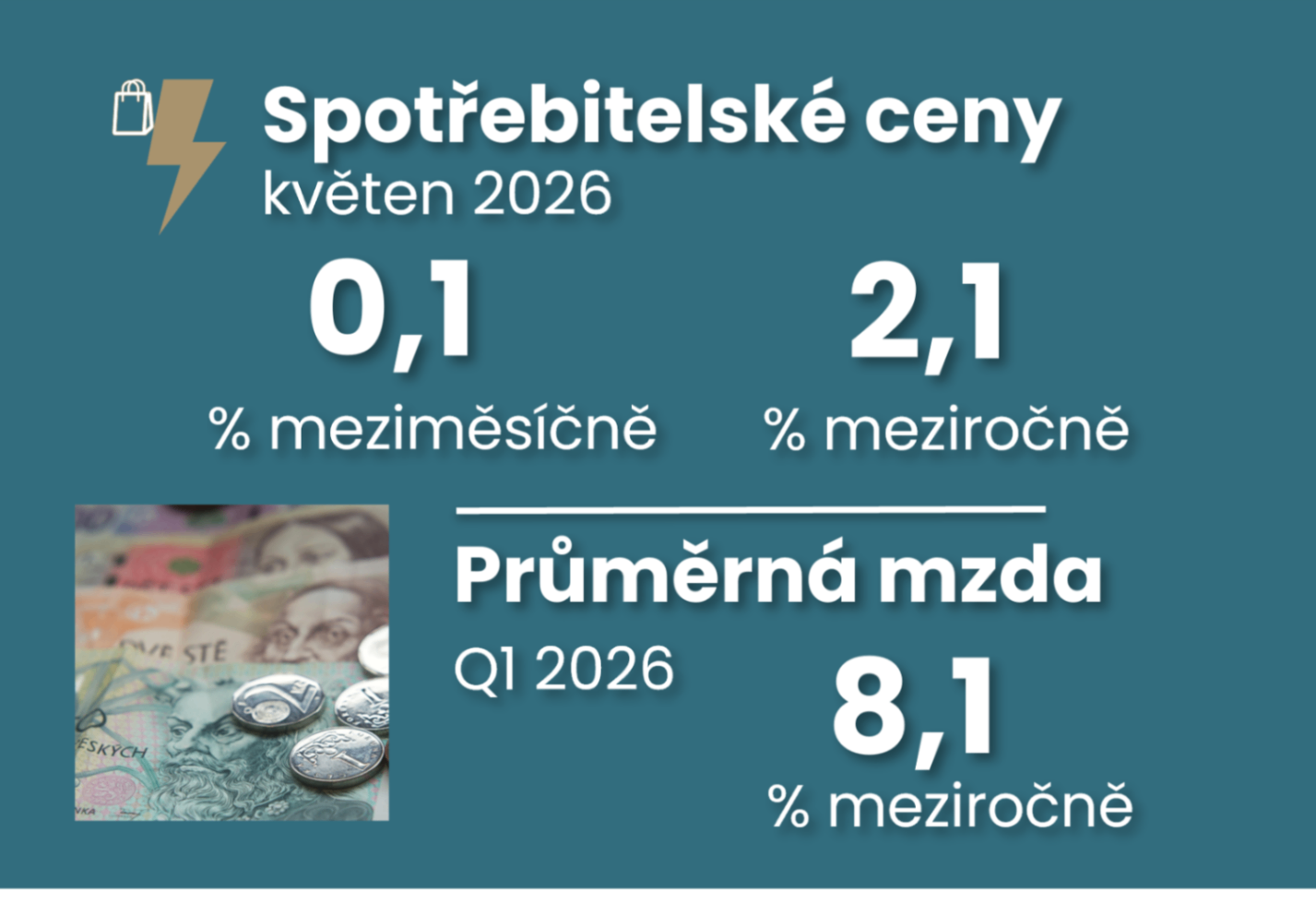
According to the CSO's preliminary estimate, annual consumer price inflation in May 2026 surprised by slowing to 2.1% from April's acceleration to 2.5%. This result is below the analyst consensus (2.4%) but in line with the CNB's forecast of 2.2%. The slowdown reflects lower food prices, slower growth for alcohol and tobacco, and a likely slight slowdown in core inflation to 2.7%.
However, two segments are taking weight off the disinflationary story of April inflation, namely food prices in view of global prices and also core inflation due to higher wage growth. However, without these factors, the April data signal the risk of weaker consumer inflation than the CBA forecast of 2.5% for this year, followed by 2.7% in 2027.
First, I do not foresee continued food disinflation in the quarters ahead. The current lower food growth reflects lower prices for Czech farmers, while producer food and import prices have already stagnated in April after a previous decline. Moreover, global prices have already reversed their upward trend since the new year, i.e. before the Hormuz crisis. Their impact has been cushioned for the time being by the solid development of the Czech koruna, but also by the reduction in excise duty on diesel. At the same time, the Central European disinflationary trend in food prices, which is not evident in Germany and the euro area, raises questions about its sustainability. Moreover, in view of higher global fertiliser prices, energy prices and the onset of a stronger El Nino climate phenomenon, a continuation in the coming quarters cannot be assumed.
Second, April's slowdown in core inflation brings rather only relief ... According to my preliminary estimate, core inflation is likely to have slowed to 2.7% yoy from 2.9% in April (the CNB was expecting 2.8% in May and 2.9% in June 2026). This estimate assumes a slightly milder 0.6% month-on-month increase in non-energy administered prices. This would suggest a slowdown in seasonally adjusted month-on-month core inflation to 0.1% from an average increase of 0.3% in the previous three months. The current three-month annualized average has slowed to 3%, which is, however, at the upper end of the upper tolerance band of the CNB's inflation target and above its 2.3% y/y core inflation forecast for Q2 2027. In addition, the CBA's forecast expects core inflation to rise by 2.6% yoy after 2.8% this year. The CZSO will publish the final May inflation data on 10 June, when the CNB will announce its core inflation estimate at 13:00 CET.
... as persistently strong inflationary wage growth does not support this trend. Why strong? Average wage growth accelerated to 8.1% y/y. This partially offsets the negative revision to last year's pace, which surprised negatively by 0.6 percentage point at 6.6%. However, the strong momentum of over 8% from the first quarter reflects an amplification to 2% quarter-on-quarter. This is 8% annualized, well above the 4.5% growth that is considered neutral to inflation. And it is also higher than the central bank's expected average growth of 1.4%.
Why inflationary? Because it is not accompanied by stronger labour productivity growth. That has long lagged behind wage growth. This gap has exceeded the CNB's expectations (see Chart 9 in the study The economy slowed in Q1, but its structure remains encouraging) and is putting pressure on producer and retailer profit margins, which are easier to maintain with strong real wage growth. And they rose 6.1% y/y. While higher price growth in Q2 is likely to temper this, it is well above the CBA' s 3.5% growth forecast for this year.
Moreover, wage growth is strong across sectors, including non-market sectors where the national accounts had suggested a slowdown. And across sectors, their momentum is outpacing non-inflationary growth. The strongest momentum persists in services, but has also strengthened in construction. In contrast, IT, finance and public administration, along with industry, have shown slower momentum. In the financial sector, and hence in banks, reasonable wage growth in line with productivity helped to maintain solid profitability with other cost items , despite a decline in the contribution from the net interest margin.
The triple dilemma for the CBN? The most noticeable is the Prime Minister's displeasure with the higher CBN rates (3.5%) compared to the ECB (2%) with such low inflation growth. While a decade or two ago it was true that CNB interest rates were near, and sometimes below, the ECB, it was also true that this was due to the disinflationary effect of core inflation. This was due to stronger productivity (foreign investment inflows) and a strengthening crown. However, due to the disruption of the export-industrial economic model and demographic change, this is no longer the case and core inflation is now inflationary.
The CNB's second dilemma precisely reflects the asymmetry in both core and headline inflation and their effects on the medium-term achievability of the inflation target. Headline inflation may suggest less difficulty in keeping inflation near the target. In my view, mistakenly, but this possibility cannot be ruled out. This factor is pushing the CNB interest rate stable and, were it not for higher energy prices due to the Iran war, down. However, the paradigm over the last decade has been that without core inflation near the target, meeting the inflation target is impossible due to the ongoing wave of supply-side geopolitical and climate price shocks. This is pushing the CNB interest rate higher, and were it not for the Iran war, given the ongoing inflationary pressure from unit labor costs, this would be a factor in the stability of CNB interest rates, not the decline that the CNB was inclined to see before the US and Israeli planes took off.
The third dilemma relates to stronger average wage growth, albeit after a negative revision to last year's numbers. However, the level of average wages is slightly (0.2%) above the CNB's forecast with 50.2k (51k seasonally adjusted) in Q1. This would have been a negligible difference, unless unit wage costs surprised with stronger growth and if prices of labour-intensive services slowed their price momentum. Even given the less detailed data sources on wages, such as the lack of data on percentiles and medians (due to the slower take-up of JHMZ), they will also pose a challenge for the CNB. In July, with the annual figures for 2025, we will see which way the unit labour cost story moves in the national economy figures.
The slower consumer price inflation was driven by lower food prices, moderate growth in alcohol and tobacco prices, and moderate but still strong core inflation
Wage growth surprised with stronger growth in the first quarter, but this partly reflects a negative revision to the previous year

Consumer prices


More food disinflation faces higher global fertilizer and energy prices, as well as an emerging stronger El Nino climate phenomenon

Lower food prices as a Central European phenomenon, not in the West

Wages and salaries
Wage growth in the first quarter exceeded expectations ...

... and while this surprise half reflects a negative revision last year, which showed average wage growth of 6.6% ...

... so the first quarter of this year brought stronger quarter-on-quarter growth ...

... which was particularly evident in real terms, but this is unlikely to continue in the second quarter.

The post-Covidian recovery in real gross wages is not yet over in the non-market sector ....

... which is also likely to be the story of net wages, which, however, in aggregate outpaced the recovery in gross wages by 3 percentage points. This is not the case for families with children in kindergarten

In 90% of sectors, wage growth is inflationary

It is mainly driven by the construction and services sector, but without IT and finance
Seasonality of monthly changes in consumer inflation
