October Inflation Does Not Undermine the CNB’s Unconventional Communication Strategy
What new insights did the details of October’s consumer price growth reveal? Food prices may no longer be holding inflation in check
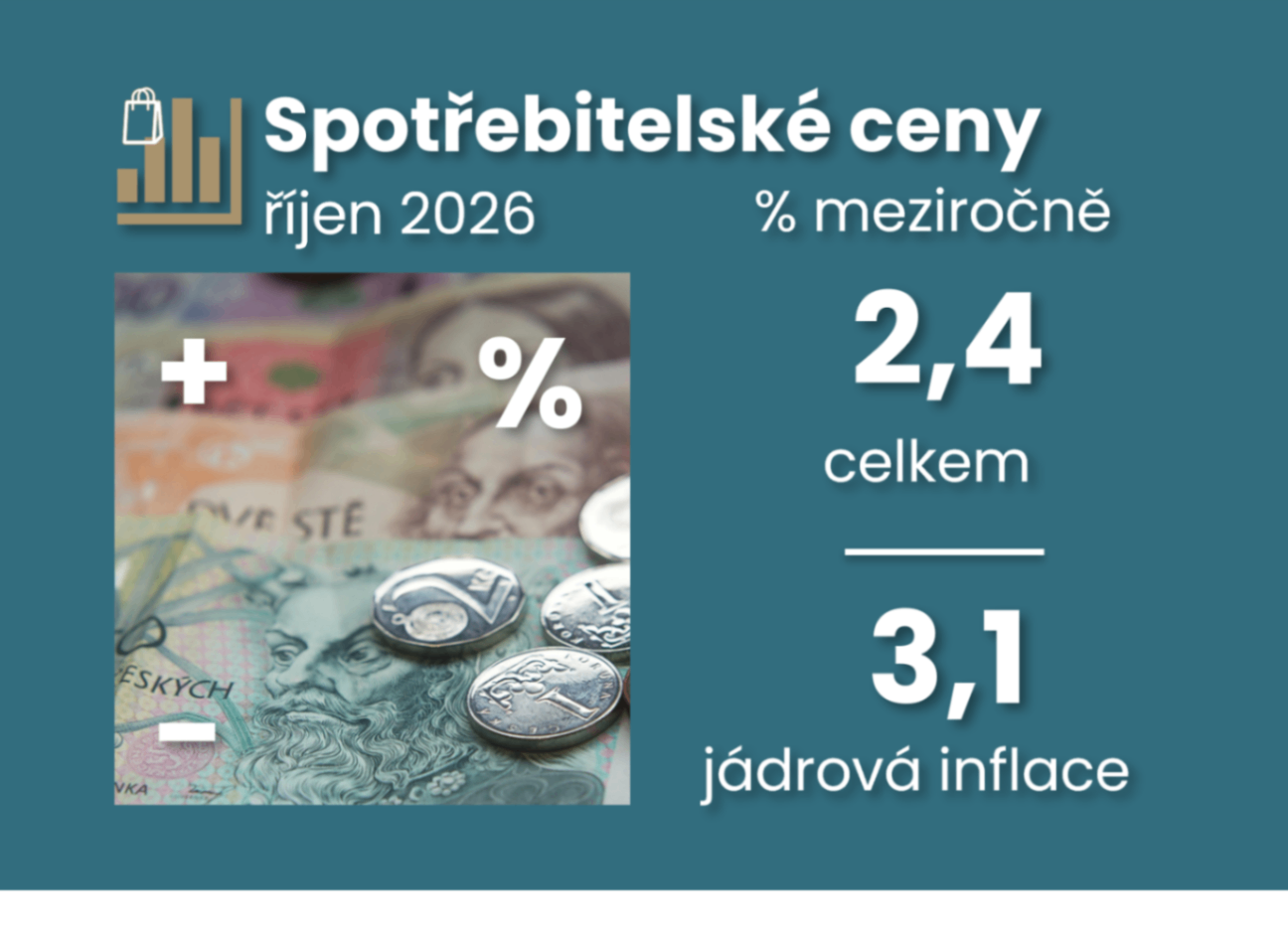
Inflation in October slowed slightly to 2.4% year-over-year. The flash estimate had already pointed to this. However, behind the scenes, the trend in food prices is likely shifting, as their October performance no longer lagged behind the usual seasonal pattern. If this trend continues, the negative year-over-year contribution of food prices to consumer price growth will reverse (see the chart below illustrating the impact of the global supply chain).
The detailed figures, however, brought two pieces of relatively good news that revise the initial conclusions from the flash estimate.
1. Price growth in the core segment did not accelerate and remained at 3.1% year-over-year, and the momentum also remains at approximately 3%.
2. The decline in fuel prices was greater than I had anticipated in the flash estimate. This suggests that household gas and electricity prices remained unchanged despite rising prices on the wholesale market, reflecting the structure of household contract terms.
… and also an interesting structure of core inflation: the same core inflation rate, but different sources of price increases
Three key factors stand out in October’s core inflation:
1. Faster price growth in the tradable component of core inflation—that is, non-energy goods excluding food. This reflects steadily rising retail demand, a koruna that is not strengthening, and rising prices for ICT equipment. A supply shock is evident in these areas. Strong demand makes it easier to pass on higher producer prices—caused by expensive chips—to consumer prices.
2. Continued strong price growth for core services compared with more moderate growth in labor-intensive services. In the case of core services, higher vacation prices have also been evident in the last two months, likely in connection with higher oil prices. From the CNB’s perspective, this may be a temporary phenomenon, and service prices may follow the more moderate growth seen in labor-intensive services. However, this slowdown may be hampered by persistently solid wage growth without a significant increase in productivity (see the discussion and charts below).
3. A noticeable slowdown in the growth of imputed rent. However, its growth has slowed more sharply than key inputs suggest (see the chart below).
Here I will digress to discuss actual rents. The chart below shows that actual rents (red line) have almost caught up with the previous rise in the overall price level (blue line). However, a gap still persists relative to imputed rent (yellow line), which may indicate that actual rent continues to grow faster than the overall consumer price level.
And how is the real economy faring? More people employed, but only a slight shift in productivity
From an inflation perspective, it is important to note that GDP growth is not accompanied by a corresponding increase in productivity. GDP growth accelerated to 0.5% quarter-on-quarter in the third quarter, following weaker growth of 0.3% in the second quarter and 0.1% in the first quarter of this year. At the same time, GDP growth was again accompanied by a relatively strong quarter-over-quarter increase in employment of 0.3%, which is in line with the average increase over the past three to five years. Weak progress in productivity, as measured by the difference between GDP growth and employment growth, is even more evident in year-over-year comparisons. GDP growth slowed from 1.8% in the second quarter to 1.6% in the third, while employment maintained a 1.5% year-over-year growth rate.
According to the Czech Statistical Office (CZSO), growth was driven by household consumption and net exports, while investment (including inventories) dampened the economy. This is consistent with the monthly figures, which show that the economic recovery in the third quarter was driven by manufacturing, core retail sales, and exports (see charts below).
The cards for the upcoming forecast have almost been dealt. Although the acceleration in GDP growth was in line with expectations, the growth rate fell short of the CBA’s August forecast. In the third quarter, the gap was only 0.1 percentage points, but cumulatively since the beginning of the year, it has widened by 0.3 percentage points due to downward revisions of first-half data. The August forecast had anticipated a slight acceleration in GDP growth to 0.6% in the final quarter of this year, but higher energy prices, a weaker economic sentiment, a slump in the German automotive industry, and higher interest rates pose a risk of slower growth.
If quarter-over-quarter GDP growth remains unchanged at 0.5% in the fourth quarter, full-year growth would slow from 2.7% in 2025 to 1.7% this year. Over the course of the year alone, the economy would grow by only 1.3%. The full-year result would thus fall short of the 2% projected for this year in the CBA’s August forecast. For 2027, it projected an acceleration to 2.2%. The CBA’s new forecast will be released on November 18.
Inflation in October slowed slightly to 2.4% year-over-year, while core inflation remained at 3.1%.

However, the trend in food prices is likely changing in the background. Their performance in October was no longer lagging behind the usual seasonal pattern.

If this trend continues, the negative contribution of food prices to year-over-year inflation will reverse.

Food prices on global markets had already begun to trend in a different direction. This shift began to be reflected in import prices, farm-gate prices, and, to a lesser extent, food manufacturer prices.

The composition of the annualized core inflation rate has changed significantly, particularly for tradable goods and imputed rent, but also for labor-intensive services …

... as confirmed by the adjusted month-over-month data

The growth in imputed rent slowed more sharply than key inputs suggest.

Actual rents have almost caught up with the previous rise in the overall price level. However, a gap remains compared to imputed rent, which will likely close over time as well. This gap also reflects higher mortgage costs relative to rent and higher construction costs.

Three Selected Charts Showing Interesting Seasonal Patterns
Are Vacation Prices Being Affected by Higher Oil Prices?

Chip prices are reflected in consumer prices.

Healthcare costs continue to rise.

Charts on the Real Economy
Economic growth continues without significant gains in productivity

The economic recovery stalled, particularly in the first half of this year

Does the September decline in unemployment, as indicated by the sample survey, suggest that unemployment has already peaked, even though registered unemployment remained flat in October?

Wage growth in the manufacturing sector remains strong

Solid industrial figures are accompanied by an improvement in sentiment, which is particularly evident in the Purchasing Managers' Index (PMI). The October confidence indicator for the Czech manufacturing sector came in weaker

The recovery was already evident in the September data on industrial production and exports. In recent months, the ICT sector, electrical equipment, and machinery have been performing particularly well.

Industrial production in September was driven by stronger performance in the automotive industry…

… but also energy-intensive industries.

In September, the construction industry relied less on the construction segment ...

… but the floor area of newly approved apartments remains high (dark blue, right axis). The graph compares it to the number of apartments under construction (red, left axis).

While the services sector struggled somewhat in the third quarter, retail continued to grow, primarily thanks to the core segment

The economic recovery in the third quarter was driven by manufacturing, core retail sales, and exports

