The Czech economy picked up slightly, but growth remained below the CNB's forecast
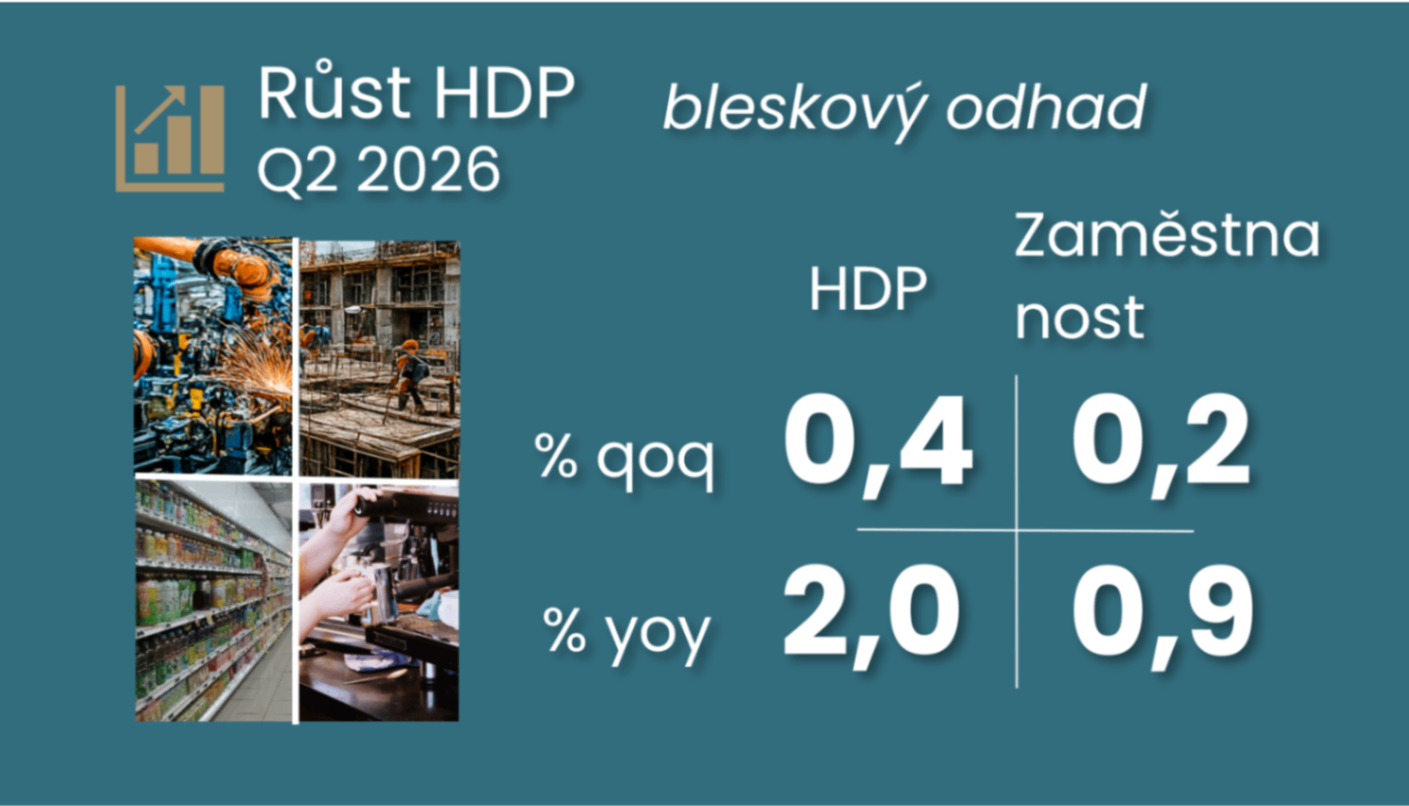
According to a preliminary estimate, the Czech economy grew by 0.4% quarter-over-quarter in the second quarter, double the 0.2% growth rate recorded in the first quarter. This growth rate matched the stronger performance of the eurozone, where, however, the core bloc—namely Germany, Italy, and France—posted weaker growth of 0.2%. GDP growth once again fell slightly short of the Czech National Bank’s forecast, thus sending a slightly dovish signal regarding the stability of its interest rate.
The more moderate acceleration in GDP growth was in line with the Czech Banking Association’s (CBA) forecast, which anticipates a slight acceleration to 0.5% quarter-on-quarter in the second half of the year—though this would still lag behind last year’s stronger growth of 0.7%.As a result, we expect year-over-year economic growth to stagnate around 2% in the third quarter as well, following a slowdown in the second quarter from 2.2% in the previous quarter. The economy is thus expected to post weaker growth of 2% following 2.7% growth in 2025, with growth not picking up until the end of next year.
GDP growth thus fell slightly short of the CNB’s forecast (0.6%), and its cumulative deviation, including the first quarter, widened to 0.5 percentage points. This can be seen as a slightly dovish signal, especially if the data show less inflationary wage growth, which will support a further slowdown in core inflation.
The Statistical Office identified household consumption and the trade balance—supported by industrial activity and most services—as the drivers of quarter-on-quarter growth in the second quarter of this year, while investment activity dampened growth.
Stronger household consumption came as no surprise following a slowdown in the first quarter to 0.1% growth after a stronger finish to last year. Although monthly retail sales figures for April and May did not show stronger growth, they were, in fact, stronger than consumption in GDP during the first quarter. Furthermore, household sentiment regarding major purchases remained solid, and consumer credit also remained strong. Despite higher unemployment—registered at around 5% and survey-based at 3.3%— —remains strong, and wage growth is solid, further supported by lower-than-expected consumer price inflation—which, against the backdrop of the Iran conflict and higher fuel prices, reached 1.5% year-over-year in June thanks to lower food prices.
We’ll see how the reported decline in investment activity plays out, though this was likely offset in the second quarter by stronger inventory buildup in the first quarter and by the fact that fixed investment was abnormally driven by investments in transportation equipment in the first quarter. Higher industrial capacity utilization—an above-average 84.8% – and stronger lending activity, up 2 percentage points to 10.7% of GDP for new loans to businesses, represent positive factors for a future recovery in investment activity.
Improved industrial performance is also reflected in more favorable figures for April and May, despite weaker results in the automotive industry, while energy-intensive sectors, on the other hand, performed well. The construction sector also posted solid quarter-over-quarter growth from April through May, but this statistically reflects strong March figures, while output actually weakened in April and May.
Foreign trade did contribute positively to quarter-over-quarter GDP growth in the second quarter, and eurozone GDP growth also strengthened. However, export growth slowed in April and May following the previous two quarters. The positive contribution from foreign trade is thus driven by a more pronounced slowdown in imports.
Although quarter-over-quarter GDP growth accelerated slightly in the second quarter ...

... including productivity, as employment increased by only 0.2%, although wage developments will be more important.

Its quarter-over-quarter growth was driven by household consumption, industry, most services, and the foreign trade balance ...

... which is also consistent with the monthly economic activity figures for April through May

GDP growth is falling short of the central bank's expectations

Sentiment remains strong, though it is vulnerable given the geopolitical situation
