December activity closed the end of last year on a solid note
Comment by Jaromír Šindel, Chief Economist of the CBA: December data brought a positive end to the year with continued better-than-expected industrial production, including its structure. The same is true for construction output, which returned to a better performance, but the weaker number of building permits remains a drag. Foreign trade posted an improved surplus of over 25 billion kronor in December and nearly 220 billion kronor for the full year 2025. This is equivalent to 2.6% of GDP, down from 2.8% a year ago. While retail trade did not impress at the end of the year, this was not the case for industrial wages, which returned to double-digit annualized growth at the end of the year. Overall, the December data should not prompt more dovish rhetoric from the CNB, as it does not yet signal a disinflationary contribution from the real economy towards core inflation. However, in its new, stronger outlook, the CNB is also assuming an improvement in labour productivity, which, together with tighter monetary conditions, will bring inflation back towards its target.
The CNB's new forecast for this year is for stronger - less inflationary - GDP growth of almost 3% year on year. This is also supported by stronger real wage growth of 1 pp, i.e. 4.5% yoy. However, taking inflation into account, the CNB also expects stronger labour productivity growth of 2.5% yoy (+0.6 pp vs. the original forecast), which will lead to only slightly stronger unit labour cost growth of 3.6% this year (+0.3 pp). Detailed Q4 CNB GDP numbers will give a clue (on March 3) as to whether we are on this disinflationary trajectory - the CNB expects unit labour costs to rise by 5.7% y/y with nominal wages in market sectors rising by an average of 6.9% y/y.
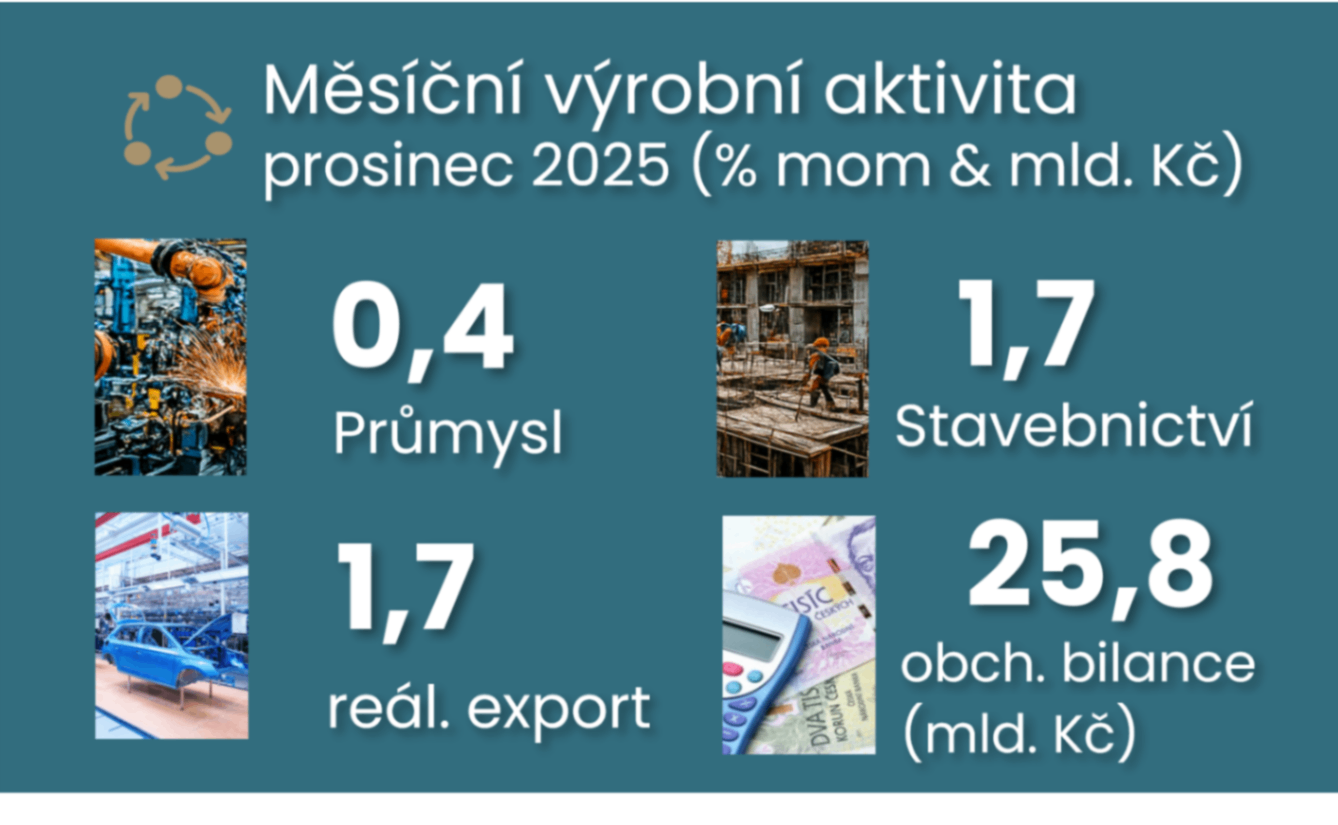
Back to the December figures: those for the end of 2025 point to a marked improvement in the short-term growth rate of the Czech economy, including manufacturing. December's figures are affected by calendar effects, but seasonally adjusted data point to a solid 0.8% increase in manufacturing output, following a 2.5% improvement in November. Automotive declined in December, but after previous stronger numbers. Energy-intensive output also held positive, but asymmetrically across sectors (minerals and chemicals vs. inferior metals). The three-month moving average annualized growth rate (3mma SAAR) for the industrial sector was 11.4% in December, with the automotive sector posting even more than 20%. This confirms that the industry has become the main driver of the cyclical recovery, despite the persistent structural risks in the European economy and the worse industrial sentiment. The latter resulted in a decline in capacity utilisation in January, with persistent weak demand as a constraint on industrial activity.
The construction sector finally surprised positively in December with its 1.7% month-on-month recovery. The combination of year-on-year growth and improved month-on-month momentum may signal a cyclical bottom has been reached, especially if the rebound in infrastructure investment this year is confirmed. However, building permits statistics remain rather negative and do not suggest a significant improvement (see ytd developments in the chart below). Across the country, some 23,000 dwellings were permitted in 2025, 5% lower than in 2024 and more than a fifth below the five-year average. The number of housing starts reached 35.5 thousand, down 2.9% y-o-y, which may indicate continued investor caution or limits on the supply side as well. On the other hand, completed apartments showed solid numbers last year with a similar increase of 11.5% y-o-y to 33.7 thousand, driven mainly by completed projects from previous years, But even so, this is less than 5% below the previous five-year average. Prague remains the weak link, with completions down 18% y-o-y, amid a simultaneous decline in both permits (-3.3%) and starts (-10%). Outside of Prague, the situation is more favourable, especially for completions, where y-o-y growth reached almost 20%, amid a steady trend in starts and a 5% decline in permits.
Foreign trade also delivered a solid result, with the monthly surplus returning to CZK 26 billion, thanks to a solid export performance and weaker imports after their strong increase in November. For export activity, the return to higher exports to the US is positive, marking a possible end to the hypothesis of overstocking of US exports related to tariff wars. Looking at the foreign trade surplus, I don't see significant structural movements and its structure (excluding autos, energy, etc.) looks similar to 2025 (see chart below).
On December's unglamorous retail trade , see analysis here. While not encouraging, household plans remain strong, which is consistent with stronger industrial wage growth (see chart below).
The services numbers are not yet available, but the numbers so far look consistent with the already published 0.5% quarter-on-quarter GDP growth in Q4.


Note: Unless otherwise stated, we use seasonally adjusted figures in the text. Annualized developments show possible year-on-year growth in the annual outlook if current month-on-month dynamics were to be maintained.