Slight economic slowdown in late 2025 and this year is poised to repeat last year's 2.5% growth
Comment by Jaromír Šindel, Chief Economist of the CBA: Economic growth slowed down at the end of last year, but still achieved solid 0.5% quarter-on-quarter GDP growth.The structure of growth has not changed significantly - consumption is dominant, which is probably not true of investment. This is in line with the latest sentiment data. A more positive sign is improving productivity. The outlook for this year is a repeat of last year's 2.5% growth, thanks to a better outlook for real wage growth and a change in fiscal policy. Conversely, weaker external demand, even given industrial sentiment, is likely to be a drag on stronger economic growth.
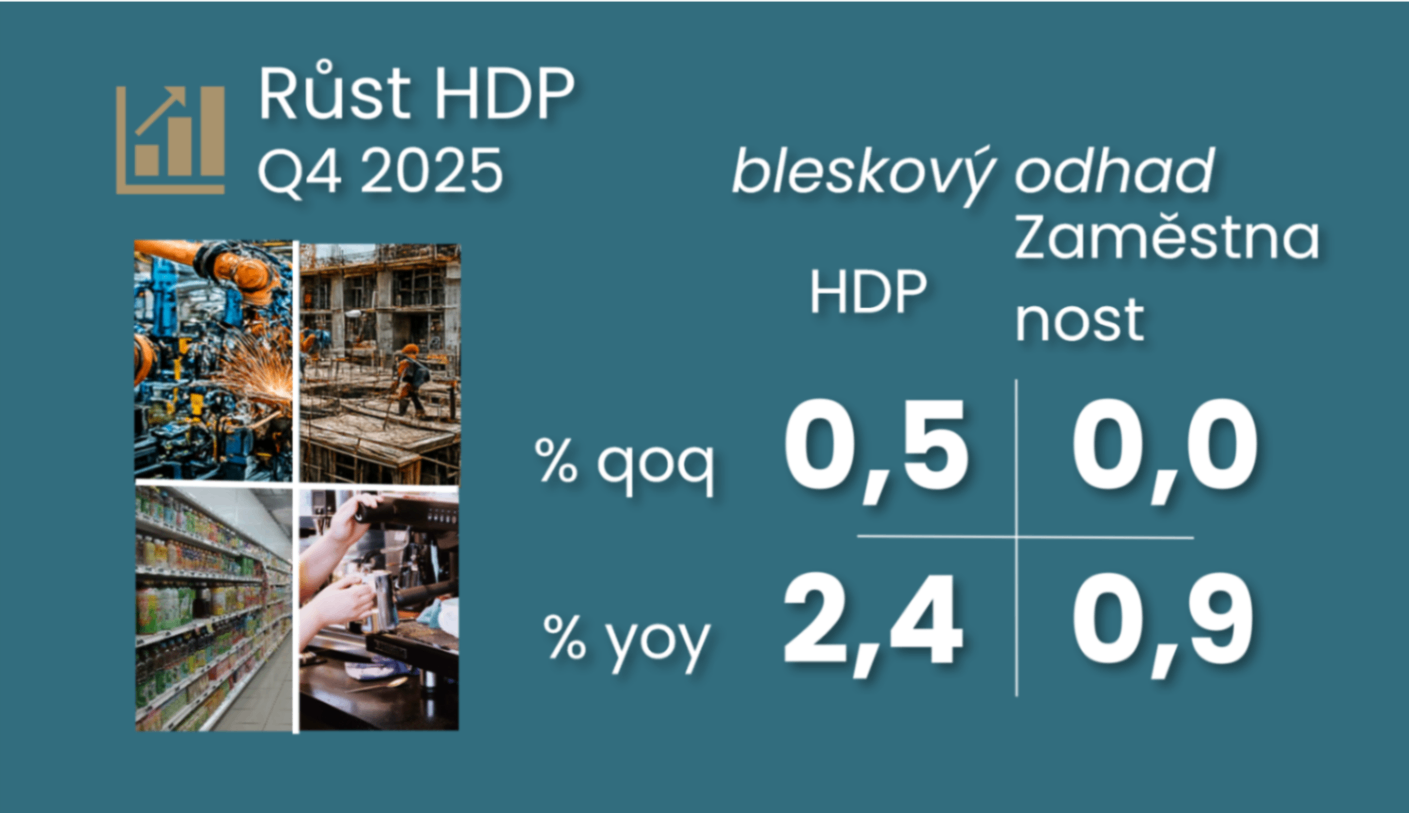
The final quarter of last year again brought a positive surprise in terms of GDP growth, at 0.5% quarter-on-quarter (vs. my expectation of 0.4% or hints of a slowdown from the CNB leading indicator), but the result is in line with the CBA Consensus Forecast. According to the CSO, the economy was driven by consumption and, to some extent, foreign trade. Surprisingly, mainly due to the dynamism of net exports during October and November. Among the surprises, I would include the missing industry in the list, whose October and November activity grew at 1.7% q/q (see analysis here). Thus, the economy slowed only slightly from the average 0.6% growth in the previous three quarters (which was also the average in 2025) and matched the average q/q growth in 2024.
Weaker investment activity is likely to be a disappointment again, but this is not so surprising given weaker construction activity in the second half of last year and given economic sentiment (see January's Stable Economic Sentiment hides four clearer signals for growth and inflation) from the turn of last year. This points to persistent weakness in industrial demand with a decline in capacity utilisation. On the other hand, consumer plans for larger purchases remain strong, amid falling price expectations. Economic sentiment is thus not conducive to expectations of a significant change in the growth structure of the Czech economy.
However, slightly weaker economic growth is also accompanied by unchanged employment, essentially throughout the second half of last year, resulting in a slight slowdown in annual growth to 0.9% at the end of 2025. This development thus partly reflects rising unemployment (see Chart 4 below); it is a trend of the past year that only moderated slightly at its very end (see analysis here).
The partly positive news for the CNB is that consumption-driven GDP growth has also been accompanied by better employment productivity figures. Thanks to unchanged employment at the end of last year, the latter rose by 0.5% q-o-q and its annual growth has thus stabilised at 1.5% (see the third chart below). Why partly? Because, while we have seen more moderate growth in employees in the previous two quarters, it has been accompanied by higher employee utilization, which means that productivity per hour worked has been weakening in the previous two quarters. The CZSO will supplement this picture with more detailed data on 3 March.
GDP growth thus reached 2.4% y/y at the end of last year and 2.5% for the full year, a marked improvement on the 1.1% in 2024 and better than earlier expectations, such as the 1.7% of last May, which was plagued by negative shocks from Trump's tariff wars (the expectation at the start of 2025 was for 2.1% GDP growth last year). This year should again be supported by government investment activity (see hints of shifts on the spending side of the proposed state budget for this year), which combined with likely stronger real wage growth (probably closer to 4% than the 3.3% originally expected for 2026 after 4.3% in 2025) should boost the economy this year.
Upside risks to the consensus November CBA forecast, which was looking for 2.2% y/y economic growth this year (due to a slowdown in late 2025) with still solid quarter-on-quarter GDP growth of 0.6%, on average the same as last year. The already improved performance of the economy in the third quarter suggested stronger annual growth of around 2.4% for this year. Further, stronger real wage growth (thanks to lower inflation) and looser fiscal policy may add 0.2-0.3 percentage points, which would push the outlook for this year's GDP improvement above 2.5% (the CNB in November expected 2.4% growth this year, which is the current MinFin projection for January). Conversely, the risk to growth this year is the strength of the German economic recovery, which may dampen the improvement in the outlook for this year. This is compounded by overall external demand in the event of a more significant correction in financial markets, which has resonated in recent weeks in conversations with CNB officials (see here or here). According to the CNB, the beginning of this year has also started weakly (see the fourth chart here).