October output disappoints, wages, consumption and historic foreign trade surplus keep driving growth
Comment by Jaromír Šindel, Chief Economist of the CBA: The manufacturing part of the Czech economy remained subdued in October, which supports expectations of weaker GDP growth at the end of this year. However, a post-covetous historical foreign trade surplus is supporting the crown, which, together with a persistently solid wage pace, supported October retail sales. This part of the recent Czech growth model thus remains unchanged, but this is no longer the case for the construction sector, where persistent weakness in building permits and uncertainty over investment financing pose downside risks next year.
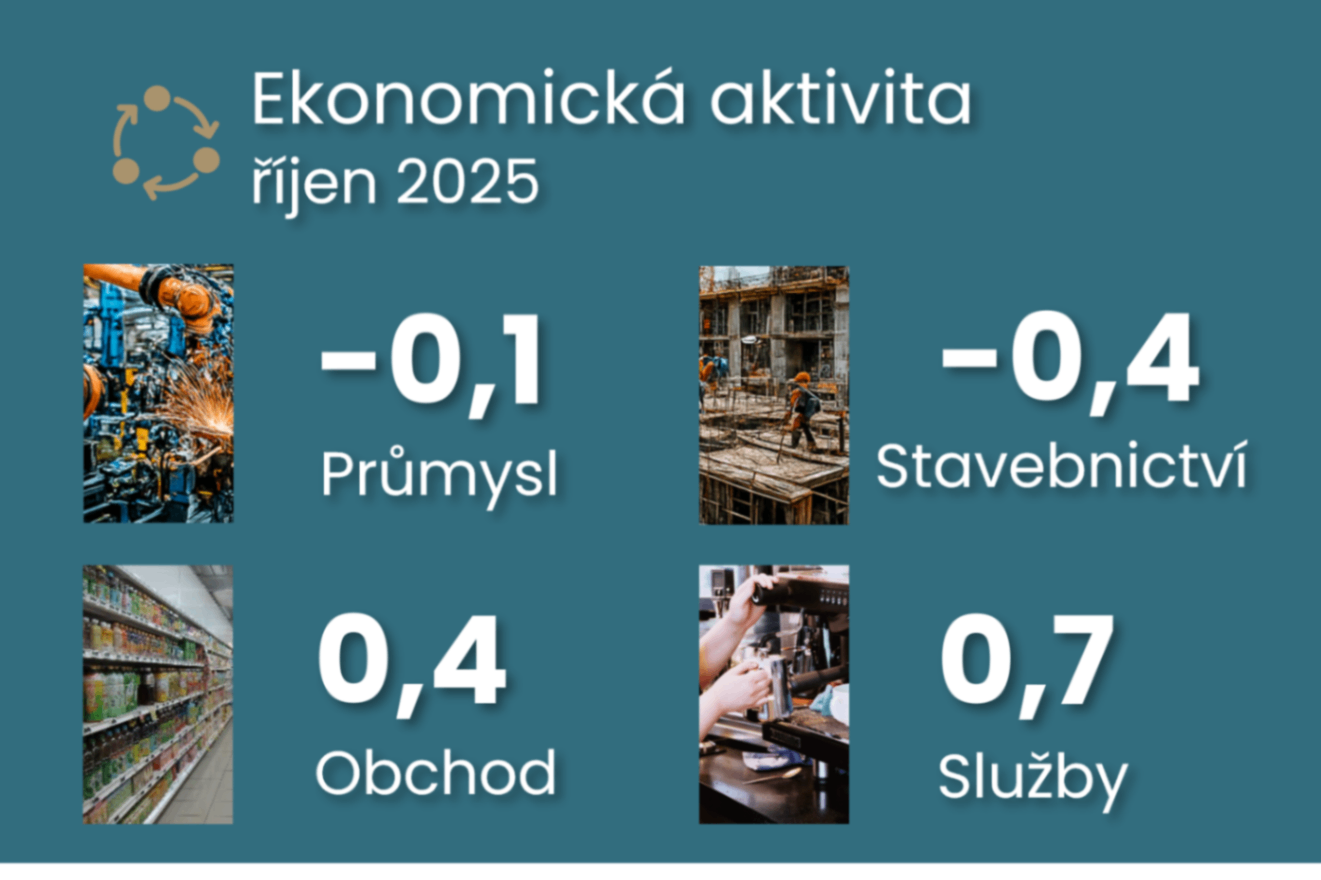
October industrial production remained in decline (almost unchanged month-on-month) due to a decline in manufacturing, including the automotive segment, despite a recovery in energy-intensive production and in the energy sector itself (which should support growth in November). The return of weakness to November industrial sentiment does not suggest an early recovery from the ongoing industrial stagnation.
Unsurprisingly, exports also fell (also due to the effect of the previous frontloading of exports to the US), but so did imports, also due to lower energy imports. As a result, foreign trade reached a historic post-covide surplus of CZK 30bn (seasonally adjusted). However, even without energy, it has been running strong surpluses in recent months. These are helping a stronger crown and thus supporting a recovery in consumption.
Construction output also fell slightly by 0.4% in October, on top of a nearly 2% decline in September, due to a weaker print in infrastructure construction and a nearly five-month stagnation in the buildings segment. Year-on-year, the sector as a whole thus increased its output by more than 8% in October, but the current six-month momentum signals a slight slowdown. Continued weakness in building permits statistics and uncertainty over the financing of government infrastructure investments next year will pose a challenge to economic growth following their positive contribution this year.
Industrial wages have maintained a solid pace despite stagnating output, up 5.8% y/y in October, but with still strong month-on-month growth, which has annualized at around 8% over the past three months. This is taking place against a backdrop of a slight decline in the labour force, of around 1.4% yoy.
Added to this is still high wage growth, which slowed to 7.1% y/y in the third quarter from 7.6% in the previous quarter. In real terms, wages grew by 4.5% yoy. But household consumption "only" grew by 3%, as real disposable income growth probably stayed around 1% y/y.
Not entirely surprisingly, retail sales in October returned to stronger growth after a stumble in September, which was particularly evident in non-food goods. Looking at households' plans for larger purchases in November (see below), as well as the still solid pace of real wage growth, a continuation of positive retail sales numbers is likely in the months ahead.
Consumer demand should continue at a solid pace next year, thanks to a strong recovery in the Czech economy. This should stabilise the labour market, i.e. halt this year's trend of rising unemployment, and consumer demand is also likely to be supported more by fiscal policy at a later stage. Wages are rising fast, but productivity per hour worked is still lagging. As a result, wage pressure on prices continues. This will dampen the scope for a dovish central bank response. The latter is likely to wait to see how the new government's fiscal and structural policies crystallise.
The industry does not support the growth model and the construction sector is also lagging ...
... which does not apply to retail and services
The industry is also losing ground due to the automotive segment
...which is reflected in exports...
... which also reflects the previous "frontloading" of exports to the US...
... but smaller energy imports lead to historic surpluses in foreign trade
Industrial wages are maintaining a solid pace despite stagnating output,
... and households' plans for major purchases
Retail and services sales growth in recent months singalizes better year-on-year dynamics