Food and energy prices kept inflation at 2.1% in December
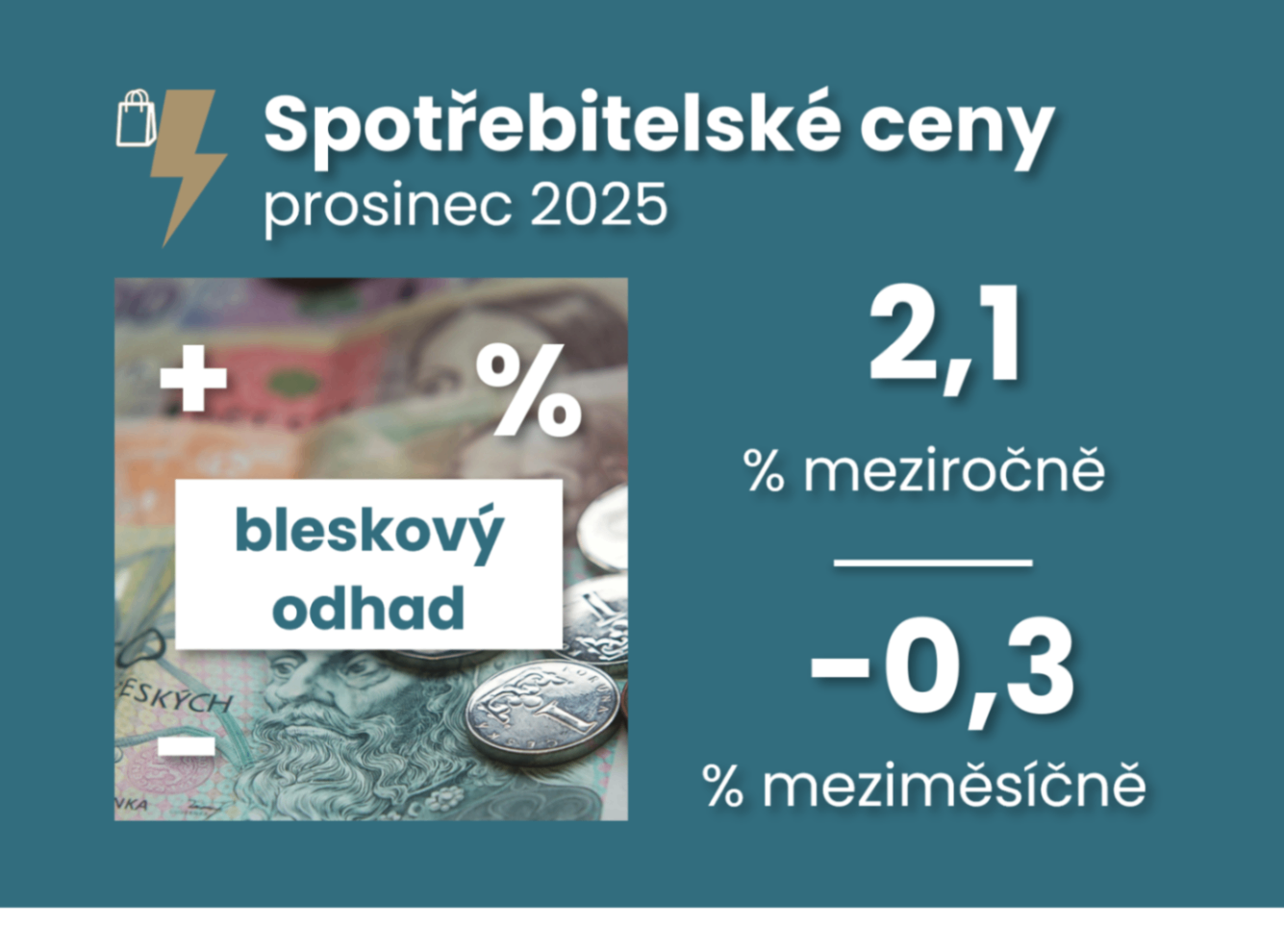
Consumer prices thus rose by 2.5% yoy last year, after 2.4% the previous year. These were much more moderate increases than the 7.1% average of the previous five years. Only 2018 was already lower at 2.1%. Consumer inflation was thus in the middle of the upper half of the CNB's tolerance band for the target (2 ± 1 p.p.) last year. Core inflation, on the other hand, accelerated slightly to 2.7% last year from 2.5% in 2024, mainly reflecting higher property prices and continued stronger wage growth without corresponding productivity gains, while a stronger koruna helped dampen demand pressures from consumption.
New energy prices are likely to lead to a downward revision of the CNB's outlook for consumer inflation this year to around 2.2%, which is in line with the CBA's forecast. However, both forecasts are likely to be underestimated by 0.3-0.4 pp due to the shift of the renewable energy payment to the state budget. This should be compounded by a stabilisation of core inflation at a lower level of around 2.5% yoy after 2.7% last year(its December recovery to 2.8% yoy is not a risk here). This is probably due to slower house price growth, a stronger koruna and moderate wage growth, which should be accompanied by higher productivity(this assumption is not yet evident in the data from the Czech economy, see link above).
According to my preliminary estimate, core inflation is likely to have accelerated to around 2.75% y-o-y from 2.6% in November (however, the CNB was expecting 2.9%). This estimate assumes a slightly milder 0.1% month-on-month increase in non-energy administered prices. If this is correct, then seasonally-adjusted month-on-month core inflation would have accelerated to 0.39% in December from an average 0.12% month-on-month increase in the previous three months, influenced by November's short-lived drop to zero.
This implies an acceleration in annualized core inflation growth over the past three months to 2.5% (from 1.4% in the previous three months), which is above the midpoint of the CNB's inflation target and above its core inflation forecast of 2.3% y/y for Q4 2026. At the six-month horizon, i.e. for April 26 to June 26, I look for annualized core inflation momentum at 2.5%, above the CNB's inflation target. The CBA forecast envisages a slowdown in the pace of core inflation to 2.5% in 2026 from 2.7% this year.
The CZSO will publish the final December inflation data on 13 January, when the CNB will announce its core inflation estimate at 13:00 CET.


