Volatile food prices pushed November inflation down to 2.1% amid still strong 7.1% wage growth
Comment by Jaromír Šindel, Chief Economist of the CBA: Consumer price growth slowed to 2.1% yoy in November. The main reason was a deeper decline in food prices, partly due to a slowdown in core inflation from the recent 2.8%. Thus, although inflation surprised positively, food price volatility and still strong rapid wage growth of 7.1% in Q3 will dampen the CNB's willingness to return to rate cuts. And the same reasons dampen the risks to the CBA's outlook for consumer inflation next year at around 2.2%. There remains a significant gap in the recovery in real gross wages between the market and non-market sectors.
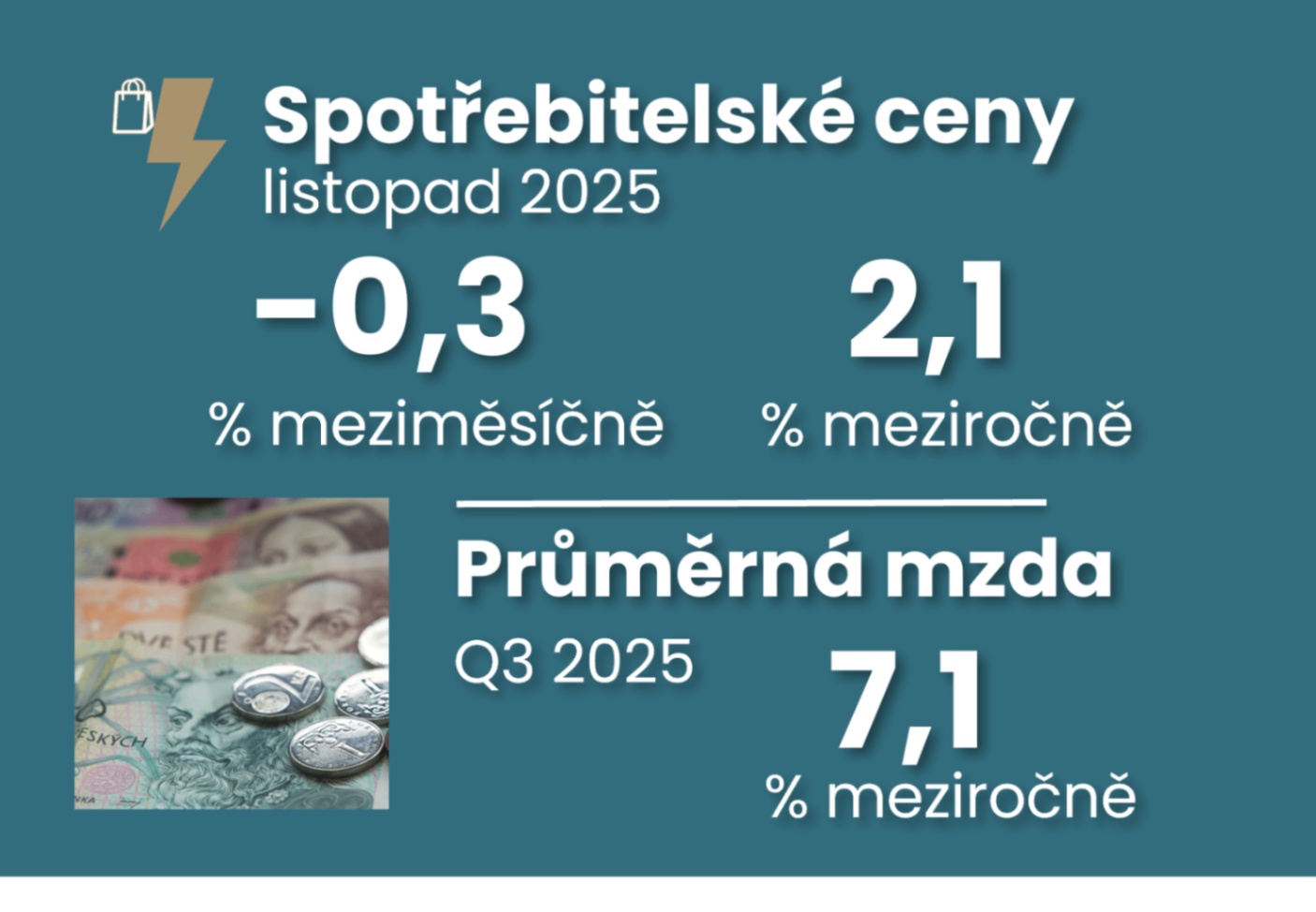
Nominal gross wages rose on average by 7.1 % year-on-year in the third quarter, reaching CZK 48.3 thousand (or CZK 49.6 thousand after seasonal adjustment), supported by a still strong quarter-on-quarter increase of 1.7 %. However, median wages grew at a slower 6.2% y-o-y pace. Q3 saw diverging quarter-on-quarter growth across sectors with weaker wage growth in industry, while the services sector maintained strong growth, particularly in ICT and real estate services, and wage growth in finance corrected the previous "zero" quarter.
Although annual nominal wage growth in the third quarter was similar across market and non-market sectors, I estimate slower quarter-on-quarter wage growth in non-market sectors than in market sectors. This keeps the scissors open between the rate of post-Covidian real gross wage recovery in market sectors (+28%) versus non-market sectors (-7.9%). Average real disposable income is about 4.2% higher than at the end of 2019.
Although real gross wages slowed only slightly to 4.5 % year-on-year in the third quarter, this does not signal a strong impulse for household consumption, as I expect real disposable income growth to remain around 1 % year-on-year. From another perspective, real wages did increase quarter-on-quarter by 0.9 % (a slower pace compared with the 1.5 % increase in Q2), but median wages decelerated to a 0.5 % quarterly growth rate. This perspective better fits a weaker private consumption growth at 0.3% qoq in Q3.
According to the CSO's preliminary estimate, annual consumer price growth slowed to 2.1% in November 2025 from 2.5% in October. This result is below analysts' consensus (2.5%), but also below the CNB's forecast (2.2% after its overshoot of 0.3% point in the previous month). On a month-on-month basis, consumer prices fell by -0.3% in November, about 0.4% point lower than normal. This mainly reflects stronger-than-normal declines in food, alcohol and tobacco prices.
Given the recent volatility in food prices and high wage growth accompanied by high unit cost growth, November's consumer price data do not pose a significant risk to our 2.2% outlook for next year following their 2.5% increase this year.
According to my preliminary estimate, core inflation is likely to have slowed to 2.6%-2.7% y-o-y from 2.8% in October (the CNB was expecting 2.8%). This estimate assumes a slightly milder 0.5% month-on-month increase in non-energy administered prices. If this is correct, then seasonally-adjusted month-on-month core inflation growth would have slowed to zero in November after averaging a 0.25% month-on-month increase in the previous three months (the current three-month annualized average is 1.3%). At the six-month horizon, i.e. for March 26 to May 26, I expect annualized core inflation momentum to be 2.3%, which is close to the CBA's forecast of 2.3% y/y for Q4 2026. The CBA forecast envisages a slowdown in the pace of core inflation to 2.5% in 2026 from 2.7% this year.
The CSO will publish the final November inflation data on 10 December, when the CBA will announce its estimate of core inflation at 13:00 CET.
Nominal wages had risen by 7.1% yoy on average in Q3, with continued strong quarter-on-quarter growth of 1.7%.

Although annual nominal wage growth in Q3 was similar across market and non-market sectors, I estimate slower quarter-on-quarter wage growth in non-market sectors than in market sectors. This


The extent of non-inflationary wage growth improved in Q3, but given the rise in unit labour costs it cannot be said to be a new disinflationary trend

There remains a significant difference in the post-Covidian recovery in real gross wages between the market and non-market sectors.


On a month-on-month basis, consumer prices fell by -0.3% in November, which was around 0.4% point lower than normal. This mainly reflects stronger-than-normal declines in food, alcohol and tobacco prices.
