November brought strong industry and exports, but also stagnation in construction
Comment by Jaromír Šindel, Chief Economist of the CBA: The November data confirm an acceleration in industrial activity, driven by the automotive industry and the recovery of energy-intensive sectors, which pushed annual industrial growth closer to 6%, the highest this year. However, further improvement may be hampered by the December decline in industrial sentiment and export expectations. Construction remains weak, and its high 7% y/y growth reflects the past rather than the current reality of limited public investment and weak building permits issued. The labour market has not yet cooled significantly despite a higher 3.3% selection unemployment rate, confirming continued solid wage growth of around 6% in industry. Quarter-on-quarter GDP growth will thus be underpinned by industrial production in Q4, probably also retail, but construction and the foreign trade surplus will rather take a bite out of it.
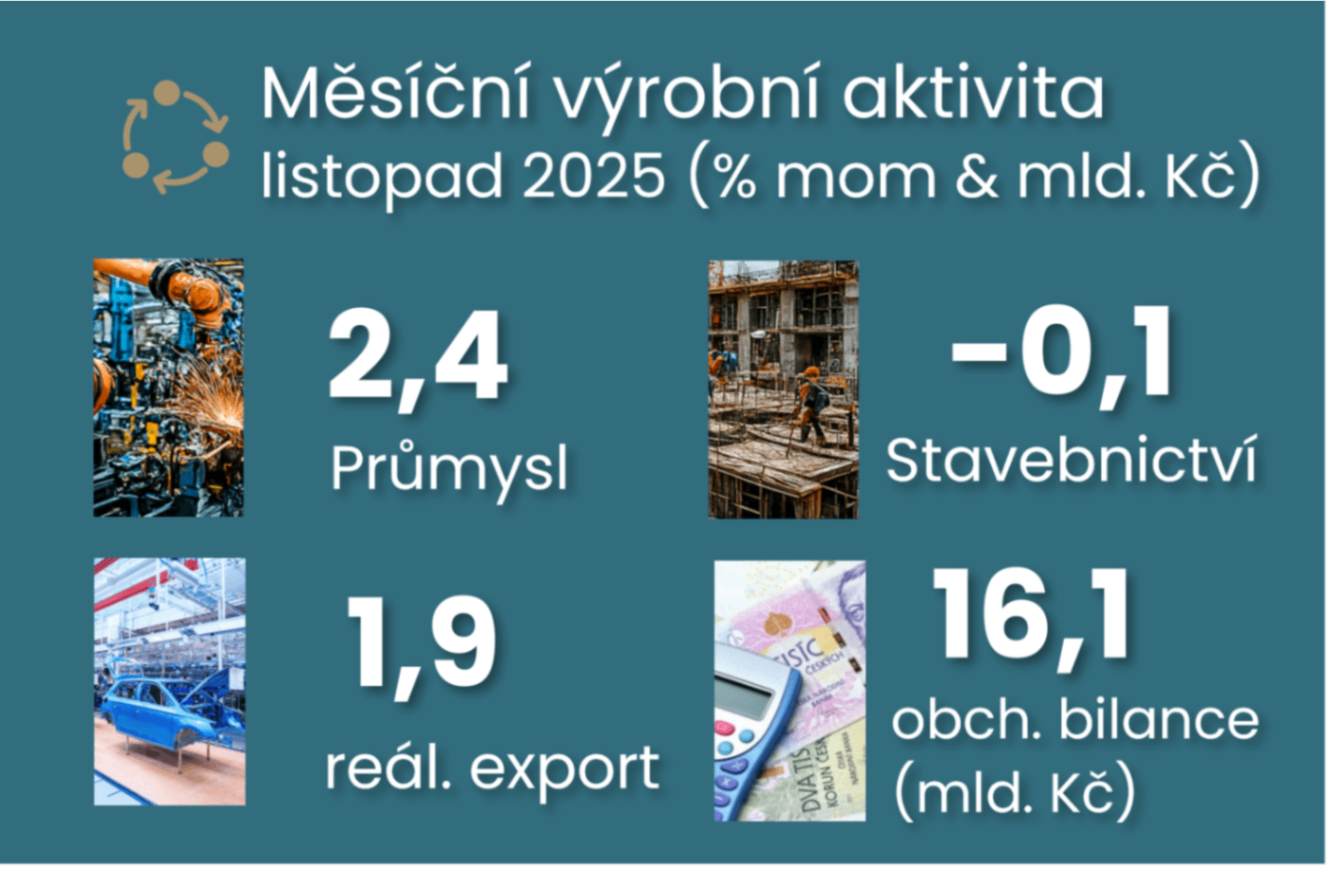
Industrial production accelerated significantly in November, rising by 5.7% year-on-year, the highest rate since the beginning of the year. The automotive industry played a key role, with output rising by 8.9% yoy, while manufacturing as a whole strengthened by 6.4%. Another positive sign is the improvement in energy-intensive industries, where growth increased to 4.2% yoy, indicating the fading of cost shocks from previous years.
On a month-on-month basis, the industry grew by 2.4%, again representing a noticeable recovery after weaker growth in previous months, with the automotive segment adding a significant 6.4% mom. This is matched by the annualized growth rate (3mma SAAR), which reached 15.9% for industry and even 19.7% for manufacturing. This strong short-term dynamics is already well above the annual rate and confirms the accelerating growth trend into the end of the year. Quarter-on-quarter, so based on data for October and November, the industry grew by 1.7% qoq in 4Q, marking the fastest quarterly growth since 2023.
Foreign trade posted a solid improvement in November. Real exports rose by 1.9% m/m, imports by 5.2%, thus narrowing the foreign trade surplus to 16.1bn qoq. On a quarter-on-quarter basis, the trade balance remains in surplus (CZK 9.4bn), but significantly lower than in Q3, and is likely to be less supportive of GDP growth. In this, a turbulent year for foreign trade due to the tariff wars, the trade surplus is likely to reach a smaller surplus of around 2.5% of GDP in 2025 after 2.8% in 2024.
The construction sector , on the other hand, remains the weaker link in terms of recent dynamics in the Czech economy. Output fell slightly by 0.1% month-on-month in November, after a nearly 2.5% decline in the previous two months, reflecting mainly weakness in the infrastructure segment over the past three months, but also a pause in construction over the past six months, but also already Annualized momentum has thus fallen to -9.4% in the last three months, signaling that the 7% year-over-year growth in construction is an old song and thus construction activity is now more likely to be dictated by the reality of weak building permits. This is then reflected in the quarter-on-quarter decline in output of 1.5% qoq pointing to continued structural weakness, consistent with low confidence in the construction sector.
Economic growth will probably rely on industry in Q4, but not on construction, and the positive contribution from exports will probably be overcome by stronger imports


A stronger industry is not just about cars
Construction output has been rather stagnant in recent months
The rebound in foreign trade activity reflects not only exports but also stronger imports, and its smaller surplus than in the third quarter is thus more likely to take a bite out of GDP growth at the end of the year
The negative impact of the "frontloading effect" due to tariff wars does not add to exports
Selective unemployment rate at 3.3% follows higher registered unemployment
However, industrial wage data continues to weaken and is holding around a solid 6%
While the statistics for completed and started dwellings are relatively solid, building permits will be a greater burden in the future